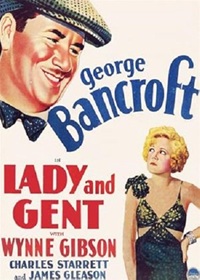
When veteran prize fighter Stag Bailey (George Bancroft) gets cocky and doesn’t bother to properly train for the big fight, he is knocked out by a young up-and-comer named Buzz Kinney (John Wayne). Stag’s manager, Pin (James Gleason), had all of his money riding on Stag winning. Now broke and with the mob after him, Pin tries to steal the cash from the boxing arena and ends up getting shot by a security guard. Stag and his girlfriend, Puff (Wynne Gibson), take in Pin’s young son, Ted, and they devote themselves to raising him. Years later, Ted (Charles Starrett) wants to become a prizefighter but Stag and Puff, who know what years of getting punched in the head can do to someone, try to convince him to go to college instead.
This boxing film is of interest to western fans because of some of the faces in the cast. This was an early John Wayne role and he’s only seen in the ring and then in one brief scene where he confronts Stag and Puff in a bar. Wayne still plays an important role, though, because Buzz’s transformation from being a fresh-faced boxer to being a bitter, punch-drunk bully serves as a warning for what waits for Ted if his adoptive parents can’t keep him out of the fight game. Charles Starrett, of course, would go on to find greater fame as the Durango Kid.
Otherwise, Lady and Gent is a standard pre-code melodrama. It’s a little more realistic than some of the other boxing films that came out in the 30s. Boxing is portrayed as a dirty business that leaves its participants with struggles that all of the prize money in the world can’t make up for. Puff sacrifices her carefree life to raise Ted but it’s worth it in the end. You can tell this was a pre-code film because Stag and Puff are a couple but they only decide to get married so they can adopt Ted.
George Bancroft was a star in the late 20s and early 30s but eventually, he transitioned to character parts. He retired from acting 1942 and became a full-time rancher. One of his final films was 1939’s Stagecoach, starring his Lady and Gent co-star, John Wayne.
Did H.P. Lovecraft enjoy movies? I’d love to think that he did but in all probability, he didn’t. After all, Lovecraft frequently wrote, in both his fiction and his personal correspondence, that he found the modern world to be “decadent.” He was not a fan of technological development, viewing it as being the source of civilization’s decline.
In all probability, Lovecraft did not enjoy the movies. When The Mummy was first released in 1932, it’s probable that Lovecraft did not rush out to a local Providence movie theater and buy a ticket.
And, really, that’s a shame. Of the many horror films released by Universal Pictures in the 1930s, The Mummy was perhaps the most Lovecraftian. The bare bones of the film’s plot could have easily been lifted from one of Lovecraft’s stories: a group of rational and educated men are confronted with an ancient evil that defies all reason. When the title character is brought back to life by a man foolishly reading from the fictional Scroll of Thoth, one is reminded of not only the Necronomicon but also of the dozens of other fictional-but-plausible texts that have appeared in the works of both Lovecraft and his successors. Just the sight of the Mummy coming back to life causes one man to have an immediate nervous breakdown, a fate shared by almost every Lovecraft protagonist who was unfortunate enough to learn about Cthulhu, Azathoth, and the truth concerning man’s insignificant place in the universe.
The story of The Mummy goes something like this: In ancient Egypt, a priest is caught trying to bring his dead lover back to life and, as punishment, he is mummified alive and locked away in a tomb. Centuries later, a group of explorers discover the tomb. The mummy comes back to life and, ten years later, he abducts the woman (played by the very beautiful Zita Johann) whom he believes to be the reincarnation of his former love.
I’ve watched The Mummy a few times and one thing that always surprises me is how little we actually see of the Mummy as a mummy. After he’s accidentally resurrected by Ralph Norton (Bramwell Fletcher), the Mummy steps out of his sarcophagus and stumbles out into the streets of Cairo, leaving a now insane Norton to giggle incoherently about how the mummy just stepped outside for a walk. That is pretty much the last time that we ever see the Mummy wrapped up in bandages. When we next see the Mummy, he’s going by the name Ardath Bey and he bears a distinct resemblance to Boris Karloff.
Karloff gives one of his best performance as the sinister and calculating Bey. Of all the horror films that were released by Universal in the 1930s, The Mummy is perhaps the only one that can still be considered to be, at the very least, disturbing. That’s largely due to the fact that, as played by Karloff, Bey is the epitome of pitiless and relentless evil. I’m always especially shaken by the scene in which Bey uses his magical powers to make a man miles away die of a heart attack. It’s not just the fact that Bey has the power to do something like this. It’s that Bey seems to get so much enjoyment out of it. There’s a sadistic gleam in Karloff’s eyes during these scenes and his expression of grim satisfaction is pure nightmare fuel.
Just compare Bey to the other Universal monsters: The Invisible Man was driven insane by an unforeseen side effect of his formula. Frankenstein’s Monster was destructive because he didn’t know any better. The Wolf Man spent five movies begging people to kill him and put him out of his misery. And while Dracula was certainly evil, he had as many limitations as he had power. He couldn’t go out in daylight. He was easily repelled by both crosses and garlic. He often didn’t do a very good job of hiding his coffin. Ardath Bey, on the other hand, was not only evil but apparently unstoppable as well.
The rest of the cast is pretty much overshadowed by Karloff but fans of the old Universal horror movies will enjoy picking out familiar faces. They’ll recognize David Manners from Dracula. Edward Van Sloan also shows up here, fresh from playing Van Helsing in Dracula and Dr. Waldman in Frankenstein. But ultimately, it is Karloff who dominates the film and that’s the way it should be. There’s a reason why Boris Karloff could get away with only his last name appearing in the credits. He was an icon of both cinema and horror and The Mummy reminds us why.
For a film that was first released 84 years ago, The Mummy holds up surprisingly well. There have been countless movies about homicidal mummies over the years but none have yet to match the original.
 When veteran prize fighter Stag Bailey (George Bancroft) gets cocky and doesn’t bother to properly train for the big fight, he is knocked out by a young up-and-comer named Buzz Kinney (John Wayne). Stag’s manager, Pin (James Gleason), had all of his money riding on Stag winning. Now broke and with the mob after him, Pin tries to steal the cash from the boxing arena and ends up getting shot by a security guard. Stag and his girlfriend, Puff (Wynne Gibson), take in Pin’s young son, Ted, and they devote themselves to raising him. Years later, Ted (Charles Starrett) wants to become a prizefighter but Stag and Puff, who know what years of getting punched in the head can do to someone, try to convince him to go to college instead.
 Through the Shattered Lens