Playing Catch-Up: The End of the Tour (dir by James Ponsoldt) and Love & Mercy (dir by Bill Pohland)


Two of the best films released last year dealt with troubled artists.
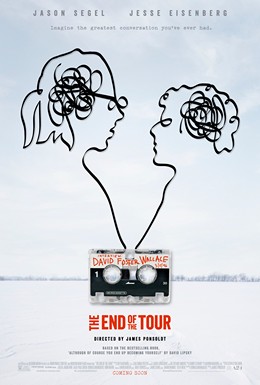
The_End_of_the_Tour

The End of the Tour opens in 2008, with a writer David Lipsky (Jesse Eisenberg) getting a call that the famous and acclaimed author, David Foster Wallace (Jason Segel), has committed suicide.  After learning of the tragedy, Lipsky remembers a few days that he spent interviewing Wallace 12 years earlier.  Wallace had just published his best known work, Infinite Jest.  At the time, Lipsky himself was a struggling writer and he approached Wallace with a combination of admiration and professional envy.  Lipsky hoped that, by interviewing Wallace, he could somehow discover the intangible quality that separates a great writer from a merely good one.

Almost the entire film is made up of Lipsky’s conversations with Wallace.  We watch as both the somewhat reclusive Wallace (who seems both bemused and, at times, annoyed with his sudden fame) warms up to Lipsky and as Lipsky forces himself to admit that Wallace might actually be a genius.  There are a few conflicts, mostly coming from the contrast between the withdrawn Wallace and the much more verbose Lipsky.  Lipsky’s editor (Ron Livingston) continually pressures him to ask Wallace about rumors that Wallace was once a drug addict.  But, for the most part, it’s a rather low-key film, one that’s more interested in exploring ideas than melodrama.  It’s also a perfect example of what can be accomplished by a great director and two actors who are totally committed to their roles.  Jason Segel, especially, gives the performance of his career so far.

The shadow of Wallace’s suicide hangs over the entire film.  Throughout their conversation, Wallace drops hints about his own history with depression.  Much as Lipsky must have done after Wallace’s suicide, we find ourselves looking for clues to explain his death.  But ultimately, Wallace remains a fascinating enigma in both life and death.
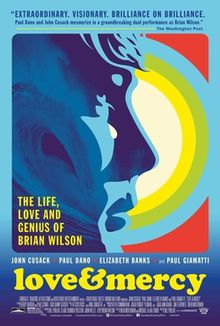
Love_&_Mercy_(poster)

Love & Mercy (dir by Bill Pohland)

Love & Mercy opens with Cadillac saleswoman Melinda Ledbetter (Elizabeth Banks) selling a car to a polite but nervous man (John Cusack).  The man sits in the car with her and rambles for a bit, mentioning that his brother has recently died.  Soon, the man’s doctor, Eugene Landy (Paul Giamatti), shows up and Melinda learns that the man is Brian Wilson, a musician and songwriter who is famous for co-founding The Beach Boys.  After having a nervous breakdown decades before, Brian is now a recluse.  He and Melinda start a tentative relationship and Melinda quickly discovers that Brian is literally being held prisoner by the manipulative Dr. Landy.

Throughout the film, we are presented with flashbacks to the 1960s and we watch as a young Brian (Paul Dano) deals with both the pressures of fame and his own relationship with his tyrannical father (who, in an interesting parallel to Brian’s later relationship with Landy, is also Brian’s manager).  As Brian struggles to maintain his grip on reality, he obsesses on creating “the greatest album ever.”

Love & Mercy is an enormously affecting story about both the isolation of genius and the redeeming power of love.  Whether he’s played by Cusack or Dano, Brian Wilson remains a fascinating and tragic figure.  It’s hard to say whether Cusack or Dano gives the better performance.  Indeed, they both seem to be so perfectly in sync with each other that you never doubt that the character played by Paul Dano will eventually grow up to become the character played by John Cusack.  Both of them do some of the best work of their careers in Love & Mercy.
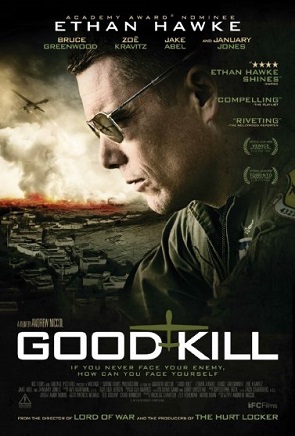
Film Review: Good Kill (dir by Andrew Niccol)


Good_Kill_poster

Good Kill is an angry film that is somewhat grounded by a strong lead performance from Ethan Hawke.  Hawke was nominated for Best Supporting Actor for his performance in Boyhood and … well, he probably won’t be nominated for anything for Good Kill.  The film’s coming out too early in the year and it’s not really a crowd-pleasing Oscar movie.  It’s too angry and polemical but still, Ethan Hawke gives an excellent performance.

Hawke plays Thomas Egan, an air force pilot who, after serving 6 tours in Afghanistan, is reassigned to pilot drones from a base in Las Vegas.  For 12 hours a day, Egan sits in a cramped room where he and three other pilots spend their time staring at video monitors and observing people going about their lives on the other side of the world.  Occasionally, a phone rings and they are given orders by a never seen CIA supervisor.  All Egan has to do is push a button and, in just ten seconds, he can blow up a stranger 7,000 miles away.

Of course, it’s not just the targets who get blown up.  Anyone unlucky enough to be standing nearby ends up getting blown up as well, which is something that Egan’s commanding officer (Bruce Greenwood) insists is a regretful but acceptable consequence of fighting the War of Terror.  Except, of course, nobody’s quite sure that they’re actually blowing up terrorists.  Instead, often times, it’s a matter of guesswork.  People are blown up because they could be terrorists, not because they definitely are.

While most of the members of Egan’s unit are unconcerned about the ethics or the legalities of drone warfare, Vera Suarez (Zoe Kravitz) is an exception.  She worries that they’re just creating more terrorists.  (And yet, interestingly enough, she still follows orders whenever she’s told to blow someone up.)  Egan is troubled by the implications of what he’s doing but, for the most part, he keeps his feelings to himself.

From the beginning, the tightly wound Egan struggles with the pressure of being a drone pilot.  After spending half of the day killing strangers who may or may not be terrorists, Egan finds it difficult to spend the rest of the day with his wife (January Jones) and his children.  Slowly but surely, cracks start to appear on Egan’s facade.  He starts drinking.  He drives recklessly.  He yells at his family.  He grows paranoid about the neighbors.  When a cop asks him how the War on Terror is going, Egan smirks and replies that it’s going as well as the War on Drugs…

Even though I agreed, for the most part, with everything that the film had to say, I still found it to be incredibly heavy-handed.  There is something to be said for subtlety and Good Kill is definitely not a subtle movie.  Rabidly anti-military audiences will enjoy having their own prejudices confirmed but, with everyone other than Egan and Vera being portrayed as being bloodthirsty and ignorant, you can be sure that this film won’t change any minds.  Politically, this a political film that’s not going to make a bit of difference.

At the same time, there is an interesting subtext running through the film.  During the 12 hours that Egan spends in that room, he essentially ceases to be a human being and becomes an extension of that drone.  Both literally and figuratively, he becomes a part of the war machine.  Just imagine if a director like David Cronenberg had handled this material.  Director Anrew Niccol briefly touches on the Cronenbergian aspects of the story but, in the end, he gets too bogged down in all of the speeches.

The problem with political films like Good Kill is that they often feel very artificial and that’s why you’re thankful for Ethan Hawke’s performance.  Hawke gives a performance of such raw power that he cuts through all of the polemical bullshit.  The film is nearly smothered under the director’s heavy hand but Hawke breathes it back to life.  Hawke’s performance brings much needed authenticity to Good Kill and, as a result, he elevates the entire film.