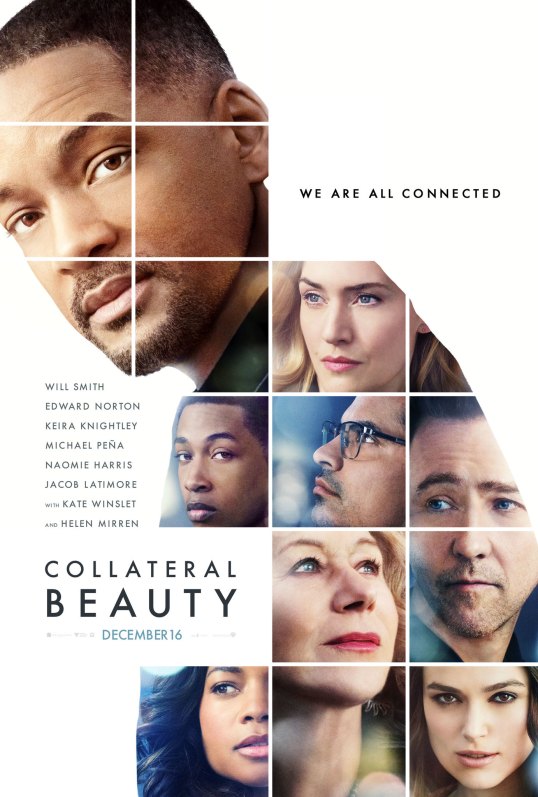
Holiday Film Review: Collateral Beauty (dir by David Frankel)


Occasionally, you see a film that is so misjudged and so poorly executed that it leaves you wondering whether or not the entire production was meant to be some sort of elaborate practical joke.  Perhaps not surprisingly, these films are usually a mix of comedy and drama and they tend to try to deal with the big issues — life, death, love, and all the rest.  These films are fueled by a mix of ambition, sincerity, and a total inability to understand how people actually think and live.  Invevitably, these films come out at Oscar time and they tend to have surprising twists that are designed to tug at the heart strings but to also make you think.  They’re usually have titles that sound good but don’t make much sense and they often feature the type of talented actors who really should know better.  Audiences should also know better but all of these films have devoted fans who insist that the rest of us are just too cynical or jaded to really appreciate a good story.

2016’s Collateral Beauty is one such film.

Set during the Christmas season, Collateral Beauty tells the story of Howard Inlet (Will Smith).  Howard was an advertising genius but then his daughter died and he sunk into a deep depression.  In this film, being clinically depressed means that you ride your bicycle a lot.  It also means that you spend a lot of time building domino chains.  Because Howard is too depressed to do anything, his advertising firm is on the verge of going bankrupt.  His partners — Whit (Edward Norton), Claire (Kate Winslet), and Simon (Michael Pena) — all want to sell the firm but they have to get Howard to sign off on it and Howard refuses to talk to anyone.

However, his three business partners come across letters that Howard wrote to the abstract concepts of Death, Time, and Love.  And, realizing that Howard had some issues with those concepts, they decided to hire three actors to pretend to be those concepts so that they can film Howard talking to them.  The plan is to film Howard talking to the actors and then use digital technology to erase the actors from the footage so that Howard will look like he’s talking to himself, which will make it easier to prove that Howard is not mentally stable enough to run the company and….

What?  Yes, that’s the plot.  Undoubtedly, it seems like there should be an easier way to prove that Howard is not mentally fit to run his company but the three business partners decided to go with the plan that makes absolutely no sense and the film applauds them for doing so.  It does seem like, if they really cared about Howard, they would have instructed the actors to provide some sort of comfort to Howard but apparently, no one in this movie has seen It’s A Wonderful Life or read A Christmas Carol.  The film assures us that making a suicidal man think that he’s gone legitimately insane is definitely the humane way to deal with this situation.

Anyway, the three actors are played by Helen Mirren, Jacob Latimore, and Keira Knightley.  And, in order to study Howard, each spends time with his business partners and we learn about everyone’s life.  For instance, Whit has a daughter that he needs to connect with.  Claire is depressed because she wants a child.  Simon is dying, which means that he spends the entire movie vomiting.  Amazingly, no one but Helen Mirren notices.  Not only does the actors help Howard but they help his partners as well.  Awwwww!

After the actors all visit him, Howard is so upset by the encounters that he goes to a support group that’s run by Madeline (Naomie Harris), who lost a daughter (just like Howard!) and who is divorced (just like Howard!) and who has a note from her ex-husband in which he says that he wishes they could act like strangers again and hey, guess who her ex-husband is!?  (Yes, it’s Howard.)  Anyway, some mysterious woman once told Madeline that, even as her daughter was dying, she should always celebrate the “collateral beauty of it all” and I have no idea what that was supposed to mean but Madeline sure does talk about it a lot.

I like to think that Collateral Beauty shares the same cinematic universe as The Book of Henry and Life Itself.  It’s a universe where simplistic thoughts are held up as being extremely profound and where no one actually does anything that makes sense.  Just as The Book of Henry asks us to be touched by an annoying little brat insisting (from beyond the grave, no less) that his mother to assassinate their neighbor, Collateral Beauty asks us to appreciate all the effort that goes into tormenting an already seriously depressed human being.  Just as Life Itself insists that life being an unreliable narrator is somehow a mind-blowing concept, Collateral Beauty insists that everything will be okay as long as we appreciate the “collateral beauty of it all.”  It may feel like a parody but Collateral Beauty not only takes itself seriously but it also seems to be convinced that you’ll take it seriously as well.  There’s something rather presumptuous about the film’s insistence that it actually has something unique or interesting to say.

Amazingly enough, a truly great cast signed up to appear in this film.  Most of them turn in performances that are either forgettable or regrettable.  Edward Norton gives a performance that is so annoyingly mannered that it’s hard not to be reminded of the rumors that he was basically playing himself in Birdman.  Considering that she’s one of the greatest actresses around, Kate Winslet is shockingly bad.  Helen Mirren appears to be having a laugh.  Will Smith actually gives a good performance but it’s a waste to cast such a great talker as someone who barely speaks.

Collateral Beauty came out in December of 2016.  Before it was released, it had Oscar buzz.  After it was released …. well, let’s just say that it didn’t.  Critics hated the film but it did well at the box office and it has its fans.  I’m not one of them but perhaps someday, I’ll appreciate the collateral beauty of it all.
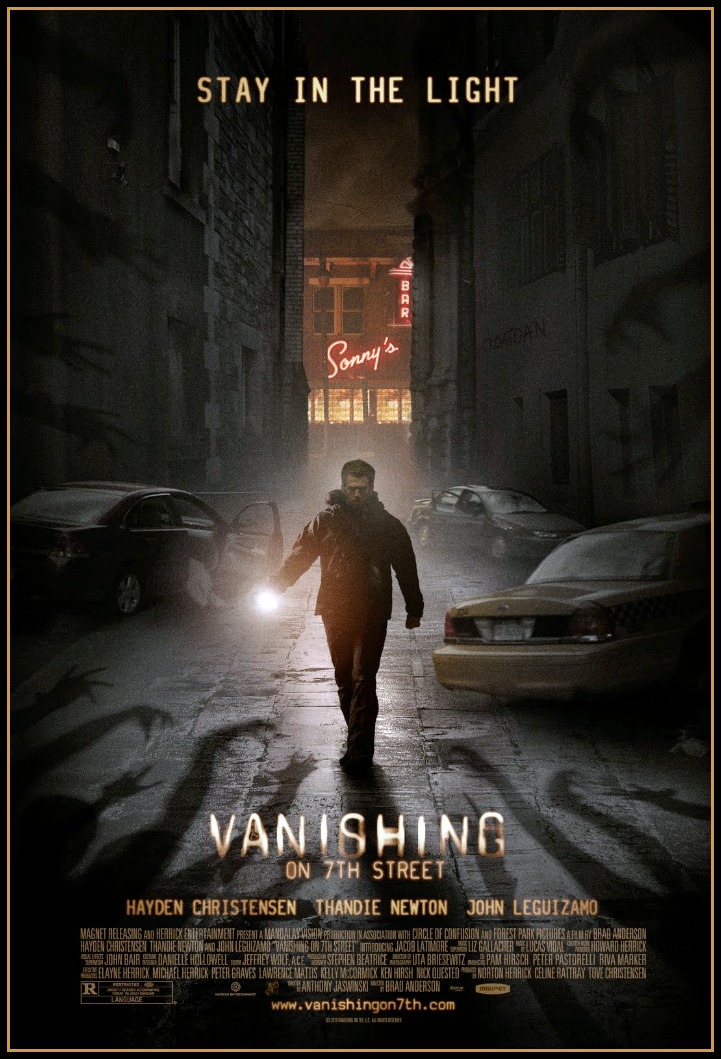
Review: Vanishing On 7th Street (dir. by Brad Anderson)


In the genre world of horror and thrillers there’s been one name who always seem to be on the verge of breaking out. He has done some exceptionally well-crafted horror and thrillers which never could get a mainstream audience to commit to but always gathering a cult-following upon their release. He has done some wonderful work as a TV director for such acclaimed shows as Fringe, Treme, Boardwalk Empire and The Wire. His best known work was a thriller collaboration with Christian Bale in The Machinist. While it’s a film more well-known for the extremes an actor was willing to go for to make their performance as authentic as possible it was also a film which showed style and talent in it’s filmmaker. The person I speak of is Canadian filmmaker Brad Anderson whose latest film was another low-budget horror-thriller which looks to be gaining a cult-following once again despite not being well-received by the mainstream critics. Vanishing On 7th Street was a film using the screenplay of Anthony Jaswinski which puts an interesting, claustrophobic and, at times, entertaining twist on the oft-used and well-ridden post-apocalyptic genre.

The film begins with film projectionist Paul in his projection booth reading up on the lost colony of Roanoke and the mysterious word left behind: CROATOAN. It’s through his point of view that we first see the beginning of what could be the end of the world as lights begin to flicker then go out throughout the theater and the mall it’s located in. Paul investigates this event only to discover sets of clothing and accessories where theater patrons and employees used to be in. With each passing moment the darkness — punctuated by just the flashlights of Paul and a lone mall security guard — becomes to take on an ominous tone before the film sudden moves ahead three days into what would become the major setting for the film: a lit bar on a deserted and darkened stretch of 7th Street in Detroit, Michigan.

We meet the rest of the main cast in this bar. There’s Luke who used to be a TV anchorman who discovers to his horror just what might have been the cause of the disappearance of most everyone in the world as he tries to find his girlfriend at the TV station they both worked at. It’s in these flashbacks to Luke’s early experience with the dark apocalypse that we see some of the most perfectly shot scenes of a major city devoid of life. An urban setting where the sudden disappearance of people during the power outage the night before has caused an eerie detritus of crashed vehicles, empty clothing and, in a sudden and violent sequence, a lone airline crashing in the background. It’s through Luke and the lone survivor in the bar, a 12-year old boy named James (Jacob Latimore), that we begin to try and piece together just what might have caused the event which continues to plague those left behind for the last three days.

The film posits the basic concept that darkness itself was the culprit for the disappearance of everyone and what continues to stalk those still left behind, alive and desperate for answers. While the film never really give definite answers as to the cause the two other characters in the back outside of Luke and James bring their own theories. There’s Rosemary (Thandie Newton), the distraught mother searching for her infant son, who thinks what’s going on around them is the the prophecized Rapture and those left behind were those who have sinned and were now being tormented for whatever sins they might have committed. On the other side is Paul from the beginning of the film who Luke rescues from an illuminated bus stop shelter who believes the very thing which caused the disappearance of the Roanoke colony during the 16th-century has now returned on a global-scale. His reasonings run the gamut of scientific causes from wormholes, black holes, gamma ray burst, nanotech gone amok and even an accident from a particle collider.

The audience are left to decide amongst themselves which explanation holds merit since neither one has enough backing to be the true answer. Vanishing On 7th Street leaves much of the questions raised by the dark apocalypse around these surviving characters to be left ambiguous and unanswered which at times becomes a detriment to the narrative as a whole. It’s a testament to Brad Anderson’s direction that the film was able to move past the apparent weaknesses in Anthony Jaswinski’s script and deliver a taut thriller (the film never truly gets to the level of horror) that just builds and builds with tension from beginning to an end that seemed almost too rushed.

With a low-budget and minimal cast the film tries to create some of the tension in the film be a construction of the differences between the four main characters. The actors were pretty game to try and make their characters more complex than what the script have provided, but in the end they still seem too basic for anyone of them to become sympathetic for the audience to truly care for their well-being. The film has to finally rely on just them as the last people on the planet as the main crux for the audience to latch onto. All the actors involved never become too cartoonish or stereotypical in their performance, but some of their decision-making in the middle and latter section of the film were too horror-typical, but they do add to the film’s many scenes of mounting terror as characters drop flashlights, lose light sources and other such problems with the living shadows in the darkness creeping up to try and take those still left. These scenes do look to be too stereotypical of other horror films but under Anderson’s direction there’s a palpable sense of claustrophobia and menace in these shadows.

What truly sells the film despite these flaws outside of Anderson’s direction would be the minimalist score by first-time film composer Lucas Vidal. His composition for the film were at once ominous and haunting. At times his score shows off hints of influences from the more doom-laden scores of Philip Glass. The other component of the film which definitely added to the atmosphere of inevitable doom to the film was Uta Briesewitz cinematography which made great use of darkness and solitary light sources to create islands of safety in a sea of encroaching terror we never truly comprehend. It’s the trifecta of Anderson’s directing, Vidal’s minimalist doom orchestration of a score and Briesewitz’s cinematography which gives Vanishing On 7th Street enough reasons to be a film which stands out as a fine piece of genre filmmaking despite weaknesses in the script.

Brad Anderson truly seem to be a filmmaker destined to remain in the fringes of mainstream cinema. His Vanishing On 7th Street continues to be another example of his great work in the horror-thriller genre. Despite same flaws which could turn off some of those who see this film it doesn’t diminish the fact that even at it’s worst this film was still an entertaining piece of post-apocalyptic work which brings some new ideas into the genre. Maybe a stronger treatment of the script would’ve made for a near-perfect thriller and one which could’ve had more horror to it, but Anderson was able to make a good enough film with an average script that I think deserves for this film to be seen by more people. For every horror remakes we get from Michael Bay’s Platinum Dunes to the latest in the Saw-like torture porn horror it’s good to see that such films as Vanishing On 7th Street exist to be the solitary beacon of light in a sea of cookie-cutter, by-the-numbers horror films that seem to dominate each film year after the other.