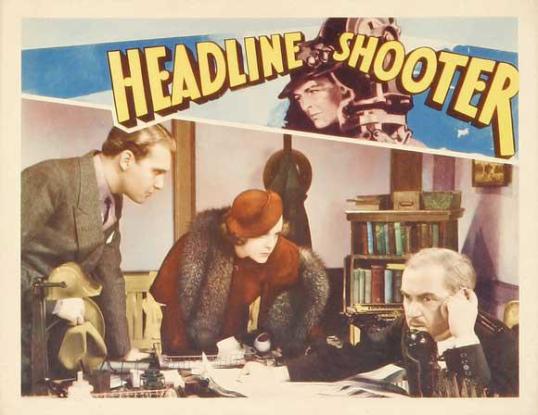
Bill Allen (William Gargan) is cynical newsreel cameraman. Everywhere he goes, he’s got a tripod and a camera ready to go. He films the disasters that other people are too scared to go near. When there’s an earthquake, he runs outside to film it. When a building catches on fire, he risks life and limb to record the event. When a dam breaks, Bill is there to not only record the devastation but also help expose the man responsible for the poorly constructed dam. When the man later commits suicide, Bill shrugs it off. The public, he says, had a right to know.
Jane Mallory (Frances Dee) is a reporter. She tough and she can just as sarcastic as Bill. When she’s held hostage by bunch of gangster, she proceeds to not only challenge them to a game of gin rummy but she beats them too! Jane loves pursuing a good story but she worries that she might end up as cynical and callous as some of her colleagues. As much as Jane loves it, a part of her is desperate to get out of the news business and, instead, marry the decent but boring Hal Caldwell (Ralph Bellamy, of course).
Together, Bill and Jane …. SOLVE CRIMES!
Actually, they do. Of course, that doesn’t happen until towards the end of this zippy 61 minute film from 1933. Before they solve a crime and run afoul some gangsters, Bill and Jane fall in love. Of course, it’s a cynical journalist type of love, where quips and snarky put-downs replace the traditional endearments. But it’s love just the same. Bill and Jane share an understanding of what it feels like to pursue a big story. It’s something that Hal, as decent a person as Ralph Bellamy ever played in a 1930s movie, just cannot understand.
This is a pre-code film, which means that the characters are allowed to smoke and drink and the dialogue is full of double entendres. When Bill mentions that a woman he knows has a cold, Jane replies, “Let me guess. It kept you up all night.” That’s the type of dialogue that, in just a few short years after the release of Headline Shooter, studio productions would no longer be allowed to get away with.
Headline Shooter is a fast-paced film, one where everyone speaks almost exclusively in the fast rat-a-tat style of 1930s New York. Considering that it’s only an hour long, it still manages to fit in a lot of plot. There’s also a lot of real footage of actual disasters, the majority of which is passed off as being footage that was shot by either Bill or his colleagues. Watching the film today, it’s interesting to consider that the newsreel cameraman were essentially early versions of the paparazzi, searching the city for anything worth shooting and, for the most part, not concerning themselves with the ethical concerns of exploiting disaster. Many of the issues raised by Headline Shooter are still pertinent today. One could almost argue that a film like Nightcrawler is a direct descendant of Headline Shooter.
Of course, Headline Shooter in never as dark as something like Nightcrawler. Instead, all things considered, it’s a rather cheerful melodrama. Gargan and Dee are wonderful in the lead roles and the cast is full of wonderful 1930s character actors. This film shows up occasionally on TCM so keep an eye out for it!

 Through the Shattered Lens