Embracing the Melodrama Part II #9: A Star is Born (dir by William Wellman)


A_Star_Is_Born_1937_poster

“Hello everybody.  This is Mrs. Norman Maine.”

— Mrs. Norman Maine (Janet Gaynor) in A Star Is Born (1937)

When I first saw the red neon of the opening credits of the 1937 best picture nominee, A Star Is Born, I thought to myself, “This is a real movie movie.”  And I was so impressed by that thought that I even jotted it down in my review notes and now, looking down at my notes, I’m struggling to figure out how to explain just what exactly it was that I meant.

I think that what I was trying to say, in my own way, was that, when we think of a typical big budget Hollywood romance, A Star Is Born is the type of film of which we tend to think.  It’s a big, glossy film that is shot in vibrant technicolor and which features a self-sacrificing woman (Esther Blodgett, played by Janet Gaynor) falling in love with a self-destructive but ultimately noble man (Norman Maine, played by Fredric March).  It’s a film that has romance, humor, and tragedy.  It’s a film that’s designed to make you laugh, cry, and ultimately fall in love.  It’s pure melodrama, the type of film that would probably be made for Lifetime today.  (And, in fact, it has been remade for Lifetime a number of times, just never under the title A Star Is Born.)

It’s a familiar story that, if I may indulge in a cliché, as old as the movies.  Esther is a girl who lives on a farm in North Dakota and she wants to be a star, despite being told by her aunt that she need to start concentrating on finding a man and having children.  Esther’s grandmother (Fay Robson) tells Eleanor to pursue her dreams and loans her some money to take with her to Hollywood.

With stars in her eyes, Esther goes out to California and deals with rejection after rejection.  (She does, however, manage to rent out an apartment.  The weekly rent is $6.00.)  Esther does befriend an assistant director (Andy Devine) who gets Esther a job as a waitress at a party.  As Esther serves the food, she imitates everyone from Katharine Hepburn to Mae West, all in an attempt to get noticed.

And, amazingly enough, it works!  She meets film star, Norman Maine.  With Norman’s help, she gets her first screen test and, after her name is changed to Vicki Lester, Esther is put under contract to a studio.  She and Norman also fall in love and soon end up married.  However, while Vicki Lester is rising to stardom, Norman is descending into irrelevance.  He’s an alcoholic who has managed to alienate almost everyone in Hollywood.  When Vicki wins her first award, Norman shows up at the ceremony drunk and destroys what little is left of his career.

Will Vicki be able to save Norman from his demons?  And will she be able to do so without destroying her own career?

Well, you probably already know the answer.  A Star Is Born is one of those stories that everyone seems to know, regardless of whether they’ve actually seen the film or not.  (And even if they haven’t seen the 1937 version, chances are that they’ve seen one of the many remakes or ripoffs.)  The original Star Is Born is an undeniably familiar and old-fashioned movie but it holds up as a celebration of both old Hollywood glamour and a heartfelt romance.

And it’s in the public domain!

Watch the original A Star is Born below!
http://www.youtube.com/watch?v=d1tnE0dqln8


Embracing the Melodrama Part II #3: The Big House (dir by George Hill)


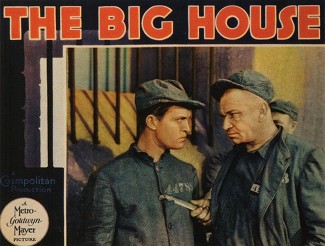
The_Big_House_film_poster

The 1930 Best Picture nominee The Big House opens with a black Model T car slowly pulling up to the front of a large and imposing prison.  Handcuffed in the back seat of the car is a handsome, nervous-looking young man named Kent (Robert Montgomery).  Kent is led into the prison where he is forced to hand over all of his possessions to a grim-looking guard.  We find out that Kent has been convicted of manslaughter, the result of hitting someone while driving drunk.  For the next ten years, this prison (which, we’re told, was designed to house 1,800 but actually holds 3,000) will be Kent’s home.

Kent finds himself sharing a cell with two lifers.  Butch (Wallace Beery) is a coolly manipulative sociopath who alternatively counsels and abuses Kent.  Meanwhile, Morgan (Chester Morris) tries to protect Kent and even helps him get his cigarettes back from Butch.  These three prisoners represent the three faces of prison: Butch is the unrepentant criminal who is actually more at home in prison than in the “real” world.  Morgan is the former criminal who has changed his ways but who is apparently destined to spend the rest of his life paying for his poor decisions.  And Kent is the young man who has to decide if he’s going to be like Butch or if he’s going to be like Morgan.  The Big House makes the still-relevant argument that the American prison system is more likely to turn Kents into Butches than into Morgans.

When the film began, I assumed that Kent would be the main character but actually, he’s secondary to most of the action.  From the moment he first shows up, Kent is not particularly sympathetic and he becomes steadily less likable as the film progresses.  Instead, the film is more focused on the always-scheming Butch and the regretful Morgan.  While Morgan makes plans to escape from captivity and ends up falling in love with Kent’s sister (Leila Hyams), Butch spends his time plotting ways to take over the prison.  For his performance as Butch, Wallace Beery won an Oscar but, seen today, it’s obvious that the film’s heart and soul belongs to Chester Morris’s Morgan.

Like a lot of films from the period, The Big House feels undeniably creaky when viewed through modern eyes.  The Big House was made at a time when Hollywood was still trying to make the transition from silent to sound films.  As such, the film’s pacing is slower than what contemporary audiences are used to and a few of the performances are undeniably theatrical.  I can honestly say that I’m never been more aware of how much I take for granted nonstop background music than when I watch a movie from the early 30s.

That said, once you’ve adapted to the different aesthetic, The Big House holds up fairly well.  Director George Hill films the prison like a town in a German expressionist horror film and Chester Morris’s performance remains sympathetic and compelling.  If the plot seems familiar, it’s important to remember that The Big House is the film first introduced a lot of the clichés that we now take for granted.

The film’s best moments are the ones that deal not with Kent, Butch, and Morgan but instead just the ones that show hordes of prisoners — all anonymous and forgotten men — going about their daily life.  It’s during those scenes that you realize just how many people have been crammed into one tiny space and why that makes it impossible for prison to reform the Kents of the world.

Gandhi once said that the true value of any society can be determined by how that society treats its prisoners and The Big House certainly makes that case.