Forgotten Horror: THIRTEEN WOMEN (RKO 1932)


gary loggins's avatarcracked rear viewer

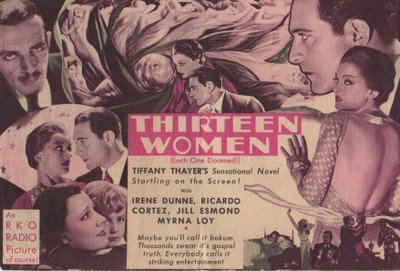
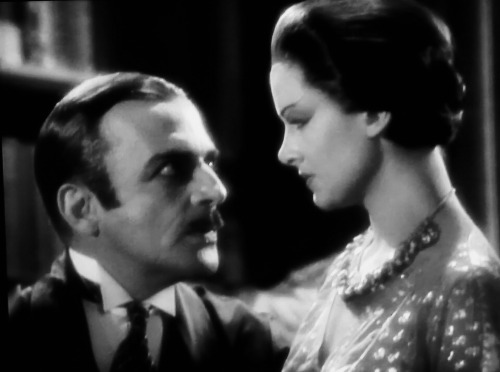
I pride myself on having seem almost every horror film made during the 1930’s, though once in a while an obscure title comes along whose attention has escaped me. But how on Earth did I miss THIRTEEN WOMEN, especially with a cast headlined by Irene Dunne (of all people!) and Myrna Loy ? This fast-paced thriller involving hypnosis, astrology, and serial murder is downright nasty, and has been cited as a precursor to the “slasher” genre… not to mention a whole lot of fun!

We begin with circus performer June Raskob receiving a letter from the mysterious Swami Yogadashi with her horoscope attached, predicting impending doom in the stars for her. But it’s her sister who dies, plunging to her death during their trapeze act (shown in gruesome detail), and poor June goes hopelessly insane. The scene shifts to exotic half-caste Ursula Georgi, who has the Swami under her hypnotic…

View original post 487 more words

Lisa Reviews An Oscar Winner: Cimarron (dir by Wesley Ruggles)


(With the Oscars scheduled to be awarded on March 4th, I have decided to review at least one Oscar-nominated film a day.  These films could be nominees or they could be winners.  They could be from this year’s Oscars or they could be a previous year’s nominee!  We’ll see how things play out.  Today, I take a look at the 1931 best picture winner, Cimarron!)

“Be careful, Hank!  Alabaster may be a little dude but he’ll mess you up.”

“No offense … but he’s from Oklahoma.”

— King of the Hill Episode 5.13 “Ho Yeah”

Some best picture winners are better remembered than others.  Some, like The Godfather, are films that will be watched and rewatched until the end of time.  Others, like Crash, seems to be destined to be continually cited as proof that the Academy often picks the wrong movie.  And then you have other films that were apparently a big deal when they were first released but which, in the decades to follow, have fallen into obscurity.

1931’s Cimarron would appear to be a perfect example of the third type of best picture winner.

Based on a novel by Edna Ferber (who would later write another book, Giant, that would be adapted into an Oscar-nominated film), Cimarron is an epic about Oklahoma.  The film opens in 1889 with the Oklahoma land rush.  Settlers from all across America rush into Oklahoma, searching for a new beginning.  Among them is Yancey Cravat (Richard Dix) and his wife, Sabra (Irene Dunne).  Yancey is hoping to become a rancher but, upon arriving at the settlement of Osage, he discovers that the land he wanted has already been claimed by Dixie Lee (Estelle Taylor).

So, Yancey gives up on becoming a rancher.  Instead, he becomes a newspaper publisher and an occasional outlaw killer.  Soon, Yancey and Sabra are two of the most prominent citizens in Osage.  Under the guidance of Yancey, Osage goes from being a wild outpost to being a respectable community.  It’s not always easy, of course.  Criminals like The Kid (William Collier, Jr.) still prey on the weak.  As the town grows more respectable, some citizens try to force out people like Dixie Lee.  Struck by a combination of personal tragedy and wanderlust, Yancey occasionally leaves Osage but he always seems to return in time to make sure that people do the right thing.  When even his wife reveals that she’s prejudiced against Native Americans, Yancey writes a vehement editorial demanding that they be granted full American citizenship.

The film follows Sabra and Yancey all the way to the late 1920s.  Oklahoma becomes a state.  Sabra becomes a congresswoman.  Oil is discovered.  Throughout it all, Yancey remains a firm voice in support of always doing the right thing.  In fact, he’s such a firm voice that you actually start to get tired of listening to him.  Yancey may be a great man but he’s not a particularly interesting one.

By today’s standards, Cimarron is a painfully slow movie.  The opening land rush is handled well but once Yancey and Sabra settle down in Osage, the film becomes a bit of a chore to sit through.  Richard Dix is a dull lead and the old age makeup that’s put on Dix and Dunne towards the end of the movie is notably unconvincing.  Considering some of the other films that were eligible for Best Picture that year — The Front Page, The Public Enemy, Little Caesar, Frankenstein — Cimarron seems even more out-of-place as an Oscar winner.

And yet, back in 1931, it would appear the Cimarron was a really big deal.  Consider this:

Cimarron was not only well-reviewed but also a considerable box office success.

Cimarron was the first film to ever receive more than 6 Academy Award nominations.  (It received seven and won 3 — Picture, Screenplay, and Art Direction.)

Cimarron was the first film to be nominated in all of the Big Five categories (Picture, Actor, Actress, Director, and Screenplay).

Cimarron was the first film to be nominated in every category for which it was eligible.

Cimarron was the first RKO film to win Best Picture. The second and last RKO film to win would be The Best Years of Our Lives, a film that has held up considerably better than Cimarron.

Cimarron was the first Western to win Best Picture.  In fact, it would be 59 years before another western took the top award.

Though Cimarron may now be best known to those of us who watch TCM, it’s apparent that it was a pretty big deal when it was first released.  Though it seems pretty creaky by today’s standards, they loved it in 1931.

The Fabulous Forties #37: Penny Serenade (dir by George Stevens)


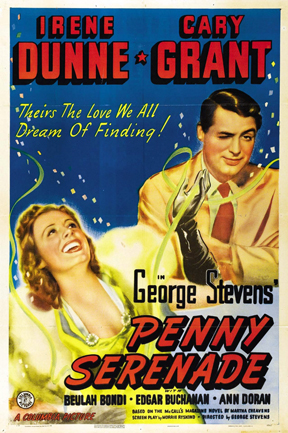
Penny_Serenade_1941_Poster

How many tears can be jerked by one tear jerker?

How melodramatic can one melodrama get?

These are the type of questions that I found myself considering as I watched the 36th film in Mill Creek’s Fabulous Forties box set, 1941’s Penny Serenade.

Penny Serenade opens with Julie (Irene Dunne) announcing that she’s planning on leaving her husband, Roger (Cary Grant).  Fortunately, before Julie goes through with her plan, she listens to a song called You Were Meant For Me.  Perhaps not coincidentally, the song is included on an album called The Story Of A Happy Marriage.  As she stares at the spinning vinyl, Julie starts to have flashbacks!

No, not flashbacks of the LSD kind.  (Though, interestingly enough, Cary Grant was reportedly a big fan of LSD…)  Instead, she has flashbacks of her marriage to Roger.  We see how she first met Roger while she was working in a music store.  Roger stopped by the store to tell her that a record was skipping and it was love at first sight.  However, Roger had no interest in getting married.  Or, at the least, he didn’t until Julie opened up a fortune cookie and read the fortune: “You get your wish — a baby!”

Julie continues to stare at the spinning record and we discover that eventually, she and Roger did get married.  Julie did get pregnant but, as the result of an earthquake, she lost the baby.  (Curse you, fortune cookie!  CURSE YOU!)  Meanwhile, Roger took over a small town newspaper and revealed himself to have absolutely no idea how to handle money.

Because of the earthquake, Julie will never be able to have a child.  (DAMN YOU, FORTUNE COOKIE!  DAMN YOU FOR YOUR LIES!)  However, they can still adopt!  She writes to Miss Oliver (Beulah Bondi), the head of the local orphanage.  Julie demands to be given a baby with “blue eyes and curly hair.”  Fortunately, Miss Oliver apparently has a surplus of curly-haired, blue-eyed babies but she’s still reluctant to approve the adoption.  After all, Julie is such a terrible housekeeper!  However, she is impressed by how much both Julie and Roger want a baby so Miss Oliver puts aside her concerns and allows them to have a baby for two years.

At the end of the two years, Roger and Julie have to go to an adoption hearing.  Unfortunately, the paper has gone out of business, the family has absolutely no money, and the fortune cookie has stopped giving advice.  Fortunately, Roger is Cary Grant and who can say no to Cary Grant?  Roger promises the judge that he’ll always love and take care of the baby…

But that’s not all!  The movie is not over yet.  And even as Roger makes his plea, we can’t help but think about the fact that this movie is being told in flashback and that present day Julie is still planning on leaving Roger.  Now, I’m not going to spoil the movie by going into why or revealing what happens in the end.  I’ll just say that it involves more tragedy and more melodrama.  In fact, it includes so much tragedy and so much melodrama, that it starts to get a little exhausting.  How much bad stuff can happen to Cary Grant!?

And the record just keeps spinning…because what goes up must come down, spinning wheel got to go round…

Over the course of his long career, Cary Grant only received two Oscar nominations.  Penny Serenade was his first nomination and, as a fan of Cary Grant’s comedies, it saddens me to say that Cary’s nominated performance really wasn’t that good.  Watching this film, you can tell that Cary felt that this was his chance to prove himself as a dramatic actor and, as a result, he acts the Hell out of every scene.  Of course, Cary’s undying popularity comes from the fact that he rarely seemed to be acting.  His charm was in how natural he was.  In Penny Serenade, he never seems natural.  He’s trying too hard and it’s just odd to see Cary Grant trying too hard.

If you want to see Cary Grant at his best, check out The Awful Truth.  Or maybe The Philadelphia Story.  Those are two great films that prove that Cary Grant was a great actor.  Even a rare misfire of a performance can’t change that fact.

Until next time…

Ride a painted pony, let the spinnin’ wheel spin. … Ride a painted pony, let the spinnin’ wheel turn.

Cleaning Out The DVR #19: The Awful Truth (dir by Leo McCarey)


(For those following at home, Lisa is attempting to clean out her DVR by watching and reviewing 38 films by this Friday.  Will she make it?  Keep following the site to find out!)

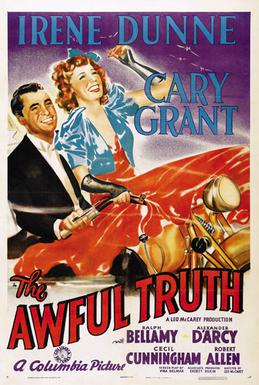
Theawfultruth1937

First released way back in 1937, The Awful Truth is one of the most delightful comedies that I’ve ever seen.  In fact, if I could recommend one movie for you to make an effort to see, it would be The Awful Truth.  This is definitely the best film to ever have the word “awful” in the title.

(Speaking of being the best, The Awful Truth is also the rare screwball comedy to receive a nomination for best picture.  However, it lost to the far more serious The Life of Emile Zola.)

Jerry (Cary Grant) and Lucy Warner (Irene Dunne) are young, married, stylish, and rich.  They seem to have it all but, as the result of Jerry’s lies and a misunderstanding concerning Lucy and her music teacher (Alexander D’Arcy), they end up getting a divorce.  Fortunately, they still share a common bond.  They both love their dog, Mr. Smith (played by Skippy, the same adorable and incredibly talented dog who played Asta in The Thin Man).  Lucy wins custody of Mr. Smith and takes him with her when she moves in with her eccentric Aunt Patsy (Cecil Cunningham).

(It’s not a screwball comedy without an eccentric aunt.)

Jerry, however, has weekly visitation rights with Mr. Smith.  It’s during once such visit that Jerry discovers that, with only two months to go before the final divorce decree, Lucy has become engaged to her next door neighbor, Dan (Ralph Bellamy).  Dan is from Oklahoma and spends most of his time wistfully talking about tumbleweed, oil, and cattle.  He also can’t wait to marry Lucy so that they can both move back to Oklahoma City.  Dan is a nice guy but he’s no Cary Grant.  (He’s also dominated by his judgmental mother.)  Realizing that he still loves Lucy, Jerry wants to reconcile with her but complications and misunderstandings ensue.

(It’s not a screwball comedy without complications and misunderstandings.)

Eventually, in order to prove that he is over Lucy, Jerry starts to date a vacuous heiress, Barbara Vance (a hilariously shallow performance from Molly Lamont).  Suddenly, Lucy finds herself in the same situation that Jerry was in with her and Dan.  Now, it’s her turn to try to break up Barbara and Jerry…

Meanwhile, the day of the final divorce decree approaches…

There’s a lot of reasons to love The Awful Truth.  There’s the snappy dialogue, the physical comedy (at one point, three different men are scurrying around Aunt Patsy’s apartment, two trying to hide from each other and one totally oblivious to everything going on around him), and Leo McCarey’s fast paced direction.  There’s Mr. Smith, a dog so talented that even a confirmed cat person like me loved watching his performance.  There’s the wonderful supporting turns of Ralph Bellamy and Molly Lamont.

But the main reason to see the film is because of the wonderful chemistry between Cary Grant and Irene Dunne.  Grant is so smooth and effortless in his charm that it’s a lot of fun to watch him having to deal with the progressively strange world that he finds himself living in.  The Awful Truth works best when Grant simply reacts to all the craziness around him.  Grant could do more with one look than most actors could do with a Shakespearean monologue.  Meanwhile, Irene Dunne … well, who wouldn’t want to get in a time machine, go back to 1937, and be Irene Dunne for a day?  She’s lively, she’s beautiful, she’s witty, she’s classy, and she’s just neurotic enough to be relatable.

The Awful Truth is pure joy.  If you haven’t seen it, you’re missing out.  If you have seen it, watch it again.

http://www.youtube.com/watch?v=B0-euBr_vRU

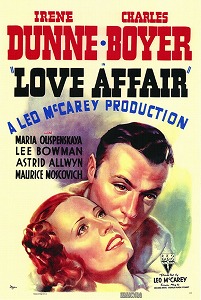
Lisa Watches An Oscar Nominee: Love Affair (dir by Leo McCarey)


Love_Affair

“If you can paint, I can walk!” — Terry McKay (Irene Dunne) in Love Affair (1939)

So, TCM’s 31 Days of Oscar has ended but I’m still on my mission to watch and review every single film that has ever been nominated for best picture.

Now, don’t get me wrong.  This isn’t going to be one of my series like Shattered Politics or Embracing the Melodrama.  I’m not going to post six best picture reviews a day for the next three weeks until I’ve reviewed every single one of them.  Instead, I’m just going to keep my eyes open.  When I see that a best picture nominee is going to be on TCM, I’ll be sure to record, watch, and review it.  On days that I have some extra time, I’ll watch and review something from my DVD and Blu-ray collection.  And, of course, I’ll keep make sure to keep up with what’s available on Netflix, Hulu, and all the other streaming services.

And, on a night like tonight when its sleeting outside and I’m aware that I probably won’t be going outside for the next two or three days, I’ll be sure to look through my DVR and see what I still need to watch.

Tonight, for example, I did just that and I ended up watching the 1939 best picture nominee, Love Affair.

Love Affair tells the story of two rich people in love.  Michel (Charles Boyer) is a painter and a notorious playboy. Terry (Irene Dunne) is an aspiring singer.  They’re both engaged to other people but, when they meet on a cruise, it’s love at first sight.  They try to avoid each other.  They try to remain faithful to their significant others.  But, when the boat docks off of the island of Madeira, Terry agrees to visit Michel’s grandmother with him.

Michel’s grandmother is played by Maria Ouspenkaya and, while Ouspenkaya does a good job playing the eccentric grandma and even received an Oscar nomination for her 10 minutes or so of screen time, it’s hard to look at her without imagining that she’s about to say something about what happens when the moon is full.  Or, at least, that’s the case if you’re a fan of the old Universal horror films and you’ve seen Ouspenkaya play the gypsy in original Wolf Man.  Instead of talking about the curse of lycanthropy, Michel’s grandma instead tells the two that they are meant to be together.

Anyway, once they return to New York, Michel and Terry agree to separate and, if after six months they still can’t stop thinking about each other, they’ll meet at the top of the Empire State Building.  Michel spends his six months becoming a more responsible human being.  Terry spends her six months singing.

Six months pass.  Michel stands at the top of the Empire State Building.  Little does he know that, on her way to meet him, Terry got struck by a car.  Michel is convinced that Terry stood him up.  Meanwhile, Terry is confined to a wheelchair.

Wow, depressing movie, huh?  Well, don’t worry.  That’s only the first half of the movie.  There’s still a lot more misunderstandings to get through before Terry can deliver her classic final line.

Occasionally, I’ve seen an old film referred to as being creaky but I don’t think I ever understood what that meant until I saw Love Affair.  Love Affair is such an old-fashioned melodrama and such a product of a bygone era that it can’t help but be a little bit fascinating.  Love Affair is definitely a film that was made at a different time and for a very different, far less cynical audiences and, watching the film today, definitely requires a bit of an attitude adjustment.  However, what Love Affair may now lack in entertainment value, it makes up for in historical value.  By today’s standards, Love Affair may seem slow and a bit too melodramatic but it remains a time capsule.  If you want to go back to 1939, you can either build a time machine or you can watch Love Affair.

(And, fortunately, Love Affair is in the public domain, which means it’ll be a lot easier to find than a working time machine.)

http://www.youtube.com/watch?v=qMIOC0st2E0