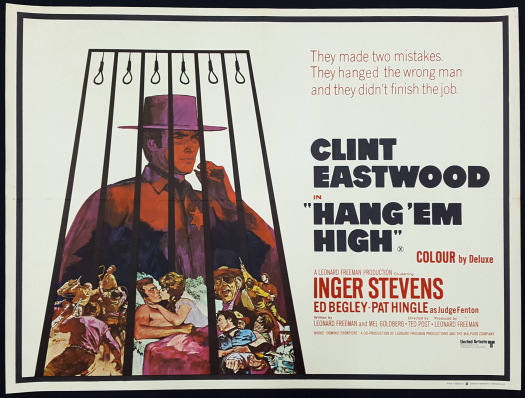
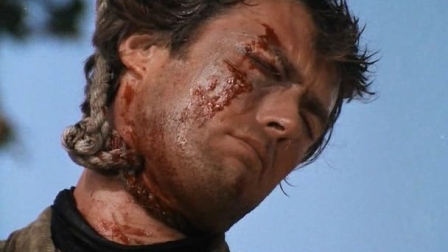
1889. The Oklahoma Territory. A former lawman-turned-cattleman named Jed Cooper (Clint Eastwood) is falsely accused of working with a cattle thief. A group of men, led by Captain Wilson (Ed Begley) lynch him and leave Cooper hanging at the end of a rope. Marshal Dave Bliss (Ben Johnson) saves Cooper, cutting him down and then taking him to the courthouse of Judge Adam Fenton (Pat Hingle). Fenton, a notorious hanging judge, is the law in the Oklahoma territory. Fenton makes Cooper a marshal, on the condition that he not seek violent revenge on those who lynched him but that he instead bring them to trial. Cooper agrees.
An American attempt to capture the style of the Italian spaghetti westerns that made Eastwood an international star, Hang ‘Em High gives Eastwood a chance to play a character who is not quite as cynical and certainly not as indestructible as The Man With No Name. Cooper starts the film nearly getting lynched and later, he’s shot and is slowly nursed back to health by a widow (Inger Stevens). Cooper is not a mythical figure like The Man With No Name. He’s an ordinary man who gets a lesson in frontier justice as he discovers that, until Oklahoma becomes a state, Judge Fenton feels that he has no choice but to hang nearly every man convicted of a crime. (Judge Fenton was based on the real-life hanging judge, Isaac Parker.) Over the course of this episodic film, Cooper becomes disgusted with frontier justice.
Hang ‘Em High is a little on the long side but it’s still a good revisionist western, featuring a fine leading performance from Clint Eastwood and an excellent supporting turn from Pat Hingle. The film’s episodic structure allows for Eastwood to interact with a motley crew of memorable character actors, including Bruce Dern, Dennis Hopper, L.Q. Jones, Alan Hale (yes, the Skipper), and Bob Steele. Hang ‘EmHigh has a rough-hewn authenticity to it, with every scene in Fenton’s courtroom featuring the sound of the gallows in the background, a reminder that justice in the west was often not tempered with mercy.
Historically, Hang ‘Em High is important as both the first film to be produced by Eastwood’s production company, Malpaso, and also the first to feature Eastwood acting opposite his soon-to-be frequent co-star, Pat Hingle. Ted Post would go on to direct MagnumForce.
The 1959 film, The World, the Flesh, and the Devil, opens with a mine cave-in in Pennsylvania. Trapped in the cave-in is a mine inspector named Ralph Burton (Harry Belafonte). Despite being trapped underground, Ralph remains in surprisingly good spirits. (In fact, as the movie progresses, Ralph’s tendency to joke when faced with bleak reality will become a recurring theme.) Ralph sings to himself. Ralph tells jokes. Ralph listens to the sound of the men who are digging a tunnel to rescue him. Except, one day, Ralph can no longer hear anyone digging. Realizing that he’s going to have to save himself, Ralph manages to dig his way out of the cave. Once again above ground, Ralph discovers that he’s alone.
The world has changed. Cars and buildings sit deserted. Everything that was made by mankind is still there but it’s all now empty. Confused but understanding that something huge has happened, Ralph makes his way from Pennsylvania to New York. During his journey, he comes across old newspapers and a recording in a radio station and he’s able to piece together what’s happened. Some country — no one was ever sure which one — released a radioactive isotope into the atmosphere. For five days, the air was poisoned. Everyone who didn’t get to shelter died. The only reason Ralph survived was because he was trapped underground.
At first, New York appears to be as deserted as Pennsylvania. (The film was shot on location in Manhattan, reportedly in the early morning hours before rush hour, when there was no one on the streets. The visuals of the empty city are often hauntingly bleak.) Struggling to maintain his own sanity, Ralph steals two mannequins and spends his days talking to them. He comes up with projects to pass the time. He’s able to get the power flowing in Times Square. And he even meets another survivor!
Sarah Crandall (Inger Stevens) was one of three friends who hid in a bunker when the world started to end. Sarah’s two friends left the bunker after two days and were killed by the radioactive cloud. Sarah waited the entire five days and survived. Though we don’t learn much about her background, it’s heavily suggested that Sarah was rich and didn’t have a care in the world before society collapsed. Now, she and Ralph are just happy to have found each other.
Sarah and Ralph quickly become friends. Sarah has obvious romantic feelings towards Ralph but, to her frustration, he keeps his distance. When Sarah asks why they don’t just live together instead of maintaining separate apartments, Ralph nervously jokes that if they got a place together, people would talk. Sarah is white and Ralph is black. When Sarah says that doesn’t matter anymore, Ralph tells her that it does matter and that she has no idea what his life was like before the world ended. When a frustrated Sarah says that she can move in with Ralph because she’s “free, white, and 21 and I can do whatever I want,” Ralph looks like she’s just slapped him. Later, Ralph tells her that, because she’s white, she will never be able to understand the pain that her words caused him. I can only imagine how audiences in 1959 reacted to this scene.
Eventually, Ralph discovers that there are scattered survivors across the world. One of them, Benson Thacker (Mel Ferrer), even comes to New York and joins Ralph and Sarah. With the arrival of the white Thacker, Ralph suddenly finds himself being treated like a servant. Thacker not only attempts to take over the group but he also tells Ralph that Sarah belongs to him. When Thacker, a self-described “former idealist,” tells Ralph, “I have nothing against Negroes,” Ralph coldly replies, “That’s mighty white of you,” and again, the modern viewer cannot help but wonder how audiences in 1959 reacted to hearing those words uttered on a movie screen.
The World, the Flesh, and the Devil is a frequently fascinating film. Belafonte brings a lot of charm and wit to the role of Ralph but he also doesn’t shy away from portraying Ralph’s anger at still being limited by the conventions of a society that, for all intents and purposes, has destroyed itself. Ralph brings New York back to life, just to watch as Thacker moves in and claims it for himself. Significantly, Thacker doesn’t view himself as being a racist. Instead, in his mind, he’s simply living the way that he’s always lived. By treating Ralph like a second class citizen, he’s keeping society alive. Sarah, meanwhile, is torn between her desire to create a new world and the temptation to return to her spoiled and privileged upbringing. While the film is dominated by Belafonte’s performance, both Inger Stevens and Mel Ferrer bring some shadings to characters that, in lesser hands, could have been extremely flat and predictable.
The film falls apart a bit during the third act. The World, the Flesh, and the Devil spends a good deal of time building up to a rather downbeat climax just to suddenly reverse itself. The film ends on a hopeful note that just doesn’t feel realistic after everything that we’ve just seen. The film’s conclusion brings a promise of renewal that feels like it was tacked on at the last moment. Still, up until that moment, it’s a compelling and intelligent film and one that’s feels ever more relevant today than it probably did in 1959.
Clint Eastwood returned to America after his amazing success in Sergio Leone’s Man With No Name Trilogy as a star to be reckoned with, forming his own production company (Malpaso) and filming HANG ‘EM HIGH, a Spaghetti-flavored Western in theme and construction. Clint was taking no chances here, surrounding himself with an all-star cast of character actors and a director he trusted, and the result was box office gold, cementing his status as a top star.
Clint plays ex-lawman Jed Cooper, who we meet driving a herd of cattle he just purchased (reminding us of his days on TV’s RAWHIDE). A posse of nine men ride up on him and accuse him of rustling and murder, appointing themselves judge, jury, and executioner, and hang him. He’s left for dead, until Marshal Dave Bliss comes along and cuts him down, taking Jed prisoner and transporting him to nearby Ft. Grant. Evidence…
Tonight’s horror on TV is an episode of The Twilight Zone that is entitled The Hitchhiker. A woman (Inger Stevens) is haunted by a mysterious hitchhiker who continually asks her if she’s “Going my way?”
It’s tempting to call this a companion piece to Carnival of Souls but actually, The Hitchhiker was first broadcast on Jan. 22, 1960, two years before the premiere of Carnival of Souls. So, it would perhaps be more appropriate to call Carnival of Souls a companion piece to the Hitchhiker.
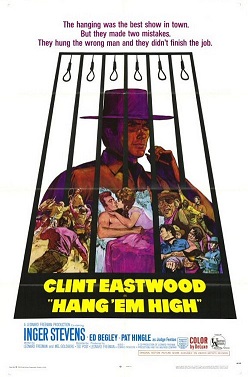 1889. The Oklahoma Territory. A former lawman-turned-cattleman named Jed Cooper (Clint Eastwood) is falsely accused of working with a cattle thief. A group of men, led by Captain Wilson (Ed Begley) lynch him and leave Cooper hanging at the end of a rope. Marshal Dave Bliss (Ben Johnson) saves Cooper, cutting him down and then taking him to the courthouse of Judge Adam Fenton (Pat Hingle). Fenton, a notorious hanging judge, is the law in the Oklahoma territory. Fenton makes Cooper a marshal, on the condition that he not seek violent revenge on those who lynched him but that he instead bring them to trial. Cooper agrees.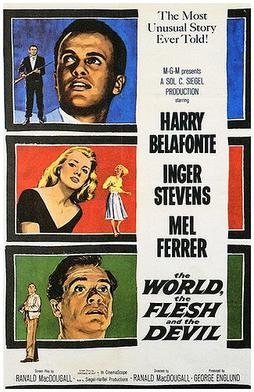


 Through the Shattered Lens