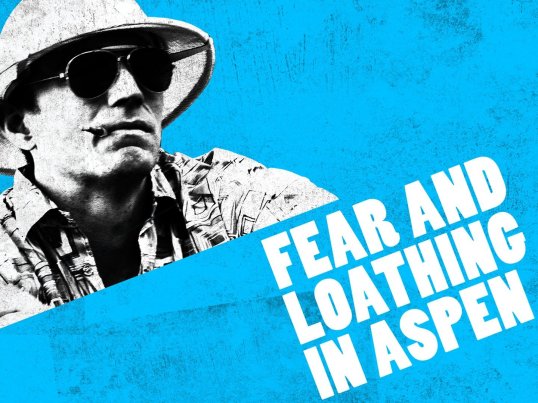
The year is 1970 and big business has all the power in Aspen, Colorado. The landscape is being bulldozed to make room for time-shares. The once pristine ground is being covered in asphalt. The rich are using Aspen as their own personal playground while the hippies, drawn to the town by the beautiful landscape, are regularly used as scapegoats for every problem that the town encounters.
A struggling journalist named Hunter S. Thompson (Jay Bulger) wants to change that. When Thompson first declares that he will be running a third party, “freak power” campaign for Sheriff of Pitkin County, his main concern is getting paid to write about it and perhaps becoming a regular contributor to Rolling Stone Magazine. But, as the campaign starts to grow and Thompson finds success in motivating the hippies to actually register to vote, he starts to realize that he could actually win this thing. Despite the efforts of Aspen’s mayor (Cheryl Hines, the stepmother of the film’s director), “freak power” is on the verge of turning the establishment upside down.
Fear and Loathing in Aspen is based on the true story of Thompson’s campaign. Thompson did not win but he did go on to write Fear and Loathing in Las Vegas and to cover the 1972 presidential election for Rolling Stone. Thompson was an iconoclast, a writer who as open about his love for drugs as he was for his love of guns. He committed suicide in 2005. If he were still with us, one imagines that he would probably love Bernie while hating Trump, Biden, and Twitter. There have been a few, generally uneven attempts to bring Thompson and his writing to cinematic life, the most famous probably being Terry Gilliam’s adaptation of Fear and Loathing in Las Vegas, starring Johnny Depp as Thompson.
Fear and Loathing Aspen stars Jay Bulger as Thompson and it should be said that Bulger does a good job in the role. While he doesn’t quite have the movie star charisma of Johnny Depp, he is believable as a sincere prankster, as someone who is genuinely torn between whether or not to burn it all down or to try to make people’s lives better by participating in the system. Unfortunately, the rest of the film doesn’t really rise up to the level of Bulger’s performance. Cheryl Hines, Laird Macinstosh, and Paul Morgan all give such cartoonishly evil performances as Thompson’s political opponents that it makes Steve Carell’s performance as Donald Rumsfeld in Vice look nuanced and intelligent by comparison. The film’s director tends to rely a bit too much on obvious tricks, like split screens and shaky hand-held footage. It gets distracting.
The director, by the way, is Bobby Kennedy III, the son of Robert F. Kennedy, Jr. There’s some irony to be found in a film about outsiders being directed by a member of the Kennedy family, particularly the son of someone who would probably just be another Facebook conspiracy troll if not for the circumstances of his birth. Fear and Loathing in Aspen may tell the story of an outsiders revolt but it doesn’t feel authentic. With the exception of a few scenes, it feels like counterculture cosplay.
 At his Colorado ranch, journalist Hunter S. Thompson (Bill Murray) is up against a deadline. He has to finish his story about his friendship with the radical lawyer and activist, Carlo Lazlo (Peter Boyle). Thompson flashes back to the time that he covered a trial in which Lazlo defended a group of young men charged with possession of marijuana. When the men are sent to prison, Lazlo snaps and physically attacks the prosecutor. Later, Lazlo resurfaces during the Super Bowl and tries to convince Thompson to join him in fighting a revolution in Latin America. And finally, in 1972, Lazlo tracks Thompson down while Thompson is traveling with the Nixon campaign.
 Through the Shattered Lens