“Leave the Bronx …. it is time to leave the Bronx….”
“Someday, a real rain will come and watch all this scum off of the streets….”
“Kill, Berkowitz!” the Dog with John Turturro’s voice commands, “Kill! KILL!”
And then there’s 1990’s Quick Change:
Of the many films that have been made about people desperately trying to get the Hell out of New York City, Quick Change is one of the funniest. The appropriately-named Grimm (Bill Murray) works in the city planning office and has had all that he can take of New York’s crime and rudeness. His solution is to dress up like a clown and rob a bank. His girlfriend Phyllis (Geena Davis) and best friend Loomis (Randy Quaid) are already inside the bank, disguised as customers. When Grimm, who claims to be a “crying on the inside” type of clown, takes everyone in the bank hostage and forces them into the vault, Phyllis and Loomis grab as much of the money as they can. Talking on the phone to police chief Rotzinger (Jason Robards), Grimm makes a series of pointless demands. Each demand that is met leads to Grimm releasing a group of hostages. By removing his clown makeup, Grimm is able to join Phyllis and Loomis when they are “released.” Rotzinger, who has even managed to procure a monster truck, thinks that the robber is still in the bank while Grimm, Phyllis, and Logan head for the airport.
Of course, things don’t go as planned. What starts out as a energetic and good-natured Dog Day Afternoon parody quickly becomes an increasingly surreal journey through New York. The streets are in terrible condition. The signs that would have provided directions to the airport have been taken down by a road construction crew. (They explain that they’re only taking down the signs today and it will be a few days before they get around to putting them back up.) One of the few polite people they meet turns out to be a thief who steals four dollars from Grimm’s wallet but fails to notice that he’s got a million dollars taped around his waist. Stanley Tucci shows up as a mobster. Tony Shalhoub plays a well-meaning taxi driver who speaks his own indecipherable language. Grimm keeps running into rude cops who, despite being on the hunt for the bank robbers, are frequently too busy being rude to notice what’s happening in front of them.
Best of all, Grimm, Phyllis, and the increasingly addled Loomis board a bus being driven by the film’s greatest character. Played by Philip Bosco, the bus driver is a wonderful comedic creation. “That’s not exact change,” the driver says when Loomis attempts to pay him with a hundred dollar bill. “Behind the white line,” he says before starting the bus. When Loomis, who has a habit of running into things and appears to be suffering from a concussion, tries to sit down, the bus driver informs him that he’s not allowed to sit until he receives exact change. The driver has a schedule to keep and, to his credit, he largely manages to do so. Bosco plays him with such deadpan determination that it’s hard not to admire his dedication to following every single regulation to his job. As opposed to Grimm, the driver has learned to deal with living in New York by obsessively making every scheduled stop.
Quick Change struggles sometimes to balance its moments of humor and drama. Scenes of Loomis running like a cartoon character are mixed with scenes of Phyllis worrying that Grimm might actually be a hardened criminal and struggling with whether or not to tell him that she’s pregnant. This was Bill Murray’s first and only film as a director and sometimes, he does struggle to maintain a consistent tone. But, in the end, what’s important is that it’s a funny film. Bill Murray is one of those actors who can make you laugh just by existing and, as a director, he’s smart enough to give Jason Robards enough room to make Rotzinger into something more than just a standard comedic foil.
Quick Change is a comedic nightmare, one that made me laugh even as it also made me glad that I don’t have to drive in New York. I get lost just driving around the suburbs of Dallas. There’s no way I’d ever be able to find my way out of New York.
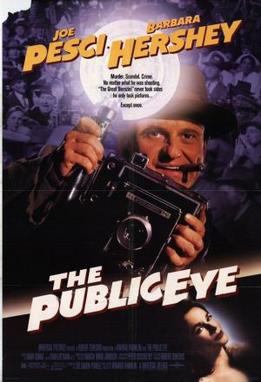 New York in the 1940s. Leon “Bernzy” Bernstein (Joe Pesci) is nearly a legend in the city, a freelance news photographer with a police radio in his car and a darkroom in his trunk. Bernzy is a solitary man who lives for his work, the type who has many acquaintances but few friends. He gets the pictures that no one else can get but his dream of seeing a book published of his photographs seems to be unattainable. As more than one snobbish publisher tells him, tabloid photographs are not art.
 Through the Shattered Lens