
So, I just finished watching Thank God, It’s Friday, a movie from 1978. It’s an episodic comedy, one that follows a group of genuinely unlikable characters as they all gather in one genuinely unlikable location and proceed to have some fairly generic experiences.
For example, there’s the married couple and the husband needs to loosen up. There’s the DJ who is going to lose his job if he can’t deliver the big stars that he’s promised. There’s the short, violent guy who is upset because he’s been set up on a date with a tall woman. There’s the dental hygienist who comes across like she’s desperately trying to convince everyone that she’s eccentric when she’s really just boring. (We all know the type.) There’s the teenager girls who try to sneak into the club, despite being underage. There’s the two dorky guys who are looking for love. There’s the two dorky girls who are looking for love.
In fact, everyone in the movie is looking for love! Except for Jeff Goldblum! He just wants to get laid. He manages the club where everyone has gathered on this particular Friday. He’s a womanizer. We can tell because he wears a red jacket and his shirt is half-buttoned. Goldblum decides that he wants to break up the married couple. Boo! Hiss! But wait a minute — neither the husband nor the wife are likable or interesting. Go, Jeff, go! BREAK UP THAT BORINGASS MARRIAGE!
Oh! And Nicole (Donna Summer) is wandering around the club too. She wants a chance to perform but the DJ refuses to let her. So, eventually, she just grabs a microphone and she starts to sing. Luckily, the song she sings is Last Dance and, by singing it, she gives everyone an excuse to go home. If you’ve ever been to a karaoke night, you know that, as soon as a drunk sings Last Dance, it’s time to pay the bill and get the Hell out of there.
Last Dance was apparently written specifically for Thank God, It’s Friday. Or maybe Thank God, It’s Friday was written specifically for Last Dance, who knows? What we do know is that Last Dance won the Oscar for Best Original Song. That’s right — Thank God, It’s Friday is an Oscar winner and therefore, will always be enshrined with fellow Oscar winners like Crash, Titanic, and SPECTRE.
(Which songs did Thank God, It’s Friday beat? It defeated a song from Grease, which is a good thing because Grease is even more annoying than Thank God, It’s Friday. That’s right, I said it. And you know it’s true.)
Anyway, Thank God, It’s Friday is a really bad movie, one that is full of bad writing, bad jokes, bad performances, and indifferent direction. It’s tempting to say that the music was really good but actually, we don’t hear much of the music. The movie is often more concerned about what’s happening in the club’s parking lot than in what is happening (and being heard) on the inside. We may not hear much music but we do get to see some pretty icky racial stereotyping and who would guess that a movie about disco would be so homophobic?
(We don’t see any cocaine, though I’m sure you could probably hear the key grip and the gaffer snorting a line off-camera if you listened closely enough. A lot of the cast looked pretty wired.)
ANYWAY — here’s the important thing about Thank God, It’s Friday. Occasionally, I’ll watch a movie like Dazed and Confused or Boogie Nights or Saturday Night Fever and I’ll get jealous because I know that I’ll never get a chance to experience the 70s first hand. Fortunately, something like Thank God, It’s Friday will always be around to reassure me, “No, Lisa. The 70s sucked!”
Thank God, it’s Friday?
No, thank God the movie’s over.

“Is it Friday yet!?”
Actually, you know what? I can’t end this review without sharing this film’s trailer:
Doesn’t Skatetown, USA look better?
Oh well! Sing us out of here, Donna!
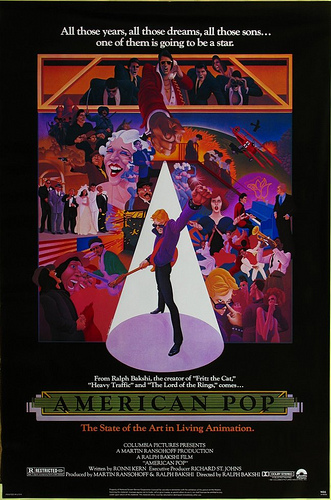 Long before South Park, The Simpsons, and Pixar, there was Ralph Bakshi. At a time when animation was considered to only be good for children, Bakshi shocked audiences and critics with animated films that dealt with mature themes and were definitely meant for adults. His first two films, Fritz the Cat (1972) and Heavy Traffic (1973), was the also the first two animated films to receive an X-rating. Bakshi satirized racism in the controversial Coonskin (1975) and Bakshi’s adaptation of The Lord Of Rings (1978) beat Peter Jackson’s by 23 years. It was after the critical and commercial disappointment of the heavily flawed but interesting Lord of the Rings that Bakshi decided it was time to make a film that would be more personal to him. The end result was American Pop.
 Through the Shattered Lens