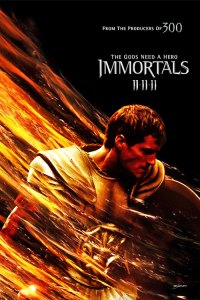
Quick Film Review: Immortals (dir. by Tarsem Singh)


Perhaps I’m jaded and spoiled by movies like Jason and the Argonauts and games like God of War.

I’m pretty sure that in an alternate dimension somewhere, audiences are sitting in the theatre and loving the hell out of Immortals. Maybe in some ways it’s actually good, but I can’t see them. At best, the film acts a great demo reel for Henry Cavill, who audiences will see as Superman sometime next year. For that reason, and perhaps Mickey Rourke’s Hyperion, Immortals is worth a peek. Even then, you may want to have someone take you to the movie, rather than pay for it yourself. Let’s put it this way. I spent more time on my iPhone with the brightness dimmed during the movie than I did actually watching it, and that’s a rarity for me. You’re better off waiting for the Netflix Edition. Everything you see in the trailer is basically the film in a nutshell.

The only other thing it really does have going for it is the 3D, which actually happens to be pretty good for the half hour that you can see it (and perhaps that’s just me, because it feels like it fades over time). The film does feel as if it were primarily filmed in 3D, and boasts some awesome visuals, but the story is a little jumbled. I won’t deny that Tarsem Singh has a really fantastic eye for painting a scene from The Cell to this point, but without sharp writing there’s something lost in the translation. It’s like watching David Fincher when he was still partnered with Darius Khondji on Seven or Spielberg with Kaminski in Minority Report. You can make pretty pictures, but there has to be some kind of meat and potatoes to it for the audience. That’s just how I felt here.

Eons ago, you once had mortals and you had gods. Zeus, Poseidon, Athena, Apollo, Dionysus, Aphrodite, etc. In Immortals, the gods learned that they had the ability to kill one another and as a result, there were a number of wars.  Enter Hyperion, who loathes the gods and wants them destroyed. In order to do this, he has to unleash the Titans, who were once servants of the gods but were punished for their treachery and sealed away in a special cage that can only be unlocked with an item called the Epirius Bow (which was one of the elements I truly enjoyed).

Our hero, Theseus (Cavill) lives a quiet life with his family when Hyperion’s forces attack. In the process, he witnesses his mother’s death at the hands of Hyperion himself and swears vengeance. Captured and left for dead with a number of others, he meets a mystic named Phaedra (played by Freida Pinto, who seems like she may be playing the same role emotionally that she did in Rise of the Planet of the Apes). Phaedra provides him with visions that allow him to reach the Bow.

Lead by Zeus, the gods watch all of this from Olympus, but are unable to interfere in the affairs of mortals on pain of death. These sequences (when they do happen) are the ones that you’re seeing in the trailers for the most part. Oceans rise and bad guys are cut down so fast that the first hardly has a chance to fall before the ninth one is hit. It’s amazing to see, it really is, but it’s been done before in movies as old as Jet Li’s The One. The film doesn’t lack in action, and in that, there’s a plus. What I had personally hoped for was something akin to giants or mythical creatures. Even though it was geared for teens, last year’s Percy Jackson and the Olympians offered more of a mystical element than Immortals did for me. It wouldn’t have hurt to have undead warriors or harpies or something. For all the money spent in effects, everything in this film seemed to be grounded in human based actions.

All of this culminates into a huge 300 like battle, right down to the narrow passageway that is used as an arena of battle. Theseus rallies his troops that are ready to retreat with a speech that’s helped along with the banging of shields. It was nice, but again, it wasn’t anything terribly new – “They’re only human!!” *clack clack clack* “We can beat them!” *clack clack clack* “For the children!!” *clack clack clack*

“And a tighter script!” I wanted to yell with a raised fist. “And maybe a refund!”

As for the audience, they seemed okay with it. There is a love scene which I don’t think younger audiences are ready for, but it was done in such a way that the “fade to black / open to the following morning” shot doesn’t let things get too far, visually.

When it gets to video, I may see Immortals again (because it is visually beautiful), but you’re better off treating yourself curling up somewhere and reading Homer’s The Odyssey for a while and letting your imagination fill in the pieces. It’s a okay film if you don’t ask for more than what it’s giving you.
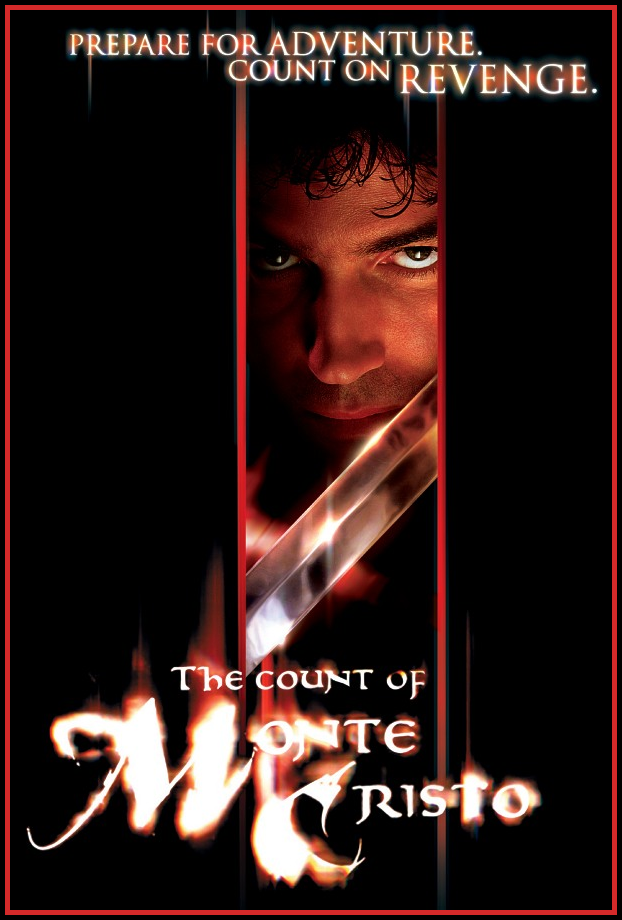
Review: The Count of Monte Cristo (dir. by Kevin Reynolds)


In what has become an unofficial ritual for myself whenever my birthday rolls around I always end up watching a film from 2002 that flew under the radar of most people. While it made modest box-office returns it wasn’t the head-turning blockbuster that some of its producers hoped it would turn out to be. It’s a romantic adventure piece by Kevin Reynolds and for readers of classic literature they’d recognize the title of the film, The Count of Monte Cristo. A film loosely based on the classic novel of adventure, revenge and redemption by French author Alexandre Dumas. The film ends up being a fun, thrilling throwback to films of an era which had marquee stars such as Errol Flynn and Basil Rathbone.

The story is one known well enough. It’s a tale of a man, Edmond Dantès wrongly accussed of a capital crime and imprisoned in the Alcatraz-like prison Chateau d’If through the machinations of three individuals: his best friend Fernand Mondego, first mate Danglars and the ambitious deputy prosecutor Villefort. Dantès spends the next several years in Chateau d’If under the cruel and sadistic eyes of it’s warden, Armand Dorleac (played by Michael Wincott with his usual flair for sadism). It’s while Dantès  has started to contemplate suicide after rejecting God for the pain and suffering he has had to endure that he has a fortuitious meeting with another guest of Chateau d’If. It’s this relationship between Dantès and Abbé Faria (Richard Harris in the mentor role he had begun to play in his later years) which take up the bulk of the first third of the film.

Dantès tells him of the circumstances which led to his imprison in Chateau d’If and the thoughts of vengeance on those responsible for his predicament. Faria tries to turn him from his dark path, but seeing how determined his young friend seems on journeying down its twisted path he agrees to teach him how to become adept at being a noble, finances and in swordcraft in exchange for help in digging themselves out of their prison. Taking several more years to complete the education Dantès needs to exact his revenge it ends at the death of Faria and his mentor’s final gift to his student. The location of a treasure so vast that Dantès could retire to a life of peace and contemplation or fund his plans of vengeance.

The middle section of the film shows Dantès finding the treasure and remaking himself through his newfound wealth as the Count of Monte Cristo to better insinuate himself amongst the wealthy and noble-born his targets mingle in. With the help of a bandit whose life spares after a duel in Jacopo (Luis Guzman) the plans Dantès has worked on for years begin to bear fruit as he manipulates and fools Fernand, Villefort and Danglars into his confidence to better see to their downfall. It’s during this time he meets his former fiancee Mercedes (played by the ridiculously beautiful Dagmara Dominczyk), now Countess Mondego after being told of Edmond’s execution earlier in the film, and Fernand’s son Albert. The circumstances of how his former love having had a child and married to one of the men who had conspired against him brings a new complication to Dantès plans.

The last third of the film shows the culmination of Dantès and his elaborate plans to bring about the downfall of all those who had wronged him. While the plans, at times, strain the bonds of disbelief at actually having fooled and worked against his enemies the way the film makes the audience root for Dantès to succeed helps. This is a Dantès who comes off as noble despite being of commoner origins who we stand behind and support in his plans of vengeance. With the amount of wealth at his disposal it’s not too difficult to put oneself in the same shoes and not think of vengeance as well to strike a balance.

It’s a testament to the direction of filmmaker Kevin Reynolds that the film and it’s story never bogs down despite a story with many elaborate plots and secondary characters introduced midway. The fact that the film only borrows some of its complexity from an even more labyrinthine novel shows how the filmmakers actually had to simplify the story as to not make it so complex that it loses the bulk of its audience.

The Count of Monte Cristo also benefit from a strong cast led by Jim Caviezel in the titular role with Guy Pearce playing his former friend and betrayer Fernand Mondego and James Frain as the prosecutor Villefort. Caviezel plays his role as Dantès and as the Count of Monte Cristo as two different people with distinct personalities. There’s Dantès the earnest sailor who just wanted to get back to his love, Mercedes and then there’s the sophisticated and ruthless Count whose machinations would lead to the destruction of lives and reputations. It’s a mystery why Caviezel hasn’t become the star he surely was in the making and this film showed that he had the talent to become one of the industry’s new leading men. I blame Mel Gibson in casting him as Jesus in The Passion of the Christ for having put a curse on Caviezel.

Guy Pierce in the role of Fernand plays the conniving and remoreless villain role to the hilt. With an overbearing and effete noble bearing to his performance it was a character written to inspire hatred not just in its main protagonist but in the audience as well. Pearce knows what his roles represent and has fun playing up the role as main heavy.

Richard Harris as the priest Faria did his usual great work as the elder mentor to a younger man. It was a role he began to be known for starting with Ridley Scott’s Gladiator right up to his final mentor role as the wizard Dumbledore in the Harry Potter film franchise. It’s hard to explain to people that Harris was not always this wise and mentoring father figure, but one who played roles where he’d play womanizers, charming cads and roguish rebel.

The Count of Monte Cristo ended up being more fun than it should be with enough complexities in its storytelling that the film doesn’t dumb down too much the story it was adapted from. To be honest the only way one could truly adapt Dumas’ novel of revenge and redemption is through a long-form tv series. It is just that complex with so many characters that a film adaptation would just be too long or just unnecessarily crowded with characters the audience would care to know. It’s a good thing that the film by Kevin Reynolds was still able to keep to the spirit of the original source while whiling away the story down to its basic core.

It’s a film that plays like a throwback to the swashbuckling films from Hollywood of the 30’s and 40’s and it wouldn’t be too difficult to see Caviezel in the roles Errol Flynn once inhabited. There’s very little special effects in the film which adds more to this sense with swordfight scenes as expertly choreographed as any of the past. The Count of Monte Cristo, for some reason still unknown to me, continues to be the one thing that keeps airing on my birthday and the fact that it’s such a fun and thrilling film that I continue to watch it everytime my day of days roll around. Can’t wait for next year.