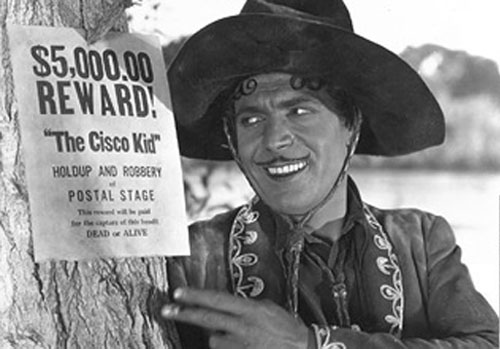
Lisa Marie Reviews An Oscar Nominee: In Old Arizona (dir by Raoul Walsh and Irving Cummings)


in-old-arizona-warner-baxter

Since the Oscars are approaching, I thought I would devote February to continuing my never-ending quest to watch and review every single film nominated for best picture!

With that in mind, I recently watched the 1928 film In Old Arizona.  In Old Arizona is a bit of an oddity in Oscar history.  Even though it is considered to have been a best picture nominee, it was never officially nominated.  In fact, in 1929, there were no official nominees.  Instead, the Academy simply announced the names of the winners.  The winners were selected by a small committee of judges.  The committee’s intentions are particularly obvious when you notice that not one film won more than one Oscar in 1929.  At a time when the industry was struggling to make the transition from silent film to the talkies, the 1929 Oscars were all about spreading the wealth and reassuring everyone that they were doing worthwhile work.  In Old Arizona‘s star, Warner Baxter, was named the year’s best actor while Broadway Melody was declared to have been the best picture.

(At that year’s Oscar ceremony, the second in the Academy’s history, the awards were reportedly handed out in 10 minutes and nobody gave an acceptance speech.  If this all seems strange when compared to the annual extravaganza that we all know and love, consider that Louis B. Mayer originally formed the Academy in order to give the studio bosses the upper hand in a labor dispute.  The awards were largely an afterthought.)

Years later, Oscar historians came across the notes of the committee’s meeting.  The notes listed every other film and performer that the committee considered.  Before settling on Broadway Melody, the committee apparently considered In Old Arizona.  For that reason, In Old Arizona is considered to have been nominated for best picture of the year.

If it seems like I’ve spent a bit more time than necessary discussing the history behind the 1929 Oscars, that’s because In Old Arizona isn’t that interesting of a film.  It was a huge box office success in 1929 and it was an undeniable influence on almost every Western that followed but seen today, it’s an extremely creaky film.  Influential or not, there’s not a scene, character, or performance in In Old Arizona that hasn’t been done better by another western.

Based on a story by O. Henry, In Old Arizona tells the story of a bandit named The Cisco Kid (Warner Baxter).  Cisco may be an outlaw but he’s also a nice guy who enjoys a good laugh and occasionally sings a song while riding his horse across the Arizona landscape.  (California and Utah stood in for Arizona.)  The Cisco Kid may rob stagecoaches but he always does it with a smile.  Besides, he only needs the money so that he can give gifts to his girlfriend, Tonia (Dorothy Burgess).  What the Cisco Kid doesn’t know is that Tonia is bored and frustrated by his frequent absences and she has been cheating on him.  Then she’s approached by Sgt. Mickey Dunn (Edmund Lowe), the big dumb lug who has been ordered to bring the Kid in (dead or alive, of course).  Will Tonia betrayed the Kid?

If you’re watching In Old Arizona and hoping to be entertained, you’ll probably be disappointed.  Almost everything about this film has aged terribly.  Watching the film, it’s obvious that none of the actors had quite figured out how to adapt to the sound era and, as such, all of the performances were very theatrical and overdone.  Probably the easiest to take is Edmund Lowe, who at least managed to deliver his lines without screeching.  Sadly, the same cannot be said of Dorothy Burgess.  As for Warner Baxter, he may have won an Oscar for playing the Cisco Kid but that doesn’t make his acting any easier to take.

And yet, if you’re a history nerd like me, In Old Arizona is worth watching because it really is a time capsule of the era in which it was made.  In Old Arizona was not only the first Western to ever receive an Oscar.  This was also the first all-talking, all-sound picture.  Watching it today, without that knowledge, you might be tempted to wonder why the film lingers so long over seemingly mundane details, like horses walking down a street, the ticking of a clock, a baby crying, or a church bell ringing.  But, if you know the film’s significance, it’s fun to try to put yourself in the shoes of someone watching In Old Arizona in 1929 and, for the first time, realizing that film could not just a visual medium but one of sound as well.  For some members of that 1929 audience, In Old Arizona was probably the first time they ever heard the sound of a horse galloping across the landscape.

(I have to admit that, as a student of American history, I couldn’t help but get excited when one of the characters mentioned President McKinley.  McKinley may be forgotten today but audiences in 1929 would not only remember McKinley but also his tragic assassination.  By mentioning that McKinley was President, In Old Arizona not only reminded audiences that it was taking in the past but that it was also taking place during what would have been considered a more innocent time.  Much as how later movies would use John F. Kennedy as a nostalgic symbol of a more idealistic time, In Old Arizona uses William McKinley.)

In Old Arizona is no longer a particularly entertaining film but, as a historical artifact, it is absolutely fascinating.

Lisa Reviews An Oscar Nominee: Imitation of Life (dir by John M. Stahl)


Louise Beavers and Fredi Washington in Imitation Of Life

Louise Beavers and Fredi Washington in Imitation Of Life

The 1934 film Imitation of Life opens with Delilah Johnson (Louise Beavers) standing on the back porch of a house owned by widowed mother Bea Pullman (Claudette Colbert).  Delilah says that she’s come for the housekeeping position.  Bea tells her that there is no housekeeping position and quickly figures out that Delilah has the wrong address.  As Delilah wonders how she’s going to get to the other side of town in time to interview for the job, Bea hears her toddler daughter falling into the bathtub upstairs.  After Bea rescues her daughter, she agrees to hire Delilah as a housekeeper.

The rest of the film tells the story of their friendship.  It turns out that, because she knows an old family recipe, Delilah can make the world’s greatest pancakes.  Bea decides to go into business, selling Delilah’s pancakes and using Delilah as the product’s mascot.  Soon Delilah’s smiling face is on billboards and she’s known as Aunt Delilah.  When it comes time to incorporate the business, Bea and her partner, Elmer (Ned Sparks), offer Delilah 20% of the profits.  They tell Delilah that they’re all going to be rich but Delilah protests that she doesn’t want to be rich.  She just wants to take care of Bea and help to raise Bea’s daughter.

Delilah, incidentally, is African-American while Bea is white.

Despite the fact that Imitation of Life is considered to be an important landmark as far as Hollywood’s depiction of race is concerned, I have to admit that I was really uncomfortable with that scene.  First off, considering that Delilah was the one who came up with recipe and her face was being used to sell it, it was hard not to feel that she deserved a lot more than just 20%.  Beyond that, her refusal felt like it was largely included to let white audiences off the hook.  “Yes,” the film says at this point, “Delilah may be a servant but that’s the way she wants it!”

It was a definite false note in a film that, up to that point and particularly when compared to other movies released in the 30s, felt almost progressive in its depiction of American race relations.  Up until that scene, Bea and Delilah had been portrayed as friends and equals but, when Delilah refused that money, it felt like the film had lost the courage of its convictions.

However, there’s a shot that occurs just a few scenes afterwards.  Several years have passed.  Bea is rich.  Delilah is still her housekeeper but now the house has gotten much larger.  After having a conversation about Delilah’s daughter, Bea and Delilah walk over to a staircase and say goodnight.  Bea walks upstairs to her luxurious bedroom while, at the same time, Delilah walks downstairs to her much smaller apartment.  It’s a striking image of these two women heading different directions on the same staircase.  But it also visualizes what we all know.  For all of Delilah’s hard work, Bea is the one who is sleeping on the top floor.  It’s a scene that says that, even if it couldn’t openly acknowledge it, the film understands that Delilah deserves more than she’s been given.  It’s also a scene that reminds us that even someone as well-intentioned and kind-hearted as Bea cannot really hope understand what life is truly like for Delilah.

The film itself tells two stories, one of which we care about and one of which we don’t.  The story we don’t care about deals with Bea and her spoiled child, Jessie (Rochelle Hudson).  Jessie develops a crush on her mom’s boyfriend, Steve (Warren William).  It’s really not that interesting.

The other story is the reason why Imitation of Life is a historically important film.  Delilah’s daughter, Peola (Fredi Washington), is of mixed-race ancestry and is so light-skinned that she can pass for white.  Throughout the film, Peola desperately denies being black and, at one point, stares at herself in a mirror and demands to know why she can’t be white.  When Peola goes to school, she tells her classmates she is white and is mortified when Delilah shows up at her classroom.  When Peola gets older, she attends an all-black college in the South but, eventually, she runs away.

When Delilah tracks her daughter down, Peola is working as a cashier in a restaurant.  When Delilah confronts her, she is almost immediately confronted by the restaurant’s owner, who angrily tells her that the restaurant is a “whites only” establishment.  Peola pretends not to know her mother.

Beyond the confrontation between Peola and Delilah, that scene in the restaurant is important for another reason.  It’s the only time that the film provides any direct evidence as to why Peola wants to pass for white.  Oh, don’t get me wrong.  We all know why Peola thinks that society will treat her differently if it believes that she’s white.  (And we also know that she’s right.)  But this scene is the first time that the film itself acknowledges the fact that, in America, a white girl is going to have more opportunities than a black girl.  Up until that point, white audiences in 1934 would have been able to dismiss Peola as just being selfish or unappreciative but, with this scene, the film reminds viewers that Peola has every reason to believe that life would be easier for her as a white girl than as an African-American.  It’s a scene that would hopefully make audiences consider that maybe they should be angrier with a society that allows a restaurant to serve only whites than they are with Peola.  It’s a scene that says to the audience, “Who are you to sit there and judge Peola when you probably wouldn’t even allow Delilah to enter the theater and watch the movie with you?”

Imitation of Life was nominated for best picture of the year and, though it lost to It Happened One Night,  Imitation of Life is still historically important as the first best picture nominee to attempt to deal with racism in America.  (Despite a strong pre-nomination campaign, Louise Beavers failed to receive a nomination.  It would be another 5 years before Hattie McDaniel would be the first African-American nominee and winner for her role as Mammy in Gone With The Wind.  Interestingly enough, McDaniel got the role after Beavers turned it down.)

Following the box office success of Imitation of Life, there were several films made about “passing.”  The majority of them starred white actresses as light-skinned African-American characters.  Imitation of Life was unique in that Fredi Washington, who played Peola, actually was African-American.  As will be obvious to anyone who watches Imitation of Life, Fredi Washington had both the talent and the beauty to be a major star.  However, she was considered to be too sophisticated to play a maid or to take on any of the comedy relief roles that were usually given to African-American performers.  (And, as an African-American, no major studio would cast her in a lead or romantic role.)  As such, her film career ended just three years after Imitation of Life and she spent the next 50 years as a stage performer and a civil rights activist.  (For an interesting look at the history of African-Americans in the film industry, I would suggest checking out Donald Bogle’s Bright Boulevards, Bold Dreams: The Story of Black Hollywood.)  

Like Peola, Washington herself could have passed for white.  She was often asked if she was ever tempted to do so.  I’m going to end this review with the answer that she gave to a reporter from The Chicago Defender:

“I have never tried to pass for white and never had any desire, I am proud of my race. In ‘Imitation of Life’, I was showing how a girl might feel under the circumstances but I am not showing how I felt.  I am an American citizen and by God, we all have inalienable rights and wherever those rights are tampered with, there is nothing left to do but fight…and I fight. How many people do you think there are in this country who do not have mixed blood, there’s very few if any, what makes us who we are, are our culture and experience. No matter how white I look, on the inside I feel black. There are many whites who are mixed blood, but still go by white, why such a big deal if I go as Negro, because people can’t believe that I am proud to be a Negro and not white. To prove I don’t buy white superiority I chose to be a Negro.”