Wizards of the Lost Kingdom (1985, directed by Hector Olivera)


The kingdom has been conquered by an evil sorcerer named Shurka (Thom Christopher).  Young Simon (Vidal Peterson), the son of the king’s wizard, barely escapes with his best friend and pet, the white fur-covered Gufax (Eugenio Martin).  In the wilderness, they meet warrior Kor (Bo Svenson), who teams up with them to free the kingdom.

This is another Roger Corman-produced sword and sorcery film from Argentina.  Corman did a lot of these in the 80s.  Wizards of the Lost Kingdom stands out by being considerably more kid-friendly than the rest of them.  There’s no nudity.  The violence is not excessive and is largely directed at fake looking giant insects.  There’s no nudity and no scenes of the bad guys forcing themselves on women.  The hero even has a toy-friendly companion!

Wizards of the Lost Kingdom also has a lot of stock footage.  The entire pre-title sequence is stock footage lifted from movies like Death Stalker to explain how “King Tyler” came to control the kingdom.  (King Tyler sounds like someone who would be the kegger king of the local college.)  Wizards of the Lost Kingdom is a short movie with a barely 72-minute run-time.  Fourteen of those minutes is footage from other movies.

Wizards of the Lost Kingdom takes a lighter approach to the sword-and-sorcery genre and it pays off with a simple and easy-to-watch movie featuring swords, magic, and monstrous insects.  It’s not a film that demands much of the audience and Bo Svenson looks convincing grunting and carrying a sword.  It wasn’t a box office hit but found a second life on video.  Of course, it got a sequel.  None of the original cast returned.

Barbarian Queen (1985, directed by Hector Olivera)


The forces of the evil Lord Arrakur (Arman Chapman) raid a peaceful Barbarian village, disrupting the wedding of Queen Amethea (Lana Clarkson) and Prince Argan (Frank Zagarino).  Along with slaughtering almost the entire village, Arrakur also kidnaps Amethea’s sister, Taramis (Dawn Dunlap).  Amethea survives the attack and, with her handmaiden Estrild (future director Katt Shea) and the warrior Tiniara (Susana Traverson), sets out for Arrakur’s realm to rescue her sister and to take vengeance on him.

In Barbarian Queen, there’s much violence, much nudity, and much time spent in a dungeon with a pool of acid.  This may sound like pretty standard fantasy stuff and it is, except for the fact that almost all of the warriors are women and Arrakur and his forces are even nastier than the typical sword-and-sorcery villain.  Arrakur uses rape to terrorize his enemies and his subjects and, while that may be historically correct, it’s not easy to watch.  By the time Arrakur and Amethea are facing off in the gladiatorial arena, most viewers will be ready to see Arrakur defeated in the most extreme way possible.

Barbarian Queen was released by Roger Corman’s Concorde Picture and it was filmed in Argentina.  Today, it is best-remembered for the presence of the tragic Lana Clarkson in the role of Amethea.  Lana Clarkson starred in several Corman-produced fantasy films before she was murdered by Phil Spector in 2003.  At the time of her death, the media often dismissively described Clarkson as being a “former B movie starlet” but anyone who caught Clarkson’s movies on late night Cinemax knows that she was always the best thing about the films she was in and that she had a likable and sincere screen presence that made you root for her, whether she was fighting off an army with a sword and hiding in a tree with a bow-and-arrow.  Lana Clarkson’s performance in Barbarian Queen is always strong and sympathetic.  She endures even the movie’s most exploitive scenes without sacrificing her dignity and when she fights back, she refuses to surrender.  Her determination to have her vengeance and to free the people from a tyrant is the thing that makes Barbarian Queen worth watching.

RIP, Lana Clarkson.  She was so much more than just “a B movie starlet.”

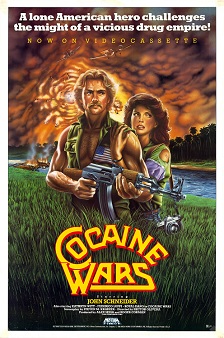
Cocaine Wars (1985, directed by Hector Olivera)


In 1980s Bolivia, the most powerful drug lord is Gonzalo Reyes (Federico Luppi).  Working with General Lujan (Rodolfo Ranni), Reyes runs his own concentration camp, where people are forced to process the cocaine that is then sold in the United States.  Reyes’s pilot is an American named Cliff Adams (John Schneider).  Reyes eventually gives Cliff a very important assignment.  He wants Cliff to assassinate Marcelo Villalba (John Vitali), a crusading journalist who is running for president of the country.

What Reyes and Lugan don’t know but soon learn is that Cliff is actually a Miami-based DEA agent who has been working deep undercover.  Despite his assignment and the fact that even the U.S. government seems to consider Villalba to be expendable, Cliff refuses to carry out the assassination.  Soon, he and his girlfriend (Kathryn Witt) and their friend Bailey (Royal Dano) are being pursued by Reyes and Lujan.  Cliff’s girlfriend is also a reporter and she has compiled a story that, if it is published, will blow the lid off of Reyes and Lujan’s partndership.

Produced by Roger Corman and filmed in Argentina, Cocaine Wars is very much a product of its time.  In the 1980s, America was all about the War on Drugs, especially the War on Cocaine.  However, some of the world’s biggest drug lords were working with the tactic approval of some of America’s most important allies in South and Central America.  For as long as it was convenient and strategically useful, the American government would look the other way.  It was only when the situation became internationally embarrassing, as in the case of Panama’s General Manuel Noriega, that the U.S. would actually step in.  This was certainly the case in Bolivia, where drug lords were so essential to overthrowing the government that the subsequent coup was referred to as being “the cocaine coup.”  General Lujan is a stand-in for a large number of Bolivian military men who continually overthrew the country’s democratically-elected leaders.  By including several Germans among Reyes’s organization, Cocaine Wars also acknowledges the role that Nazi war criminal Klaus Barbie played in not only propping up a series of Bolivian strongmen and drug organizations but also teaching the Bolivian secret police how to torture information out of political prisoners.  While Cocaine Wars is not primarily a political film, it is still notable as an early example of a film that pointed out why the War on Drugs was destined for failure.

As for the film itself, it is a standard low-budget action film.  There aren’t any huge surprises to be found but, at 82 minutes, it moves quickly and it has enough action to satisfy fans of the genre.  John Schneider may not have been Sylvester Stallone, Arnold Schwarzengger, or even Chuck Norris but that works to the movie’s advantage.  Unlike those bigger-than-life heroes, Schneider does not come across as being indestructible and that adds a little more suspense to the inevitable gunfights and torture scenes.  Schneider is a likable and effective action lead, even if you never do forget that you’re essentially watching a TV actor taking a stab at the big screen.