Missouri in 1864. The Civil War is raging and the state is divided between those who support the Union and those secretly support the Confederate guerillas led by Willian Quantrill (Ray Corrigan). The Union’s Major Baker (Jack Holt) is determined to track down rebel Bob Shelby (Jimmie Martin) and he enlists the Native American Chief Whitecloud (played by Chief Thundercloud) to help find him. Whitecloud has a personal vendetta against the Shelby family and, when he finds Bob, he executes him in cold blood. Bob’s sister, Jean Shelby (Ann Savage), is also a Confederate sympathizer and she seeks revenge. Complicating things is that Jean has fallen in love with Union Captain Fred Raymond (Alan Curtis).
One of the many B-westerns produced by Robert L. Lippert and directed by William Berke, Renegade Girl packs a lot of plot into just 65 minutes. The action is nonstop and fans of westerns will find all of the horse chases, gunfights, and threats of hanging that they could want. The main thing that distinguishes Renegade Girl from other B-westerns is the fierce performance of Ann Savage as Jean Shelby, a woman who will not stop until she gets her revenge. While the film’s portrayal of the Quantrill and Chief Whitecloud definitely goes against modern sensibilities, Ann Savage’s performance feels ahead of her time. No one is going to stand in Jean Shelby’s way.
Chief Thundercloud’s real name was reportedly Victor Daniels, though his past is shrouded in mystery. He claimed to be a Cherokee from Arizona, though he was listed as being Mexican on a marriage record that was filed before he started his film career. As Chief Thundercloud, he was a mainstay in westerns from the 30s to the time of his death in 1955. He was the first actor to play the Lone Ranger’s Tonto and he also played Geronimo in a 1939 Paramount film of the same name. His final film role was a posthumous appearance in John Ford’s The Searchers.
1942’s The Mummy’s Tomb picks up 30 years after the end of The Mummy’s Hand.
Archeologist Steve Banning (Dick Foran) is now living a peaceful life in the small town of Mapleton, Massachusetts. As the film opens, he is telling his guests about the time that he and his friend, Babe Hanson (Wallace Ford), went to Egypt and discovered the tomb of an Egyptian princess. He tells them how Andoheb (George Zucco) tried to use the ancient mummy, Kharis, to protect the tomb. Steve assures everyone that Andoheb is now dead and Kharis is no longer a threat to anyone.
The film then travels to Egypt where we discover that Steve was not quite correct. Adoheb survived being shot at the end of The Mummy’s Hand. He’s now an old man, dying but still obsessed with getting revenge. He instructs his disciple, Mehemet Bey (Turhan Bey), to travel to America with Kharis (now played, under a bunch of bandages, by Lon Chaney, Jr.) and to get revenge on the remaining members of the Banning expedition.
Bey and Kharis travel to Massachusetts and soon, the entire town of Mapleton is gripped in fear as Kharis starts to murder people. Steve Banning is the first victim. Then Steve’s sister, Jane (Mary Gordon). Kharis even kills Babe Hanson, whose role in the previous film was largely comic relief. Seriously, not even Frankenstein’s Monster killed the comic relief. Kharis is a ruthless and unstoppable killer and, in a performance that is totally focused on his hulking physicality, Lon Chaney, Jr. makes for a frightening mummy. Kharis moves slowly, dragging one foot behind him. But when he does attack, he’s relentless. This movie reminded me of why the mummy has, to me, always been the scariest of the old Universal monsters.
Despite the fact that Kharis is leaving bandages and ancient mold all over the place, the authorities are not quite convinced that an ancient mummy has come to their small town. However, the townspeople have no doubt what’s happening and, since this is a Universal film, they are soon running around with torches and pitchforks. Meanwhile, Steve’s son, John (John Hubbard), tries to figure out how to destroy the mummy and how to protect his fiancée, Isobel (Elyse Knox). Bey has decided that he’s in love with Isobel and he orders Kharis to bring her to him. Even under all the bandages, Kharis’s facial expression still suggests that he knows this isn’t a good idea.
The Mummy’s Tomb suffers from the same problem that afflicted The Mummy’s Hand. It feels like it takes forever to actually get to the good stuff. This is only a 60-minute film and ten of those minutes is taken up with a flashback to The Mummy’s Hand. But no matter! Once Kharis arrives in America, the pace of the film picks up and it becomes an effective little horror film. Lon Chaney, Jr. is frightening Kharis. I wouldn’t want him following me down a dark alley!
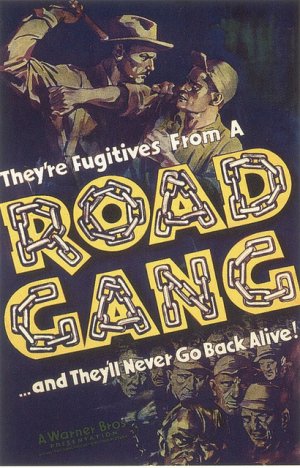
I was going to start this review with a quote from Gandhi: “A nation’s greatness is measured by how it treats its prisoners.” That was something that I first heard from a perpetually stoned ex-seminarian who used to live in a trailer park in Lake Dallas. I always figured that, being as stoned as he usually was, he probably knew what he was talking about but, upon doing research for this review, I have discovered that Gandhi actually didn’t say that. What Gandhi said was, “A nation’s greatness is measured by how it treats its weakest members.” Fortunately, it’s the same basic idea and, regardless of how you phrase it, it’s a quote that perfectly encapsulates the message of the 1936 film, Road Gang.
Road Gang tells the story of Jim (Donald Woods) and Bob (Carlyle Moore, Jr.). Bob is fun-loving. Jim is more serious and engaged to marry heiress Barbara Winston (Kay Linaker). Jim and Bob live in an unnamed Southern state (though I’m going to assume that the state is supposed to be Georgia, just because). Jim has just written an article that exposes the corruption of political boss, J.W. Moett (Joe King). The article is so good that both Jim and Bob have been offered jobs in Chicago! There’s a lot of corrupt political figures who can be exposed in Chicago!
However, while driving up north, Jim and Bob are arrested on trumped-up charges. At first, Jim and Bob laugh off Moett’s desperation but, unfortunately, another criminal happens to be breaking out of jail at the same time that Jim and Bob arrives for booking. That criminal kills the arresting officer and then forces Jim and Bob to drive him across the state. Eventually, the police recapture the three of them. However, the escaping criminal is killed and Jim and Bob are arrested as accessories. Under the advice of their lawyer, Mr. Dudley (Edward Van Sloan), they plead guilty and accept a deal. What they don’t know is that Dudley works for Moett and that, as a result of pleading guilty, they are going to be sentenced to five years in a prison camp.
Okay, so the film gets off to a pretty melodramatic start. And, to be honest, the entire film is extremely melodramatic. A lot of time is devoted to Barbara trying find evidence that Jim and Bob were set up, something that is made difficult by the fact that Barbara’s father, like Mr. Dudley, works for Moett. Fast-paced and not-always-logical, this is a B-movie, in every sense of the term.
And yet, as melodramatic as it is, Road Gang is deadly serious when it comes to portraying the brutality of the prison camp. From the minute that Bob and Jim arrive, they find themselves at the mercy of the corrupt warden and his sadistic guards. The prisoners are largely used as slave labor and subjected to punishments that are often arbitrary and extreme.
Road Gang doesn’t flinch when it comes to portraying why prison often not only fails to rehabilitate but also helps to transform minor offenders into hardened criminals. There’s a disturbing scene in which Jim, Bob, and the other prisoners are forced to listen as another prisoner is whipped. The crack of the whip and his howls of agony explode across the soundtrack in a symphony of pain and sadism. Jim and Bob have two very different reactions to being in prison. One survives. One allows himself to be killed rather than take one more day in confinement.
Road Gang is often compared to I Am A Fugitive From A Chain Gang. Actually, beyond the theme of a fatally compromised justice system, there is no comparison. The angry and fact-based I Am A Fugitive From A Chain Gang is a hundred times better and, quite frankly, Donald Woods was no Paul Muni. However, Road Gang still has its moments of power. Decades after it was made, the issues it raises continue to be relevant. Do we send people to prison to rehabilitate them or to punish them and are the two goals mutually exclusive? And how can we say that someone has “paid his debt to society” when, even after a prisoner serves his time, the stigma of having been imprisoned closes and locks most doors of opportunity?
Road Gang shows up occasionally on TCM. There’s where I recorded it on January 23rd of this year.
(For those following at home, Lisa is attempting to clean out her DVR by watching and reviewing 38 films by this Friday. Will she make it? Keep following the site to find out!)
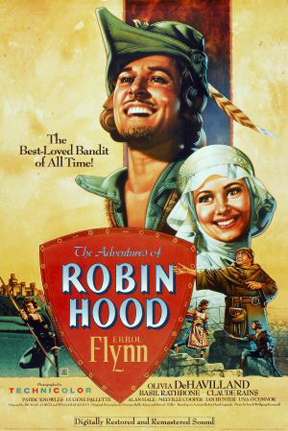
Flamboyant. Athletic. Joyous. Determined. Handsome. Outspoken. Bigger than life. Revolutionary. Anarchist. Sexy. Libertarian. Is there any doubt why Errol Flynn remains the definitive Robin Hood?
And. for that matter, is there any doubt why the 1938 film The Adventures of Robin Hood remains not only the definitive Robin Hood film but also one of the most influential action films in history?
The Adventures of Robin Hood tells the story that we’re all familiar with. The King of England, Richard The Lionhearted (Ian Hunter), is captured while returning from the Crusades. His brother, King John (Claude Rains, in full autocratic villain mode), usurps the throne while Richard is gone and immediately raises taxes. He claims that he’s only doing this to raise the money to set Richard free. Of course, the real reason is that John is a greedy tyrant.
The only nobleman with the courage to openly oppose John is Sir Robin of Locksely (Errol Flynn). Sir Robin protects his fellow citizens from John’s main henchman, Sir Guy of Gisbourne (Basil Rathbone, also in full autocratic villain mode). In fact, Robin is so brave that, on multiple occasions, he even enters Sir Guy’s castle so that he can specifically tell King John and Sir Guy that he has no use for their laws. This, of course, always leads to Robin having to make a dramatic escape while arrows flies and swords are unsheathed all around.
And through it all, Robin Hood keeps smiling and laughing. He’s a wonderfully cheerful revolutionary. He may be fighting a war against a ruthless and unstoppable enemy and he may be the most wanted man in England but Robin is determined to have fun. One need only compare Robin to his humorless foes to see the difference between freedom and bureaucracy.
(We could use Errol Flynn’s Robin Hood today, though I suspect our government would just blow him up with a drone and then issue a statement about how, by stealing money from the rich and giving it to the poor, Robin was keeping the government from being able to rebuild bridges and repair roads.)
When Robin isn’t exposing the foolishness of organized government, he’s hanging out in Sherwood Forest. He’s recruiting valuable allies like Friar Tuck (Eugene Pallette) and Little John (Alan Hale, Sr.) He’s playing constant pranks and promoting revolution and, to his credit, he’s a lot more fun to listen to than that guy from V For Vendetta. He’s also romancing Maid Marian (Olivia de Havilland) and good for him. Two beautiful people deserve to be together.
Even better, he’s doing it in glorious Technicolor! There’s a lot of great things about The Adventures of Robin Hood. The action scenes are exciting. The music is thrilling. The film is perfectly cast. Errol Flynn may not have been a great actor but he was a great Robin Hood. But what I really love about the film is just the look of it. We tend to take color for granted so it’s interesting to watch a film like The Adventures of Robin Hood, one that was made at a time when color film was something of a novelty. For those of us who spend a lot of time talking about how much we love old school black-and-white, The Adventures of Robin Hood is a film that says, “Hey, color can be great too!”
(True, nobody in The Adventures of Robin Hood shouts, “I declare him to be …. AN OUTLAAAAAAAAAAAAWWWWWWWW!” Actually, now that I think about it, Ridley Scott’s Robin Hood would have worked much better if Oscar Isaac and Russell Crowe had switched roles.)
The Adventures of Robin Hood was nominated for best picture and it probably should have won. However, the Oscar went to Frank Capra’s You Can’t Take It With You.
 Missouri in 1864. The Civil War is raging and the state is divided between those who support the Union and those secretly support the Confederate guerillas led by Willian Quantrill (Ray Corrigan). The Union’s Major Baker (Jack Holt) is determined to track down rebel Bob Shelby (Jimmie Martin) and he enlists the Native American Chief Whitecloud (played by Chief Thundercloud) to help find him. Whitecloud has a personal vendetta against the Shelby family and, when he finds Bob, he executes him in cold blood. Bob’s sister, Jean Shelby (Ann Savage), is also a Confederate sympathizer and she seeks revenge. Complicating things is that Jean has fallen in love with Union Captain Fred Raymond (Alan Curtis).
 Through the Shattered Lens