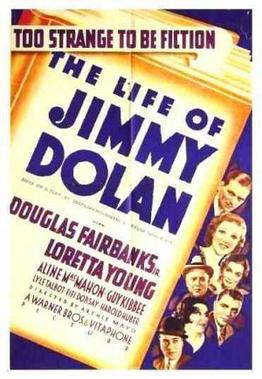
Jimmy Dolan (Douglas Fairbanks Jr.), the light heavyweight champion of the world, goes out of his way to present himself as being a wholesome boxer who loves his mom and is as saintly outside the ring as he’s fearsome inside. Instead, in private, Jimmy is a hard-drinking cynic with a corrupt manager (Lyle Talbot) and a wild girlfriend (Shirley Grey). When a reporter (George Meeker) threatens to reveal the truth, Jimmy’s manager punches him and accidentally kill him. The manager frames Jimmy for the crime and then flees with Jimmy’s girlfriend, just to suffer a fiery end in a car accident.
Everyone except for weary Inspector Phalanxer (Guy Kibbee) thinks that Jimmy is dead. Jimmy goes on the run, hitching rides on freight trains and nearly starving to death before he stumbles over a home for orphans. Peggy (Loretta Young) takes Jimmy in and gives him food and a place to live. Jimmy helps with the kids (including Mickey Rooney). When Jimmy learns that the orphanage might be shut down, he agrees to fight in a charity boxing match against the fearsome King Cobra (Sammy Stein). King Cobra is so tough that even John Wayne (playing a boxer named Smith) is scared to get in the ring with him. Jimmy risks his life and his freedom for the orphanage.
This is a good pre-code melodrama. Because this was a pre-code film, it doesn’t have to shy away from portraying Jimmy’s decadent lifestyle outside of the ring. Douglas Fairbanks, Jr. was a likable actor and easy to root for. He was athletic enough to be convincing as someone who could handle himself in a fight. When he finds himself down-and-out, he’s standing in for everyone who was struggling during the Depression. The great character actor Guy Kibbee also has some great moments as the inspector, especially towards the end of the film. Fans of John Wayne won’t see much of him here but it’s still interesting to see Wayne play a character who is frightened of something.
All in all, The Life of Jimmy Dolan is a good, pre-code boxing movie.
The 1933 film, Lady For A Day, tells the story of Apple Annie (May Robson) and Dave the Dude (Warren William), who is perhaps the nicest gangster that you could ever hope to meet.
Of course, when I refer to Dave the Dude as being a gangster, I should make clear that he’s not the type of gangster who guns down his rivals or sells drugs in back alleys. I mean, I guess he might do that but we certainly don’t see much of evidence of it in the film. Instead, Dave is just a dapper gambler who travels with a bodyguard named Happy McGuire (Ned Sparks) and whose girlfriend, Missouri Martin (Glenda Farrell), owns a nightclub where, since this is a pre-code film, the acts are slightly racy but not excessively salacious. The country may be mired in a depression but Dave appears to be doing okay for himself. Yes, Dave may be a criminal but at least he’s honest about it.
Surviving the Depression has proven to be far more difficult for Apple Annie. She’s known as Apple Annie because she makes a meager living by selling fruit on the streets of New York City. Dave is one of her regular customers, as he believes that her apples bring him good luck. Annie has a daughter named Louise (Jean Parker). Louise has never met her mother, having spent the majority of her life in a Spanish convict. Annie regularly steals stationary from a high class hotel so that she can sends letters to Louise. Not wanting her daughter to be ashamed of her, Annie has always presented herself as being a rich woman named Mrs. E. Worthington Manville.
However, it now appears that Annie’s charade is about to be exposed. Louise is coming to New York with her fiance, Carlos (Barry Norton) and her prospective father-in-law, Count Romero (Walter Connolly). Annie knows that when the Louise arrives, she’s going to discover that her mother is not wealthy and that the marriage will probably be called off. So, led by Dave, Annie’s customers conspire to fool Louise into believing that her mother really is a member of high society. And if that means that Dave is going to have to not only kidnap (but, let’s be clear, not harm) three nosy reporters and then make a deal with not just the mayor but also the governor to pull of the deception, that’s exactly what he’s going to do.
Though it may be disguised as a sweet and rather simple comedy, Lady For A Day is actually a rather melancholy little film. Even when Annie and her friends are pretending to be wealthy members of high society, the film is aware that their escape from reality is only temporary. Eventually, they’ll have to return to the reality of being poor in 1930s America. At heart, it’s a sad story but May Robson, Warren William, Glenda Farrell, and Guy Kibbee (who plays the pool hustler who is recruited to pretend to be Annie’s husband) all bring such sincerity to their roles that you can’t help but smile while watching it. Rejected by “polite” society, Annie and her friends have formed a community of outsiders and, throughout the film, the audience is happy that, no matter what, they have each other.
Lady for a Day was the first Frank Capra film to ever be nominated for Best Picture. Capra was also nominated, for the first time, for best director but he had the misfortune to be competing with Frank Lloyd, who directed Cavalcade. At the awards ceremony, when host Will Rogers, announced the winner for best director, he said, “Come on up here, Frank!” An excited Capra ran down to the podium, just to discover that Rogers had actually been talking to Frank Lloyd. Rogers, seeing what had happened, quickly invited the other nominated director, Little Women‘s George Cukor, to come join Lloyd and Capra at the podium. Fortunately, one year later, Capra would win the directing Oscar for It Happened One Night.
Cavalcade would go on to win Best Picture but Capra retained so much affection for Lady For A Day that it was the only one of his films that he would subsequently remake. A Pocketful Of Miracles came out in 1961 and featured Bette Davis in the lead role. It would be Capra’s final theatrical film.
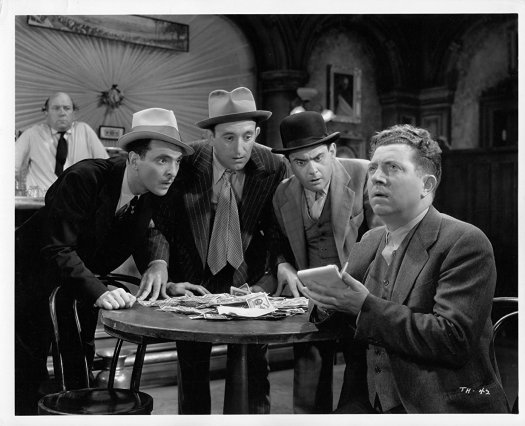
Frank McHugh got a rare starring role in the comedy THREE MEN ON A HORSE, based on the hit Broadway play by George Abbott and John Cecil Holmes. McHugh was usually cast as the funny friend of fellow members of “Hollywood’s Irish Mafia “ James Cagney and Pat O’Brien, but here he takes center stage as a meek, hen-pecked type who has an uncanny knack for picking winning horses – as long as he doesn’t bet on them!
Greeting card writer Erwin Trowbridge is beset by a whiney wife, obnoxious brother-in-law, and bullying boss. After a row with wifey brought on by meddling bro-in-law, Erwin leaves his humble Ozone Park, Queens abode and decides to skip work and get sloshed. Stumbling into a seedy hotel bar frequented by Runyonesque gamblers, Erwin gives them a winning pony – then passes out. The three mugs, Patsy, Charlie, and Frankie, bring him up…
If you’re a regular reader of this site, it will not take you by surprise to learn that the 1933 Best Picture Nominee, 42nd Street, is one of my favorite films of all time.
I mean, how couldn’t it be? Not only is it a pre-Code film (and we all know that pre-Code films were the best) and one the features both Ginger Rogers and Dick Powell in early roles but it’s also a film that depicts the backstage world of a stage musical with such a combination of love and snark that it will be familiar to everyone from community theater nerds to Broadway veterans. 42nd Street is a classic musical, though I have to admit that I think the majority of the songs are a bit overrated. Even more importantly, 42nd Street is the ultimate dance film. The film’s big production number, choreographed and filmed in the brilliant and flamboyant Busby Berkeley style, is such an iconic moment that it’s still being imitated and lovingly parodied to this day.
Every dance movie owes a debt to 42nd Street but few have come close to matching it. Remember how much we all hated Smash? There were a lot of reasons to hate Smash but the main reason was because it tried to be 42nd Street and it failed. There can only be one 42nd Street.
It’s hard to estimate the number of show business clichés that currently exist as a result of 42nd Street. Then again, it can be argued that they were clichés before they showed up in 42nd Street but 42nd Street handled them in such an expert fashion that they were transformed from being urban legends to immortal mythology.
42nd Street takes place in the backstage world, following the production of a Broadway musical through casting to rehearsals to opening night. It’s an ensemble piece, one populated by all the usual suspects. Julian Marsh (Warner Baxter) is the down-on-his-luck producer who desperately needs a hit. Dorothy Brock (Bebe Daniels) is the celebrated star who is dating a rich, older man (Guy Kibbee, who made quite the career out playing rich, older men) while secretly seeing her ex, a down-on-his-luck Vaudevillian (George Brent). From the minute that we first see Dorothy, we know that she’s eventually going to end up with a boken ankle. It’s just a question of which chorus girl will be promoted to take her place. Will it be “Anytime” Annie (Ginger Rogers) or will it be the naive and wholesome Peggy (Ruby Keeler)? You already know the answer but it’s still fun to watch.
If you had any doubts that this was a pre-code film, the fact that Ginger Rogers is playing a character named “Anytime” Annie should answer them. 42nd Street is often described as being a light-hearted camp spectacle but there’s a cynicism to the film, a cynicism that could only be expressed during the pre-code era. The dialogue is full of lines that, just a few years later, would never have gotten past the censors.
(This is the film where it’s said that Anytime Annie “only said no once and then she didn’t hear the question!” This is also the film where Guy Kibbee cheerfully tells Annie that what he does for her will depend on what she does for him. Just try to get away with openly acknowleding the casting couch in 1936!)
The menacing shadow of the Great Depression looms over every glossy production number. Julian needs a hit because he lost all of his money when the Stock Market crashed and if the show is not a hit, everyone involved in the production will be out on the streets. The chorus isn’t just dancing because it’s their job. They’re dancing because it’s an escape from the grim reality of the Great Depression and, for the audience watching, the production numbers provided a similar escape. 42nd Street said, “Yes, life is tough. But sometimes life is fun. Sometimes life is sexy. Sometimes, life is worth the trouble.” Someday, 42nd Street promises, all the misery will be worth it.
Ultimately, 42nd Street is all about that iconic, 20-minute production number:
42nd Street was nominated for best picture but it lost to the nearly forgotten Cavalcade.
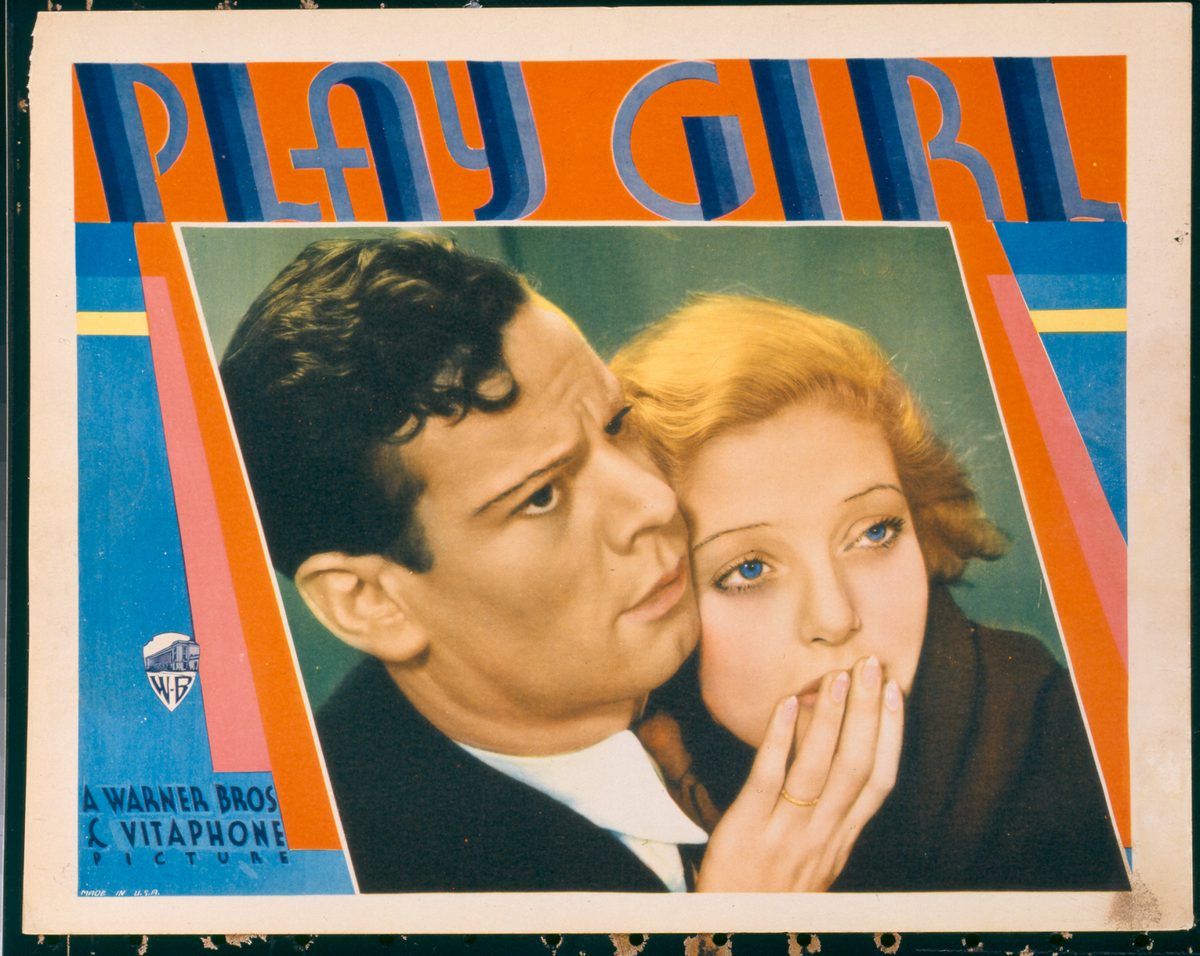
One of the many fun things about Pre-Code films is seeing how they get away with racy dialog without being overly explicit. The risqué double entendres fly freely in PLAY-GIRL, starring Loretta Young as an independent woman who ends up marrying a degenerate gambler, winding up pregnant and husbandless until the conclusion. The story didn’t really matter to me; it was the innuendo-laden script that kept me interested.
That saucy script was written by Maurine Dallas Watkins, who wrote the play “Chicago”, later adapted into the 1942 film ROXIE HART with Ginger Rogers, and then turned into Bob Fosse’s smash Broadway musical CHICAGO, which in turn became the Oscar winning Best Picture of 2002. Ms. Watkins was a former crime reporter for the Chicago Tribune, and based her play on the murder trial of “jazz babies” Beulah Annan and Belva Gaertner. Hollywood beckoned, and she wrote screenplays for UP THE RIVER (the film…
 Jimmy Dolan (Douglas Fairbanks Jr.), the light heavyweight champion of the world, goes out of his way to present himself as being a wholesome boxer who loves his mom and is as saintly outside the ring as he’s fearsome inside. Instead, in private, Jimmy is a hard-drinking cynic with a corrupt manager (Lyle Talbot) and a wild girlfriend (Shirley Grey). When a reporter (George Meeker) threatens to reveal the truth, Jimmy’s manager punches him and accidentally kill him. The manager frames Jimmy for the crime and then flees with Jimmy’s girlfriend, just to suffer a fiery end in a car accident.



 Through the Shattered Lens