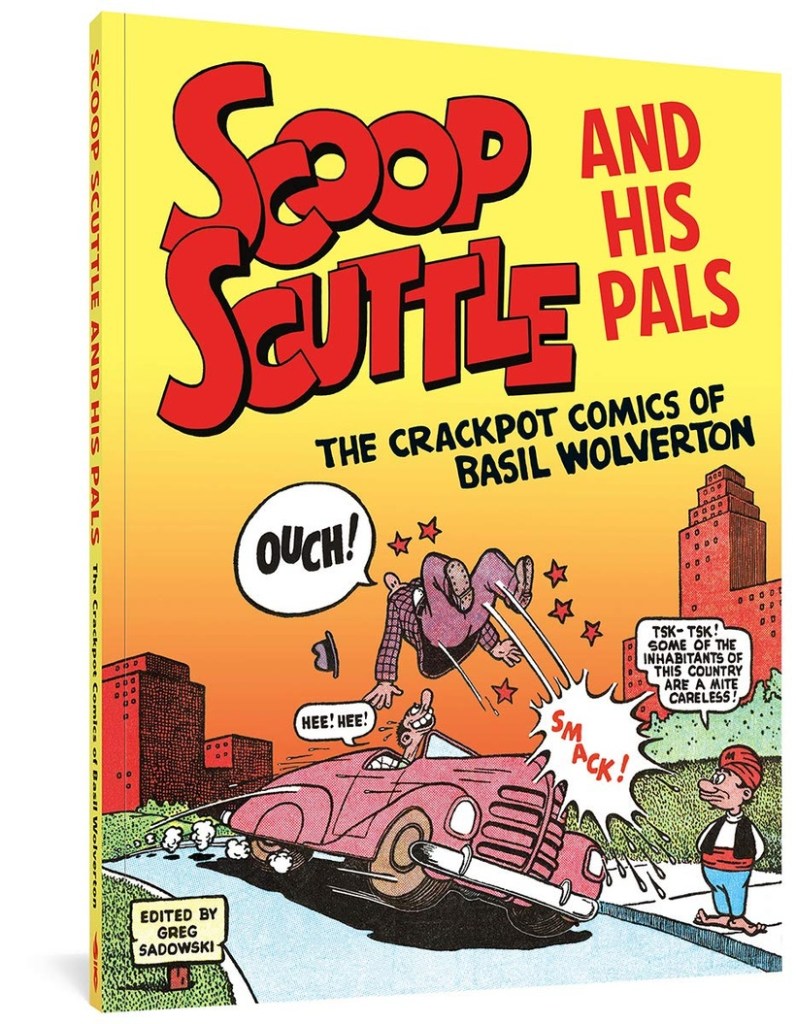
Patreon Preview Week : “Scoop Scuttle And His Pals : The Crackpot Comics Of Basil Wolverton,” Edited By Greg Sadowski


I do this once a year, and figured the first week of the year might be a better time for it than some random week in July or August or whatever — essentially the point here being, and I’m not too proud to admit it, to gin up a little interest in my Patreon site by offering everyone a sampling of the wares they’ll find if they decide to join up. I update it three times weekly, and seriously, it does help make all this writing (somewhat) financially viable. Plus, we’ve got a great group of folks on there, the conversation in the comments section is usually pretty lively, and everyone whose a member is, at the risk of sounding corny, more than just a member, they’re a friend. And couldn’t we all do with more of those in life? Anyway, first up is a review I did a couple months back of editor Greg Sadowski’s 2021 Fantagraphics collection SCOOP SCUTTLE AND HIS PALS : THE CRACKPOT COMICS OF BASIL WOVERTON, with a link to my Patreon at the end if you’re interested in reading more stuff of this nature..

Most people are well aware that visionary cartoonist Basil Wolverton’s legendary contributions to MAD were hardly his first go-’round with humor strips, but leave it to Wolverton scholar par excellence Greg Sadowski to curate a long-overdue collection of some of his most obscure and overlooked comedic creations of the 1940s and 1950s : goofball reporter Scoop Scuttle, magic-nosed swami Mystic Moot, idiot savant cowboy Bingbang Buster and his horse Hedy, and slapstick spacefarer Jumpin’ Jupiter. To say that none of these characters made much by way of a lasting impression on the readership of the time is undoubtedly true, sure — but each in their own way presaged much of the madcap shenanigans to come from Wolverton’s mind and pen, and their misadventures are sure to delight even the most jaded of modern readers.

Which, admittedly, is a camp that I all-too-frequently find myself numbered amongst, given my frankly robust reading schedule, yet even for those of us who’ve literally seen it all before, there’s something about seeing how it was done earlier that feels like, if you’ll forgive the cliche, a breath of fresh air. And talking of cliches —
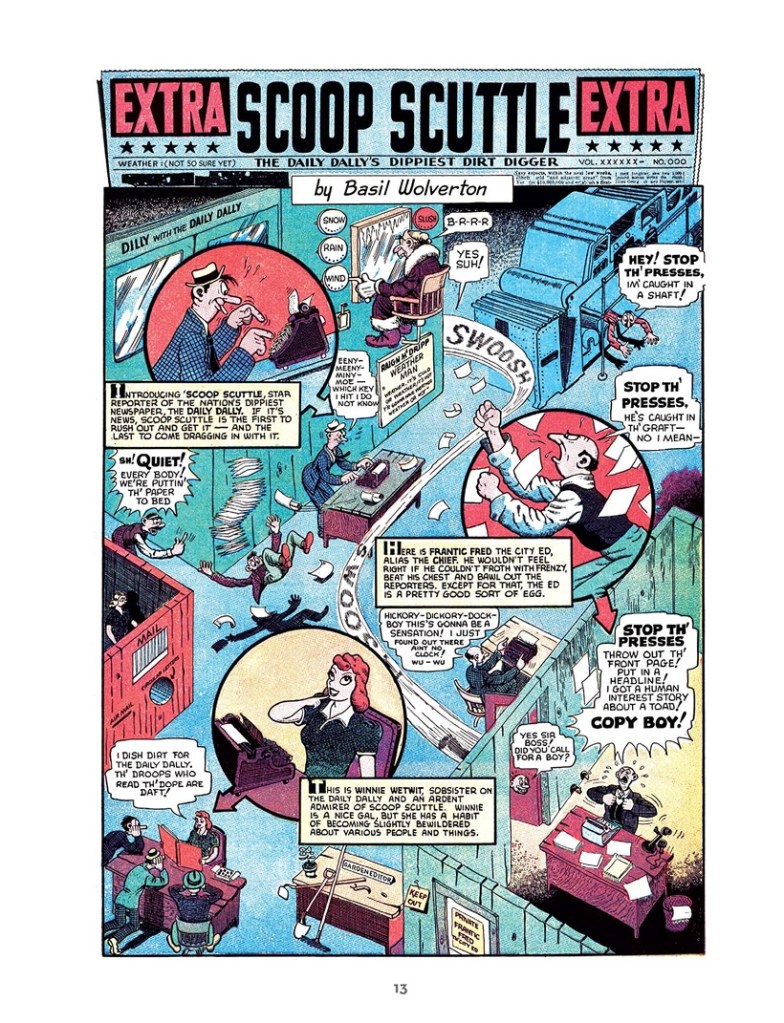
OF COURSE they’re a dime a dozen in these pages, but Wolverton’s ability to poke good-natured fun at them remains an unbridled joy, even if the occasional ethnic stereotype rightly gives today’s readers some pause. That being said, such offensive caricatures are in far shorter supply in Wolverton’s work than they are in that of many of his contemporaries, and the persons, places, and things he draws are so uniformly outlandish that they don’t especially stand out from what’s more or less ALWAYS a crowded field of visual eccentricities. Simply stated, then, it’s safe to say that these stories (and it should be stated for the record that Sadowski presents the printed exploits of all four characters in their entirety) were all constructed as FUN strips fist and foremost, and that they remain precisely that to this day.

Admittedly, there’s no escaping the fact that these are “toned down” a notch compared to Wolverton’s MAD work, but it’s intriguing to see him feeling his way forward, so to speak, and it’s also important to remember that he was working under undoubtedly tighter editorial standards. Even for all that, though, there’s a tremendous amount of innovation on display in many of these strips, and not just in terms of the far-out sound effects that Sadowski draws particular attention to in his thoroughly absorbing introductory essay — indeed, the page layouts, intuitive flow of the action, outrageous character designs, and even some of the plot twists are all several levels above and beyond the standard humor comics fare of the era.
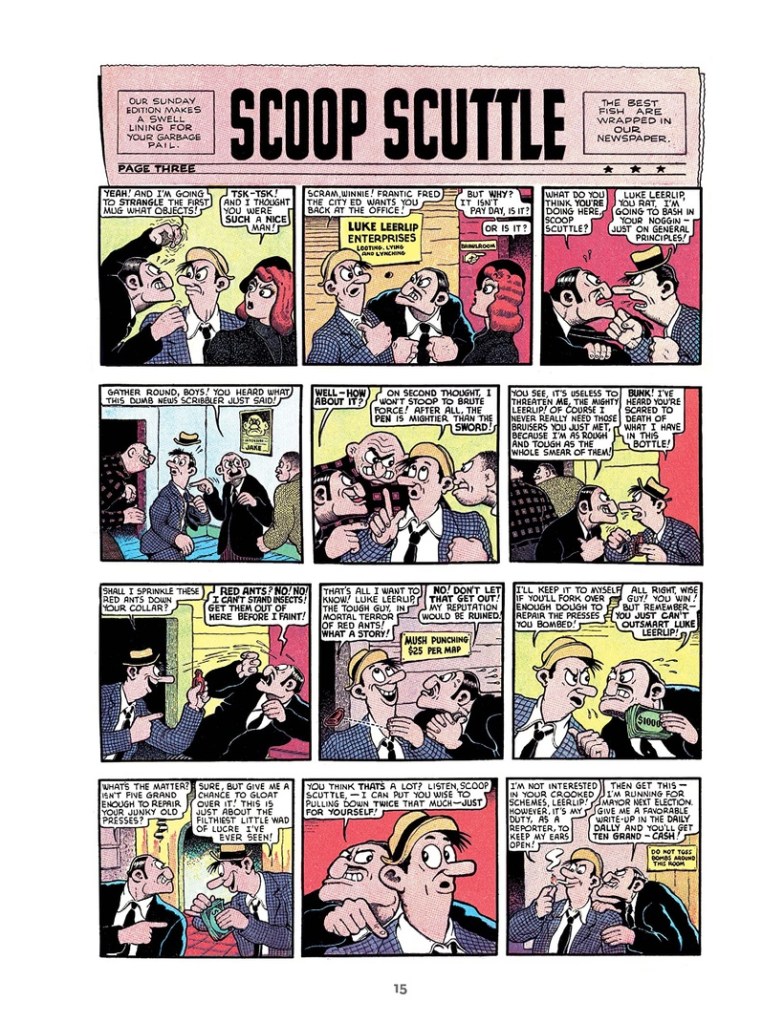
None of which means this isn’t ultimately formulaic stuff, mind you — but a big part of Wolverton’s genius always rested in his ability to thoroughly subvert expectation WITHIN a given formula; to give readers a combination of MORE than what they bargained for and EXACTLY what they bargained for simultaneously. In that respect, then, this necessarily “hemmed in” work could potentially be said to represent a MORE INGENIOUS distillation of the “Wolverton ethos,” if you will, than later material where he was more free to let it all hang out.
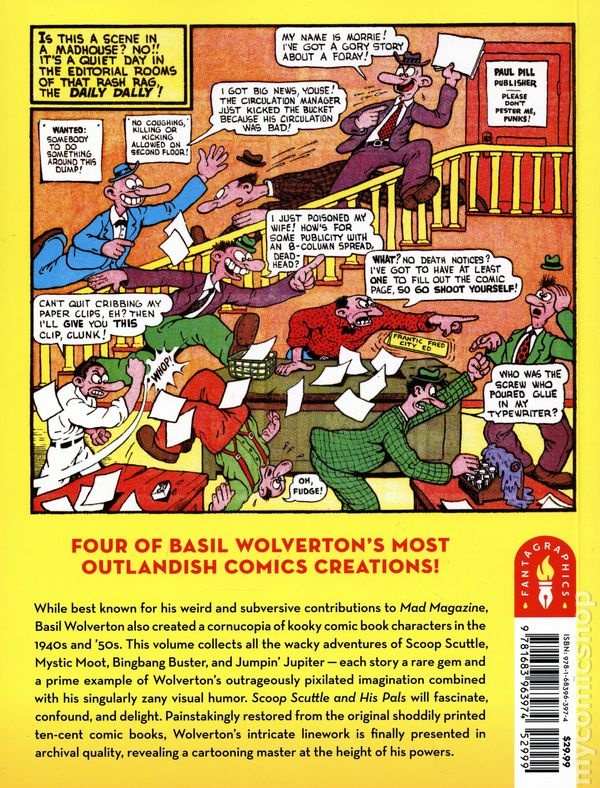
Sure, ultimately I don’t think there’s any argument that SCOOP SCUTTLE AND HIS PALS will primarily be of interest to hard-core Wolverton aficionados above all (certainly the admirable amount of care that went into the flat-out amazing restoration process makes this an essential purchase even for collectors who might own a fair number of time-yellowed originals), but it’s also this critic’s considered opinion that Sadowski has managed to put together a collection that damn near ANYONE can take a tremendous amount of enjoyment from, be they crusty veteran or member of comics laity. Given what we’ve all been through over the past year and change, some extra laughter in our lives is likely to be welcomed by anyone and everyone, and if the source of that laughter is 70-80 years old, then hell, that’s reason to be IMPRESSED as well as amused.

Okay, I hope you’ve enjoyed this first little sample offering. If you’re interested in more, my Patreon costs as little as a dollar a month to join and can be found by heading over to https://www.patreon.com/fourcolorapocalypse

Four Color Apocalypse Year In Review : Top Ten Vintage Collections


Moving right along with our 2021 round-up, we arrive at the TOP TEN VINTAGE COLLECTIONS list. The rules for this category are as simple as they are arbitrary on my part : basically, any book which collects and/or presents comics material originally published prior to the year 2000 fits my definition of “vintage.” One of these years I should probably bump that up by a decade or so, but this is not that year. This category also includes translated works such as manga, Eurocomics, and the like, provided they’re chronologically appropriate. And with that out of the way, here’s what we’ve got :

10. Scoop Scuttle And His Pals : The Crackpot Comics Of Basil Wolverton, Edited By Greg Sadowski (Fantagraphics) – A legitimately uproarious collection or little-seen early Wolverton humor strips meticulously restored and overseen by the comics historian who knows his work best, these are admittedly not as outrageously OTT as what would come later, but stand well enough on their own to mark this book as more than simply a compendium of early-days curiosities. If there’s not enough fun stuff in your current reading pile, picking this up will surely rectify that situation immediately.

9. Alberto Breccia’s Dracula, Translated By Jamie Richards (Fantagraphics) – Lavish wordless strips from the Argentinian master that place history’s most infamous vampire in conflict with the dual soul-crushing forces of military dictatorship and US commercial imperialism, this was both gutsy stuff for its time and, as it turns out, a prescient warning about the future. Even Breccia’s funniest work packs a conceptual wallop.

8. Red Flowers By Yoshiharu Tsuge, Translated By Ryan Holmberg (Drawn+Quarterly) – After dabbling in genre for his earliest stores, Tsuge left its safe confines to create these emotionally immersive tales informed by his own travels, and the results are still several levels above the merely “impressive” to this day. I’d say something about witnessing the flowering of an artist’s talents, but surely that would be too painfully obvious for its own good, wouldn’t it? Except I sort of just did. Whoops.

7. My Life & Times : Spain Vol. 3 By Spain Rodriguez, Edited By Patrick Rosenkranz (Fantagraphics)  The most recent volume of Rosenkranz’ exhaustive Spain retrospective is also the best, focusing as it does primarily on the underground master’s autobiographical comics. Gorgeously restored and thoughtfully presented, this is the “deluxe treatment” this work has long been deserving of.

6. The Biologic Show By Al Columbia (Hollow Press) – Apparently the cartoonist himself is none too pleased with this collection for reasons I’m not privy to, but damn if I wasn’t impressed. One of the most disquieting series ever produced as well as one of the finest auteur works of the 1990s, having this material back in print is something for which all of us not named Al Columbia should be incredibly thankful.

5. BugHouse Book One By Steve Lafler (Cat Head Comics) – Bridging the 1990s/early 2000s divide but with very much a 1950s Beatnik “vibe” to it, Lafler’s under-appreciated gem of a series is richly deserving of finding a broader audience. Jazz, drugs, femmes fatales — there’s no telling which is more dangerous in this unassumingly, and unquestionably, visionary comic.

4. It’s Life As I See It : Black Cartoonists In Chicago 1940-1980, Edited By Dan Nadel (New York Review Comics) – Released in conjunction with a retrospective exhibition of the same name, Nadel’s superb collection features everything from political cartooning to newspaper strips to undergrounds to downright mainstream-leaning fare and presents a comprehensive and engrossing view of the rich cartooning history that’s been an integral part of the Black experience in Chicago. There are names both familiar and less so on offer in these pages, as well as plenty of work that’s seldom been made available outside the city itself, making this the definition of an “essential” read.

3. Jimbo : Adventures In Paradise By Gary Panter (New York Review Comics) – Unquestionably the most influential book on this list, there’s no underestimating the impact of Panter’s masterwork on generations of cartoonists who followed in its (and his) wake. Some unfortunate production errors on the part of the publisher (including cropped-off artwork) prevent this from being ranked higher than it deserves to be, but its nevertheless a fairly decent presentation of one of the best comics every made by anyone.

2. Enigma : The Definitive Edition By Peter Milligan And Duncan Fegredo (Dark Horse/Berger Books) – The finest mainstream comic of the 1990s finally gets its due with an impressive presentation that may leave a bit to be desired in terms of color reproduction and page size, but still represents a more comprehensive package than fans of this cult classic (myself included) probably had any right to hope for. More than the “British Invasion” mind-fuck to end all “British Invasion” mind-fucks (although it sure is that), Milligan and Fegredo’s magnum opus is a labyrinthine, clever, and hilarious meditation on identity, reality creation, and the nature of meaning itself in a postmodern world.
1. Trots And Bonnie By Shary Flenniken, Edited By Norman Hathaway (New York Review Comics) – If “long overdue” is a running theme here, no collection fits that description better than this deluxe oversized presentation of Flenniken’s groundbreaking National Lampoon classic. “Irreverent” is the most polite way to put it when it comes to these strips — “beyond good and evil” might be more like it. Obliterating all boundaries of taste (good and otherwise), Flenniken created a comic whose power to shock and disturb is only exceeded by its ability to make you laugh your ass off and empathize with its characters. Like nothing else, before or since.

We’ve got two lists left to go, for TOP TEN CONTEMPORAY COLLECTIONS and TOP TEN ORIGINAL GRAPHIC NOVELS, and my plan is to get them both done in the next day or two. Until then, it’s my duty to remind you that ALL of these are “brought to you” by my Patreon site, where I serve up exclusive thrice-weekly rants and ramblings on the worlds of comics, films, television, literature, and politics for as little as a dollar a month. Subscribing is the best way to support my continuing work, so I’d be very appreciative if you’d take a moment to give it a look by directing your kind attention to https://www.patreon.com/fourcolorapocalypseAdvertisement