The Fabulous Forties #16: Dr. Kildare’s Strange Case (dir by Harold S. Bucquet)


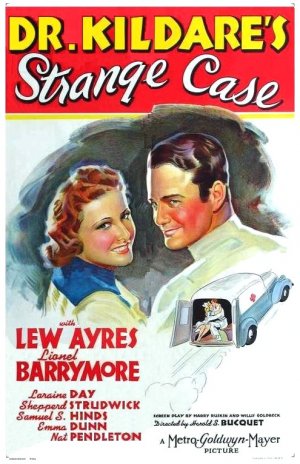
Dr._Kildare's_Strange_Case_FilmPoster

The 16th film in Mill Creek’s Fabulous Forties box set was 1940’s Dr. Kildare’s Strange Case.  It’s about a doctor who investigates a medical case and wow, is it ever a strange case.

Apparently, there was a whole series of Dr. Kildare films that were released in the 30s and 40s.  I guess the films were the cinematic equivalent of a TV show like Grey’s Anatomy or ER or Children’s Hospital or… well, every medical show that’s ever shown up on TV since the beginning of time.  Dr. James Kildare (Lew Ayres) is a passionate young doctor who may break the rules but he gets results!  His mentor is Dr. Gillipsie.  Gillipsie is played by Lionel Barrymore and since the character is cranky and confined to a wheelchair, it was impossible for me to watch him without thinking about Mr. Potter from It’s A Wonderful Life.  Whenever Kildare went to him for advise, I kept expecting Gillipsie to glare at him and say, “You once called me a warped old man…”

Anyway, Dr. Kildare works in a hospital and, when he’s not silently judging everyone else that he works with, he’s busy silently judging the wealthy Dr. Lane (Sheppard Strudwick), a brain surgeon whose patients keep dying.  Kildare and Lane are also both in love with the same nurse, Mary Lamont (Laraine Day).  Mary wants to marry Kildare but Kildare would rather be poor and single than compromise his medical principles.  Lane, on the other hand, sends her a box full of silk stockings.  Plus, he’s rich!

Seriously, how is this even a competition?  Forget Kildare and marry Lane!

Except, as I mentioned earlier, all of Lane’s patients keep dying.  Is Lane incompetent or, as Kildare suggests, is it possible that brain surgery is just really, really hard?  I imagine it was even harder in 1940, when this movie was being made.  While Kildare and Lane are operating on brains, Dr. Gillipsie is still using leeches to suck sickness out of the poorer patients.

(You don’t actually see it happen in the movie but Gillipsie comes across as being a leech man.)

Anyway, eventually, Kildare has to cure a schizophrenic and it turns out that he can do this by putting the man into an insulin coma.  As is explained in great detail, forcibly putting a patient in a coma will cause that patient’s mind to go back to a reset point.  It’s kind of like how Windows sets up a restore point before doing a major update.

And that therapy sounds so crazy that you just know it had to be based in an actual practice.  I checked with Wikipedia and I was not shocked to discover that apparently Insulin Shock Therapy used to be a thing!

Anyway, Kildare’s gets into a lot of trouble for putting his patient into a coma and attempting to erase a huge part of his mind.  Will Kildare’s results vindicate his methods or will Gillipsie have to use leeches to suck the crazy out of the patient’s brain?

Watch the film to find out!  Or don’t.  Dr. Kildare’s Strange Case was directed by Harold S. Bucquet, who did a pretty good job with The Adventures of Tartu.  His direction here is flat and uninspired, which only serves to make this entire film feel like an old TV show.  I’m tempted to recommend the movie just because of the scene where it’s explained that insulin shock therapy causes patients to devolve so that they can re-evolve but otherwise, Dr. Kildare’s Strange Case is forgettable.

If you want to see it, you can watch it below!

http://www.youtube.com/watch?v=8UPFyrlNiGM

Or you can just watch this classic episode of Children’s Hospital!
http://www.youtube.com/watch?v=dpBjqgVaEbk

Lisa Reviews An Oscar Nominee: Blossoms In The Dust (dir by Mervyn LeRoy)


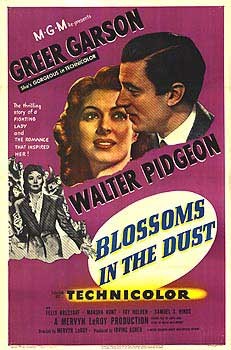
Blossoms_dust_movieposterDid you know that up until the year 1936, if a child was born to unwed parents, it was common practice to actually put the word “illegitimate” on that child’s birth certificate?  As you all know, I am perhaps the biggest history nerd in the world and, while I knew that there was once a huge stigma associated with being born outside of marriage, I did not know just how institutionalized that stigma was.

I’m also proud to say that my home state of Texas — the state that all the yankees love to bitch about — was the first state to ban the use of the word “illegitimate” on birth certificates.  This was largely due to the efforts of Edna Gladney, an early advocate for the rights of children.  Along with starting a home for orphans and abandoned children in Ft. Worth, Edna also started one of the country’s first day care centers for the children of working mothers.

That’s right — there was a time when day care was itself a revolutionary concept.

I have TCM to thank for my knowledge of Edna Gladney, largely because TCM broadcast a 1941 biopic called Blossoms in The Dust.  According to Wikipedia, the film was a highly fictionalized look at Edna’s life but, to be honest, I would have guessed that just from watching the movie.  While Blossoms In The Dust gets the important things right (and it deserves a lot of credit for sympathetically dealing with the cultural stigma of being born to unwed parents at a time when it was an even more controversial subject that it is today), it’s also full of scenes that are pure Hollywood.

In real life, Edna knew firsthand about the challenges faced by children of unwed parents because she was one herself.  Apparently, at the time, that was going too far for even a relatively progressive film like Blossoms In The Dust so, in Blossoms, Edna (played by Greer Garson) is given an adopted sister named Charlotte (Marsha Hunt).  When the parents of Charlotte’s fiancée discover that she was born outside of marriage, they refuse to allow Charlotte to marry their son.  In response, Charlotte commits suicide.

In real life, Edna was born in Wisconsin but, following the death of her stepfather, moved to Ft. Worth to stay with relatives.  Edna was 18 at the time and eventually met and married a local businessman named Sam Gladney.  In Blossoms in The Dust, Edna is already an adult when she first meets Sam (played by Walter Pidgeon, who played Greer Garson’s husband in a number of films) and they meet in Wisconsin.  It’s only after Charlotte dies that Edna marries Sam and it’s only after they’re married that Edna moves to Texas.  Whereas the real life Edna had relatives in Texas, the film’s Edna is literally a stranger in a strange land.

That said, the film is actually rather kind to my home state.  The film spend a lot of time contrasting the judgmental snobs up north with the more straight-forward people who Edna meets after she moves to Ft. Worth and it’s occasionally fun to watch.  (Of course, I would probably feel differently if I was from Wisconsin.)

Blossoms In The Dust was nominated for best picture but it lost to How Green Was My Valley.  Greer Garson was nominated for best actress but she lost to Joan Fontaine in Suspicion.  However, just one year later, Garson would win an Oscar for her performance in the 1942 best picture winner, Mrs. Miniver.  Incidentally, her husband in that film was played by none other than Walter Pidgeon.

Ultimately, Blossoms in the Dust is typical of the type of movies that you tend to come across while watching films that were nominated for best picture.  Some best picture nominees were great.  Some were terrible.  But the majority of them were like Blossoms in the Dust, well-made, respectable, and just a little bit bland.  Blossoms in the Dust is not bad but it’s also not particularly memorable.  If, like me,  you’re a student of history and social mores, Blossoms in the Dust has some historical interest but, when taken as a piece of cinema, it’s easy to understand why it’s one of the more forgotten best picture nominees.

Lisa Reviews An Oscar Nominee: The Pride of the Yankees (dir by Sam Wood)


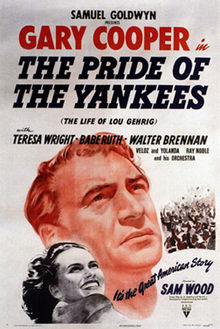
220px-The_Pride_Of_The_Yankees_1942

“People all say that I’ve had a bad break. But today … today, I consider myself the luckiest man on the face of the Earth.”

— Lou Gehrig (Gary Cooper) at the end of The Pride of the Yankees (1943)

After airing Foreign Correspondent earlier tonight, TCM followed up by showing the 1943 best picture nominee, The Pride of the Yankees.  Knowing that Pride of the Yankees was going to be a baseball film and that I know next to nothing about baseball, I recruited my sister, the Dazzling Erin, to watch the movie with me.  Erin loves baseball and I knew that she would be able to explain anything that went over my head.

Well, I absolutely loved watching this movie with my sister but it turns out that The Pride of the Yankees isn’t really much of a baseball movie.  True, it’s about a real life baseball player.  Several actual players appeared as themselves.  About 85% of the film’s dialogue deals with baseball and probably about 70% of the film features characters playing some form of the game.  But the film never goes into any great detail about baseball or how it’s played.  There’s no talk of strategy or rules or deeper meaning or anything else.  Going into the film, I knew that baseball was a game that involved throwing, swinging bats, and running.  And it turns out that was all that I needed to know.

The Pride of the Yankees is less about baseball and more about celebrity.  It’s a biopic of Lou Gehrig, who today is best known for his battle with ALS, a disease that is also known as Lou Gehrig’s disease.  Lou Gehrig died on June 2, 1941 and The Pride of the Yankees was released just a year later.  Watching the film, it’s obvious that Gehrig was a beloved figure, the type of celebrity who, if he were alive today, would probably be the center of stories like, “Lou Gehrig Did Something This Weekend And It Was Perfect.”  Watching the film, it easy to imagine how traumatic it must have been for the nation when a beloved athlete like Lou Gehrig died at the age of 37.

As a result, The Pride of the Yankees is less a biopic and more a case for canonization.  From the minute that the film’s Lou Gehrig appears on-screen, he is presented as being the type of saintly athlete who, by promising to hit two home runs in one game, inspires a crippled child to walk.  Lou is modest, kind, unpretentious, and never gets angry.  Over the course of the film, he takes care of his mother, displays a worthy work ethic, and marries Eleanor.  He and Eleanor have a perfect marriage without a single argument or a hint of trouble, except for the fact that Lou sometimes gets so busy playing baseball with the local children that he’s late coming home.  There’s not a hint of sadness in their life, until Lou suddenly gets sick.

And really, it should not work.  If ever there’s ever been a film that should be painfully out-of-place in our more cynical times, it would be The Pride of the Yankees.  However, the film still works because Lou is played by Gary Cooper and Eleanor is played by Teresa Wright.  These two excellent performers bring their considerable talents to making overly sentimental scenes feel credible.  Gary Cooper was 40 years old when he made The Pride of the Yankees and there’s a few scenes — especially the ones where Lou is supposed to be a student at Columbia University — where Cooper is clearly too old for the role.  But, for the most part, Gary Cooper did a great job as Lou Gehrig.  Cooper is especially memorable when Lou first starts to show signs of being ill.  Watching Lou struggle to swing a bat, I was reminded of a horse struggling to stand on an injured leg.  It was almost painfully poignant.

The Pride of the Yankees was nominated for 11 Academy Awards, including best picture.  However, it lost to another sentimental film that featured Teresa Wright, Mrs. Miniver.