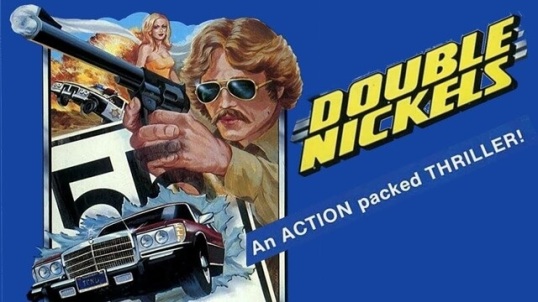
The TSL Grindhouse: Double Nickels (dir by Jack Vacek)


First released in 1977, Double Nickels tells the story of two California highway patrolman.  Smokey (Jack Vacek) and Ed (Ed Abrams) have been tasked with enforcing the speed limit but they’re usually too busy chasing each other up and down the highway to worry about doing their job and, in fact, they even have a friendly relationship with the local street racers.

Now, you may think Smokey and Ed are just wasting the tax payer’s money by taking such a casual attitude towards their work and technically, you’re right.  But let’s be honest.  Nobody likes the speed limit.  There’s a reason why it’s usually the rural speed limit signs that end up getting used for target practice.  Smokey and Ed are a part of the system for the paycheck but, deep down, they hate the system just as much as the rest of us do.  They’re fighting the Man by taking his money and refusing to enforce his rules.

Anyway, one day, Smokey and Ed pull over George (George Cole).  George explains that he’s got a pretty good thing going as a repo man.  He and his associates drive up and down the California highways, repossessing cars for non-payment.  George says that he could always use some help and Smokey and Ed decided to take him up on the offer.  The only problem is that, as employees of the Highway Patrol, they’re not allowed to moonlight.  So, when they repossess a car, they have to do it without getting caught by either the local police or the car’s former owners.

Double Nickels establishes its pattern early on.  Smokey and Ed stake out a house and see the car that they’re repossessing.  They repossess the car.  They end up getting chased around by either the cops or the car’s owner or both.  Smokey and Ed trade a few lame quips and then flirt with their waitress girlfriends.  Eventually, George realizes that the people who have hired him are actually car thieves and Smokey and Ed have to break up the car theft ring but, regardless of any individual complications, the pattern pretty much remains the same throughout the film, with mild comedic moments followed by an elaborate car chase.

As long as the film focuses on the cars, it’s fine.  The cars are the true star of the film.  Jack Vacek and several other members of the cast and crew were previously involved with the production of the original Gone In 60 SecondsDouble Nickels never comes anywhere close to being as entertaining as Gone In 60 Seconds but the car chases are still exciting enough to hold the viewer’s attention.  Where Double Nickels struggles is whenever the focus shifts to the guys driving the car, as neither Jack Vacek nor Ed Arbams were particularly charismatic actors and neither really had the comedic timing necessary to pull off the film’s humor.

Despite its flaws, Double Nickels does have something of a following.  Its popularity actually makes sense.  Because the film’s plot is so simple, you can literally start watching the film at any point and automatically know exactly what’s going on.  The makers of Double Nickels understood that, above all else, audiences love to watch fast cars do their thing.

Embracing the Melodrama Part II #26: Cleopatra (dir by Joseph L. Mankiewicz)


Cleopatra_posterWhile watching the 1963 best picture nominee, Cleopatra, I had many thoughts.  The film lasts over 4 hours so I had a lot of time to think.

For instance, I often found myself impressed by the sheer size of the production.  I marveled at the recreation of ancient Greece and Rome.  I loved looking at the ornate costumes.  I loved feeling as if I was taking a look back at what Rome may have actually looked like at the height of the Roman Empire.  Making it all the more impressive was that this film was made in the days before CGI.  When the film’s Romans walked through the streets of Rome, they weren’t just actors standing in front of a green screen.  They were walking down real streets and surrounded by real buildings.  It reminded me of the awe and wonder that I felt when I was in Italy and I was visiting the ruins of ancient Rome.

(I don’t know if any of the cast accidentally flashed everyone like I did when I visited during Pompeii on a windy day but considering how short some of the skirts on the men were, it wouldn’t surprise me if they did!)

And, as I marveled at the recreation of Rome, I also thought to myself, “How long is this freaking movie?”  Because, seriously, Cleopatra is an amazingly long movie.  It’s not just the film is over four hours long.  It’s that the film feels even longer.  Gone With The Wind, The Godfathers Part One and Part Two, Once Upon A Time In America; these are all long films but, because they’re so great, you never find yourself checking the time while watching.  Cleopatra is the opposite of that.  Cleopatra is a film that, at its slowest, will make you very much aware of how many seconds are in a minute.

I found myself marveling at the lack of chemistry between Elizabeth Taylor and Richard Burton.  If anything, this is the most shocking thing about Cleopatra.  If Cleopatra is famous for anything, it’s famous for being the film where Elizabeth Taylor (cast in the role of Cleopatra) first met Richard Burton (who was playing Mark Antony).  Their affair dominated the gossip headlines.  (If TMZ and YouTube had been around back then, there would be daily videos of Richard Burton punching out paparazzi.)  Cleopatra was the first of many big-budgeted, overproduced films that Taylor and Burton co-starred in.

(Then again, they also starred in Who’s Afraid of Virginia Woolf, a film that is almost the exact opposite of Cleopatra.)

In the role of Mark Antony, Burton spends most of the film looking absolutely miserable.  Elizabeth Taylor, meanwhile, seems to be having a lot more fun.  It’s almost as if she understood what Cleopatra was going to become so she went out of her way to give the type of over-the-top performance that the film deserved.  The same can also be said about Rex Harrison, who plays Julius Caesar and who, perhaps because he appears to have shared her attitude, actually does have some chemistry with Taylor.

Actually, if anyone gives a truly great performance in Cleopatra, it’s Roddy McDowall.  McDowall plays the future Emperor Augustus with a mesmerizing intensity.  Again, McDowall’s performance is not exactly subtle but Cleopatra is not a film that demands subtlety.

As the film finally neared its end, I found myself wondering how Joseph L. Mankiewicz went from directing two close to perfect films, A Letter To Three Wives and All About Eve, to directing this.  Even more amazing, Mankiewicz had previously directed one of the best Roman Empire films ever, 1953’s Julius Caesar.  (When compared to Cleopatra, the low-key and thoughtful Julius Caesar appears to have been filmed on an entirely different planet.)  Well, in Mankiewicz’s defense, he was not the original director.  He was brought in to replace Rouben Mamoulian, who had previously attempted to make the film with Joan Collins, Ben-Hur‘s Stephen Boyd, and Peter Finch.  When Mankiewicz was brought in, the cast was replaced with Taylor, Burton, and Harrison.  Between the expensive stars, the troubled production, and all of the offscreen romantic melodrama, Mankiewicz probably did the best that he could.

Today, Cleopatra is mostly interesting as an example of a film from the “Only Gigantic Productions Will Save Us From Television!” era of Hollywood filmmaking.  Cleopatra started out as a $2,000,000 production and ended up costing $31,000,000.  It was the number one film at the 1963 box office and it still nearly bankrupted 20th Century Fox.  While the film does have some kitsch appeal, the critics hated it and it’s easy to see why.

And yes, it was nominated for best picture of the year, a tribute to the size of the production and the determination of 20th Century Fox to get something — anything — in return for their money.

Cleopatra is a bit of a chore to sit through but it can be fun if you’re in a snarky mood.  It’ll do until the inevitable Angelina Jolie remake comes along.