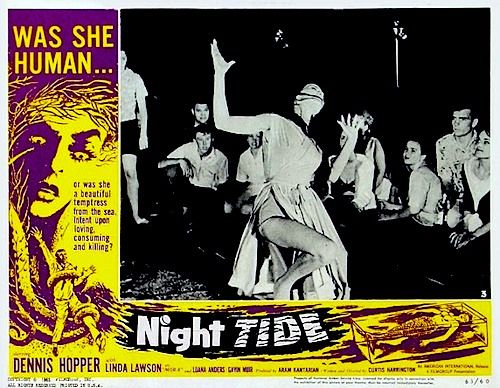
Long before he became Hollywood’s favorite quirky character actor, Dennis Hopper was a young performer who was known for his devotion to the method and for being more than a little difficult. In fact, directors like Henry Hathaway had gotten so frustrated with Hopper and his refusal to “compromise his art,” that, by the time the 1960s rolled around, Hopper had gone from being a promising young star to being virtually blacklisted. He had gone from scene-stealing turns in Rebel Without a Cause and Giant to struggling to get anyone at the major studios to even admit to knowing who he was.
Unable to get a job on a mainstream film, Hopper teamed up with another unconventional talent, director Curtis Harrington. A film critic-turned-experimental filmmaker, Harrington was talented but, like Hopper, he had a reputation for being an eccentric. An openly gay artist who was living and working a time when that was still a crime in some states, Harrington gravitated to other outsiders so it was perhaps inevitable that he and Dennis Hopper would become early collaborators and make a film together.
That film was 1961’s Night Tide. Harrington directed while Hopper played Johnny, a naïve young sailor who, while in on leave in Santa Monica, meets a mysterious woman named Mora (Linda Lawson). Mora works as a mermaid at a sideshow. Her boss is the overly possessive and somewhat brutish Captain Samuel Murdock (Gavin Muir). Captain Murdock makes it clear that he doesn’t want Johnny to have anything to do with Mora. Is it because he’s worried about losing Mora or is there another, more supernatural reason?
Johnny hears rumors that the men who fall in love with Mora tend to disappear. Mora, herself, explains that she’s a Siren. Her destiny is to lead sailors to their doom. Johnny tells her that’s ridiculous but what if she’s right?
It’s a strange film, one that moves at its own slow and rather deliberate pace. As Mora, Linda Lawson delivers her lines hesitantly, as one might expect from someone who is having to pretend to be a human being. Meanwhile, Dennis Hopper gives a compelling but nervous performance as Johnny. As written, Johnny is a pretty bland character but Hopper plays up Johnny’s sense of isolation. He’s far from home, he doesn’t know many people in town, and the woman he loves just explained that she’s a sea monster. One can understand why Johnny is a bit jumpy. There’s a few scenes where Hopper’s devotion to the method works against him. He’s convincing when he’s at the center of the scene but a bit too fidgety in the scenes where he just has to listen to other people speak. But, ultimately, Hopper’s performance works. He plays Johnny with a mix of fresh-faced innocence and hints of instability.
As I said, it’s not a conventional film. It moves at its own dream-like pace. The film was shot in black-and-white and that’s the version to see. Avoid the colorized version, in which the colors are so garish that they ruin the film’s surreal atmosphere. Night Tide is an experiment that won’t be for everyone but, when taken on its terms, it’s definitely intriguing.
 Through the Shattered Lens