Musical Film Review: National Lampoon’s Lemmings (directed by Michael Keady)


“Welcome to the Woodchuck Music Festival, three days of peace, love, and death.”

Your emcee is a bearded John Belushi and, in between warning the audience about spiked drugs and encouraging the people climbing the sound tower to jump off from the high spot possible, he introduces several musical acts.  Christopher Guest appears as Bob Dylan, repeatedly walking to and then retreating from the stage until Belushi produces enough money to convince him to perform a song called Positively Wall Street.  Introduced as the ultimate “bummer” by Belushi, Joan Baez (Rhonda Coullet) comes out on stage with a baby and rambles about her imprisoned husband David (whose hunger strike was so successful that he and the inmates of Cell Block 11 have all starved to death) before singing a protest song with a title that I can’t repeat.  Joe Cocker (Belushi) sings while shaking on stage.  James Taylor (Christopher Guest) attempts to perform but his band (including Belushi and Chevy Chase) are too zoned out on heroin to play their instruments.  The owner of Yasser’s Farm (played by Christopher Guest) comes out to praise everyone in the audience who has already died.  Finally, a heavy metal group called Megadeath (no, not that Megadeth!) come out on stage and turn up their amplifiers so loud that the entire audience dies at the end of their song.

An Off-Broadway production that premiered in 1973 and ran for over 300 performance, National Lampoon’s Lemmings has achieved legendary status amongst comedy nerds.  It’s rare that you read any history of Saturday Night Live, Second City, or This Is Spinal Tap without coming across a reference to Lemmings.  Along with satirizing Woodstock and the 60s counterculture in a way that probably few would have the guts to do today, the production features Belushi, Chase, and Guest before any of them became (however briefly) stars.  Fortunately, HBO — which started broadcasting a year before the premiere of Lemmings — filmed one of the stage shows.

Viewed today, Lemmings still carries a strong satiric bite.  Though Lemmings was clearly a 70s production, much of its humor still feels relevant today.  The vapid political posturing, the greed disguised as altruism, the audience blindly following their idols, there was little in Lemmings that one can’t see today just by spending a few minutes on social media.  Beyond the humor, though, Lemmings is a chance to see Belushi, Chase, and Guest as youngish men who had their entire lives ahead of them.  Chase is surprisingly likable, playing up his goofy physical comedy.  Guest disappears into each role that he plays, with his impersonation of Dylan being the clear highlight.  That said, Belushi is the clear star of the show, delivering the most absurd of lines with an engaging sincerity.  As I watched Lemmings, it was hard not to wonder what type of roles John Belushi would be playing today.  Would he still be doing comedy?  Would he have faded away?  Or, like Bill Murray (or, for that matter, Jim Belushi), would he now be appearing in a mix of comedic and serious roles?

We’ll never know.  But we’ll always have his performance as Joe Cocker.

Film Review: Stay Hungry (dir by Bob Rafelson)


In the 1976 film Stay Hungry, Jeff Bridges plays Craig Blake.

When we first meet Craig, he doesn’t have much of a personality, though we still like him because he’s played by Jeff Bridges.  Living in Alabama, he’s a young rich kid who, after the death of his parents, divides his time between his nearly empty mansion and his country club.  Craig suffers from a good deal of ennui and seems to spend a lot of time writing letters to his uncle in which he promises that he’s going to eventually get his life together.  Craig eventually gets a job at a real estate firm that is managed by Jabo (Joe Spinell).  We know that the real estate firm is shady because Joe Spinell works there.

Craig is assigned to handle the purchase of a small gym so that he can eventually close the place and allow it to be torn down to make room for an office building.  However, Craig soon falls for the gang of colorful eccentrics whose lives revolve around the gym and bodybuilder Joe Santo (Arnold Schwarzenegger, who gets an “introducing” credit, even though this was his fourth film).  The friendly Franklin (Robert Englund) is Santo’s “grease” man.  Anita (Helena Kallianiotes) is tough and can kick anyone’s ass.  The receptionist, Mary Tate (Sally Field), is a free spirit with whom Craig soon falls in love.  In fact, the only less than likable person at the gym is the former owner, Thor Erickson (R.G. Armstrong), a heavy-drinking perv who has a hole in the floor of his office that he uses to peek down at the women’s locker room.

There’s not much of a plot here.  Instead, the film plays out in a rather laid back manner, with Santo befriending Craig and showing him the joy of embracing life.  Arnold Schwarzenegger actually won an award (well, a Golden Globe) for his performance here and it must be said that he’s very good as the gentle and easy-going Santo.  Because he’s huge and he’s Schwarzenegger, we expect him to be intimidating.  Instead, he’s a soft-spoken guy who is quick to smile and who doesn’t even get upset when he finds out that Mary Tate and Craig are now involved.  There’s even a surprising scene where Joe Santo picks up a fiddle and starts playing with a bluegrass band.  Schwarzenegger is so likable here that it’s easy to wonder where his career might have gone if he hadn’t become an action star.  Even early in his career (and when he was still speaking with a very thick accent), Schwarzenegger shows off a natural comic timing.  He’s fun to watch.

In fact, he’s so much fun that the rest of the film suffers whenever he’s not onscreen.  The cast is full of talented people but the film’s loose, plotless structure keeps us from truly getting too invested in any of them.  (Santo is training for Mr. Universe so at least he gets an actual storyline.)  Sally Field and Jeff Bridges are cute together but their romance is never quite as enchanting as it seems like it should be.  The main problem with the film is that, when it ends, one still feels like Craig will eventually get bored with the gym and return back to his mansion and his country club.  One doesn’t get the feeling that Craig has been changed so much as Craig just seems to be slumming for the heck of it.

There are charming moments in Stay Hungry.  I’m a Southern girl so I can attest that the film captured the feel of the South better than most films.  If you’re a Schwarzenegger fan, you have to see this film because it really does feature Arnie at his most charming and natural.  Unfortunately, despite all that, the film itself never really comes together.

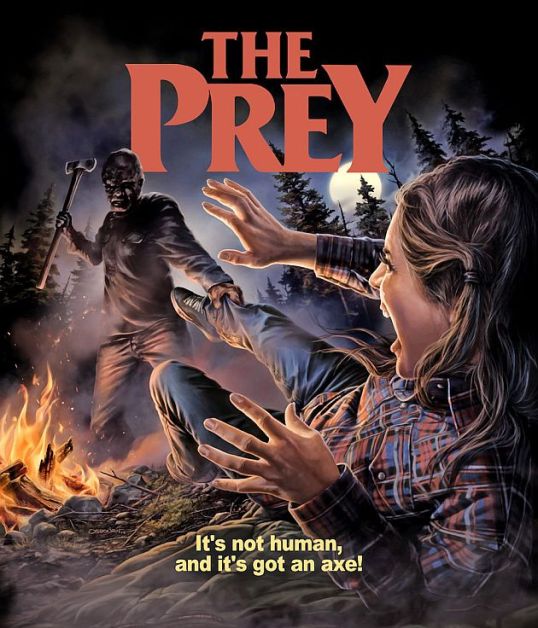
October Hacks: The Prey (dir by Edwin Brown)


The 1983 slasher film, The Prey, opens with a wildfire raging through the Rocky Mountains, destroying a community of people who lived in a cave.  32 years later, the only survivor of the fire (played by Carel Struycken, who would later be memorably cast on Twin Peaks as the “It is happening again” giant), wanders through the forest.  When he spots a middle-aged couple camping and tending to a campfire, the survivor snaps and kills them both.

The next morning, a van drives through the national park.  Inside the van are three young couples, Nancy (Debbie Thureson) and Joel (Steve Bond), Bobbie (Lori Lethin) and Skip (Robert Wald), and Gail (Gayle Gannes) and Greg (Philip Wenckus).  They are looking forward to a nice weekend of camping, sex, and mountain climbing.  The girls are especially happy when they meet the handsome local parker ranger, Mark O’Brien (Jackson Bostwick).  The couples head into wilderness, little realizing that they are being followed and watched by the murderous survivor.

Watching The Prey, I was reminded of why I don’t go camping.  I mean, I like looking at nature.  I like handsome park rangers.  There’s a sweet scene where Mark tells an extremely corny joke to a baby deer and it made me go, “Awwwwww!”  But seriously, I would never want to spend my night sitting around a campfire or sleeping on the ground.  Not only is the wilderness full of bugs but there’s always the danger of getting trapped in a sudden storm or some other natural disaster.  And I have to admit that I’m just not a fan of the way that people act while camping.  My fear is that, if I ever did go camping, I would end up with people shouting, “Go!  Go!  Go!’ at me.  If my camping companions insist on going mountain climbing, am I obligated to accompany them?  If one of them falls off the side of the mountain, that’s really going to ruin my weekend.

As for The Prey as a film, the plot is standard slasher stuff.  Attractive young people end up stranded out in the middle of nowhere and they are picked off, one at a time, by a monster who seems to take issue with anyone trying to have any fun.  That said, The Prey has enough strange moments to make it memorable.  With an 80-minute running time, The Prey is an oddly paced film.  (And yes, oddly paced does often translate to boring.)  The majority of the film is just made up with footage of the three couples walking through the forest and having conversations that were reportedly improvised by the cast.  (Gayle laughs as she talks about a time that she nearly drowned.)  The film is full of skewed camera angles that give the entire proceedings an off-balance feel and occasionally the action cuts away from the main characters to Mark playing a banjo or another park ranger (played by former Charlie Chaplin co-star Jackie Coogan) having a tense conversation with a policeman who calls to ask about the missing middle-aged couple.  The survivor doesn’t really go after the main couples until the film’s final 15 minutes and the pace suddenly quickens as if to mirror the relentless violence of the film’s killer.  The strange pacing and the weird details gives The Prey a dream-like feel and the ending, in which the survivor reveals that he has interests outside of killing, is fascinating in just how unexpectedly bizarre it is.

The Prey was undoubtedly made to take advantage of the popularity of other wilderness slasher films but it’s just weird enough to establish an identity of its own.

Film Review: The Connection (dir by Shirley Clarke)


1961’s The Connection opens with a title card and voice over from someone identifying himself as being J.J. Burden.  Burden explains that what we are about to see is the last known work of an aspiring documentarian named Jim Dunn.  Burden explains that, after he and Dunn filmed the footage that’s about to be shown, Dunn disappeared.  It was left to Burden to put the footage together and he swears that he has gone out of his way to stay true to Dunn’s intentions.

Of course, if you’ve watched enough old movies, you might recognize Burden’s resonate voice as belonging to the distinguished actor, Roscoe Lee Browne.  And, once the film starts, you may also notice that you’ve seen Jim Dunn in other movies.  That’s because Dunn is played by William Redfield, a character actor who specialized in playing professional types.

The Connection takes place in a New York loft.  A group of jazz musicians are waiting for their drug dealer.  Sometimes, they play music.  Sometimes, they look straight at the camera and answer questions about what it’s like to be a heroin addict.  While Burden always remains behind the camera, Jim Dunn occasionally steps in front of it and scolds the men for not being dramatic enough.  Dunn is attempting to stage reality.  Leach (Warren Finnerty), the most verbose of the addicts, taunts Dunn over never having done drugs himself.  Dunn jokingly says that maybe he could start with some marijuana.

This is no Waiting for Godot.  The dealer does eventually arrive.  His name is Cowboy and he’s slickly played by Carl Lee.  (Carl Lee was the son of Canada Lee, who appeared in Hitchcock’s Lifeboat.  Sadly, 25 years after filming his role in The Connection, Lee would die of a heroin overdose.)  He’s accompanied by a flamboyant woman named Sister Salvation (Barbara Winchester).  As Burden films, the musicians enter a small bathroom one-by-one, so that they can shoot up.  Music is played.  Overdoses are dealt with.  And Dunn, who was originally so detached, becomes more and more drawn into the junkie life style…

Was The Connection the first mockumentary?  To be honest, I’m really not sure but it definitely has to be one of the first.  The beginning title card (and Burden’s narration) feels like it could easily be used in front of any of the hundreds of found footage horror films that have been released over the last few years.  The film itself makes good use of the found footage format, though it’s also trapped by the genre’s limitations.  With all of the action taking place in just one room, there’s no way that The Connection can’t feel stagey.  (And, indeed, it was based on a play.)  Along with detailing the lives of those on the fringes of society, The Connection makes some good points about the staging of reality, though it never goes quite to the lunatic extremes of Ruggero Deodato’s Cannibal Holocaust.

(The Cannibal Holocaust comparison is not as crazy as it may sound.  Much as how the arrogant filmmakers in Deodato’s film attempted to exploit the cannibals, Jim Dunn attempts to exploit the addicts.  When the addicts and Cowboy start pressuring Dunn to try heroin, it’s not that much different from the cannibals eating the cameraman in Cannibal Holocaust.  The exploited are getting their revenge.)

The Connection was the first dramatic film to be directed by documentarian Shirley Clarke and, like many of Clarke’s films, it struggled to find an audience.  (Both the film and Clarke would have to wait several decades before getting the recognition that they deserved.)  The subject matter was considered to be so sordid (and the language so shocking) that the film was originally banned in New York.  The filmmakers actually had to file a lawsuit to get the film released.  The New York State Court of Appeals ruled the film was “vulgar but not obscene.”

Seen today, the film seems to be neither vulgar nor obscene.  Instead, it seems like a time capsule of the era in which it was made.  We tend to think of the early 60s as a time of beach movies, drive-ins, early rock and roll, and Kennedy optimism.  The Connection reveals that there was a lot more going on than just that.