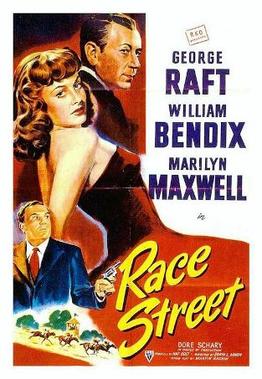
An Offer You Can’t Refuse: Race Street (dir by Edwin L. Marin)


The 1948 film noir, Race Street, tells the story of what happens when the mob comes to San Francisco.

Led by the ruthless Phil Dickson (Frank Faylen, who you might recognize as Ernie the Cab Driver from It’s a Wonderful Life), the mob is looking to move in on San Francisco’s bookmaking rackets.  Dickson wants all of the bookies to pay him for protection.  Of course, he knows that he’s going to have a hard time convincing some of them to go along with his plans so he comes up with the brilliant idea of making an example of one bookie.  He sends two of his men to talk to a small-time bookie named Hal Towers (Harry Morgan).  They tell Hal that he can either pay Phil or he can suffer the consequences.  Hal says that he’ll suffer the consequences so they promptly through him down a flight of stairs, killing him.

When Hal’s best friend, nightclub owner Dan Gannin (George Raft), discovers what has happened, he swears that he’s going to get revenge.  Even after Dickson’s men abduct Dan and give him a brutal beating, Dan remains committed to getting justice for Hal.  Lt. Barney Runson (William Bendix), who has been Dan’s best friend since childhood, tries to convince Dan to let the police handle it.  He even tries to get Dan’s sister, Elaine (Gale Robbins) and Dan’s mysterious girlfriend, Robbie (Marilyn Maxwell), to convince him to back off but Dan won’t hear of it.  Of course, because this is a film noir, Robbie has secret of her own….

Race Street is a low-budget noir that only has a running time of 79 minutes but still somehow finds time to sneak in a few musical performances from Gale Robbins.  When the film first started, I have to admit that I wasn’t expecting much.  George Raft seemed bored with his role and William Bendix’s opening narration didn’t fill me with much confidence.  However, it didn’t take long for the film to win me over.  Harry Morgan, for instance, brought a lot of wounded dignity to his relatively small role and his monologue before his murder is surprisingly moving.  Frank Faylen was cast against type as the evil mobster but it worked.  Seeing the normally amiable Faylen threatening to kill people was a good reminder that not all monsters look like monsters.  Some of them look like the friendly Bedford Falls cab driver.  As befits a film noir, the film is full of ominous shadows and sudden bursts of violence.  The scenes where Hal is murdered and Dan is beaten both stand out as being perhaps a bit more brutal than one might expect a film from 1948 to be.

Race Street is a minor noir but aficionados of the genre should enjoy it.  This is a short and no-nonsense film that gets the job done.  It’s an offer you should not refuse.

Previous Offers You Can’t (or Can) Refuse:

  1. The Public Enemy
  2. Scarface
  3. The Purple Gang
  4. The Gang That Could’t Shoot Straight
  5. The Happening
  6. King of the Roaring Twenties: The Story of Arnold Rothstein 
  7. The Roaring Twenties
  8. Force of Evil
  9. Rob the Mob
  10. Gambling House

Lisa Cleans Out Her DVR: The Girl In the Red Velvet Swing (dir by Richard Fleischer)


(Lisa is currently in the process of cleaning out her DVR!  How long is it going to take?  Forever!  For instance, she recorded 1955’s The Girl In the Red Velvet Swing off of FXM on February 1st and has now gotten around to actually watching and reviewing it.)

The story of Evelyn Nesbit is an interesting one, even if it is now a largely forgotten one.

In 1901, Evelyn Nesbit was a showgirl in New York City.  While she always claimed that she was 16 at the time, there are some historians that think it more likely that she was only 14.  One night, the beautiful Evelyn was introduced to Stanford White.  At the time, White was 47 years old and the most successful and prominent architect in New York City.  White was also a notorious womanizer and Evelyn soon became his latest mistress.  He moved her into one of his many apartments.  Years later, when the details of their relationship became public knowledge, people were shocked to hear that Stanford White kept a red velvet swing in the apartment and that he enjoyed watching Evelyn swing back and forth.  They would be even more scandalized by the news that Stanford also had a “mirror room.”  As Evelyn would later testify, she “entered the room a virgin” but did not come out as one.

Though Evelyn occasionally claimed that she and Stanford were truly in love, she never married him.  (Indeed, Stanford White apparently never married anyone over the course of his life.)  Instead, she ended up meeting and marrying Harry K. Thaw.  Harry was the heir to a 40 million dollar fortune.  He also had a long history of mental illness.  When he learned that, before meeting him, Evelyn had lost her virginity to Stanford White, he was outraged.

(It’s debatable how well Stanford and Harry knew each other.  Some historians claim that they were barely acquainted.  Other accounts claim that Harry and Stanford were business rivals even before Evelyn Nesbit arrived in New York.)

In 1906, Harry and Evelyn ran into Stanford White at Madison Square Garden.  Harry promptly pulled out a pistol and, in front of hundreds of witnesses, shot Stanford dead.

Harry’s subsequent trial was reportedly the first to ever be described as being “the trial of the century.”  Because hundreds of people had seen Harry Thaw shoot Stanford White and the Thaw family was adamant about not publicizing Harry’s history of mental illness, Harry’s defense team attempted to make the trial about Stanford White.  The defense attempted to portray Stanford as being such a depraved predator that Harry really had no other option but to shoot him in cold blood.  Evelyn took the stand and testified to every single detail of her relationship with Stanford White.  The details appeared in every major newspaper in America.

In the end, Harry was found not guilty by reason of insanity and was committed to the  Matteawan State Hospital for the Criminally Insane.  (Reportedly, due to his great wealth, he had the best room in the hospital.)  Meanwhile, Evelyn became one of America’s first reality stars.  Her notoriety led to her appearing in several silent films.  It’s a fascinating story, one that very much feels ahead of his time.  If Evelyn was a star in 1906, just imagine how famous she would be today.

The Girl in the Red Velvet Swing is about Evelyn Nesbit and her relationships with both Stanford White and Harry Thaw.  It’s a shame that the film isn’t as interesting as the real life story.  Ray Milland plays Stanford White.  Farley Granger is Harry Thaw.  Joan Collins is Evelyn Nesbit.  They all give good performances, especially Farley Granger.  But the film itself is just so bland.  Perhaps because it was made in the 1950s, it leaves out the majority of the sordid details that made the story so fascinating to begin with.  For instance, the red velvet swing appears but, in this film, no time is spent in the mirror room.  This true life story is pure tabloid material but The Girl In The Red Velvet Swing is way too respectful for its own good.  By refusing to come down firmly on the side of Harry Thaw or Stanford White, the film feels shallow and a bit empty.  (All good melodramas — even fact-based ones — need a good villain.)  And poor Evelyn Nesbit!  In real life, she was a savvy self-promoter who knew exactly how to manipulate the press.  In this film, she’s just an innocent ingenue.  Considering the facts of the case, the film version is unforgivably dull.

So, I don’t recommend The Girl In The Red Velvet Swing but I do recommend Paula Uruburu’s fascinating 2008 biography, American Eve: Evelyn Nesbit, Stanford White, The Birth of the ‘It’ Girl, and the ‘Crime of the Century.’  It goes into all of the fascinating details that were left out of this film.