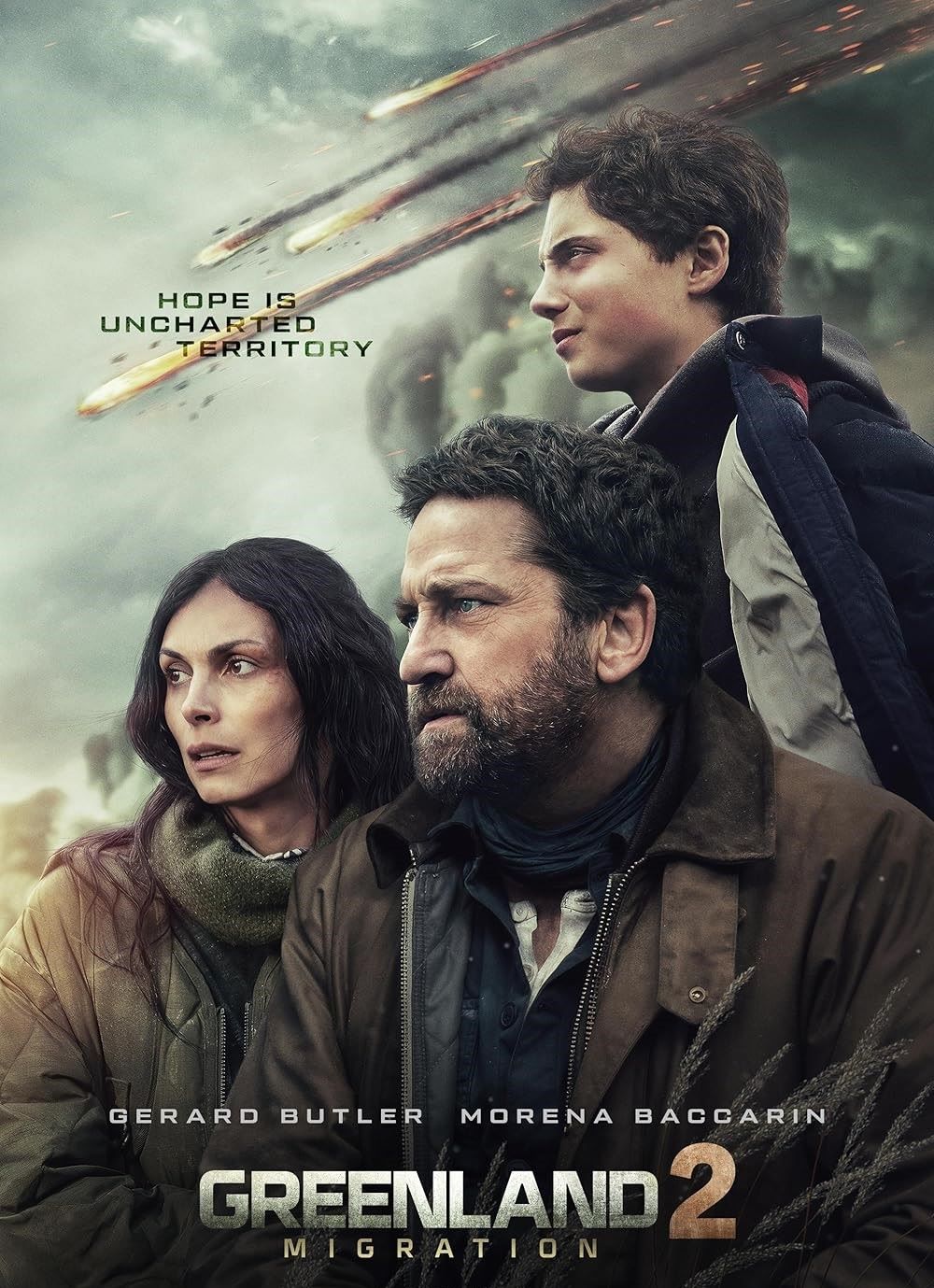
Greenland 2: Migration is a sequel that mostly leans into “if it ain’t broke, don’t fix it,” for better and for worse. It delivers sturdy spectacle, a committed Gerard Butler, and a tense family-through-hell journey, but it also rehashes a lot of the first film’s beats and pushes the plausibility envelope more often this time around. If you were on board with Greenland as a grounded, human-scale disaster movie, this one feels like the more bombastic, road-movie expansion pack rather than a full evolution.
Set about five years after the comet strike that wiped out most of civilization, Greenland 2: Migration finds the Garrity family still holed up in the Greenland bunker complex, part of a fragile community waiting for the surface to become livable again. John (Gerard Butler) now works as a scout/engineer, Allison (Morena Baccarin) has stepped into more of a leadership role within the bunker, and their son Nathan is older, restless, and itching to prove himself outside the relative safety of underground life. When escalating quakes, electromagnetic storms, and general planetary chaos literally collapse the bunker around them, the film quickly turns into a survival trek across a devastated Europe toward the Clarke impact crater in southern France, rumored to be the one spot on Earth that has actually healed.
As a premise, the film works; it gives the story a clear A-to-B structure and justifies the shift from the contained panic of the first movie to a post-apocalyptic road odyssey. The script keeps the stakes straightforward: reach the crater region or die trying, while dodging unpredictable weather events, territorial military forces, and desperate survivors who are just as dangerous as the environment. There is something appealingly old‑school about how it plays as a throwback survival picture—less interested in intricate worldbuilding and more in reaction, improvisation, and narrow escapes.
The downside is that you can feel the film constantly echoing Greenland’s structure: another long, peril-filled journey, another series of escalating close calls, another parade of briefly sketched side characters who exist to either help or threaten the Garritys for a single sequence. The first film had novelty on its side and a sharper sense of dread as the comet approached; here, the formula is familiar enough that you can often tell who will live, who will die, and roughly when another set piece is about to kick off. That predictability doesn’t kill the tension outright, but it does flatten the emotional peaks, especially if you walked in hoping for a genuinely new angle on this world.
Gerard Butler remains the anchor, and this is squarely in his comfort zone. He plays John as perpetually exhausted yet stubbornly practical, the kind of guy who will grumble his way through heroism, and there’s an easy, weathered charm to that. Morena Baccarin gets a bit more agency this time, with Allison often driving decisions instead of just reacting to them, though the movie still stops short of really turning her into a co-lead with equal interiority. Roman Griffin Davis steps in as the older Nathan, and he brings a nervous, teenage energy that fits the “kid who grew up in a bunker and wants to see the world” vibe, even if the character’s arc hits pretty familiar notes about bravery and responsibility.
The script does flirt with heavier themes: the psychological toll of surviving the end of the world, the guilt of those who made it into the bunkers versus those left outside, and the question of what “home” even means when the planet itself has effectively turned against you. There are moments—like the chaotic clashes around remaining bunkers or the wary interactions with other survivor groups—that suggest a more morally murky, Children of Men‑style story lurking underneath. But the movie rarely lingers on these ideas; it tends to touch them, nod, and then hurry back to the next escape sequence or visual spectacle.
Visually, though, Greenland 2: Migration is where the sequel justifies its existence. Director Ric Roman Waugh and the crew make great use of European locations and Icelandic landscapes to sell a world that has been carved up by tectonic violence and choked with ash, but is slowly, unevenly rebuilding. The dried-out English Channel, the ravaged coastlines, and the eerie, storm‑lit skies give the film a distinct apocalyptic texture that feels different enough from the North American focus of the first movie. While some of the physics and survival odds strain credibility—especially as the Garritys walk away from setpiece after setpiece—there’s no denying the spectacle is engaging on a big screen.
The pacing is generally brisk; at around an hour and a half, the film doesn’t overstay its welcome, and it’s usually onto the next problem before you have time to overthink the last one. That said, the middle stretch starts to feel a little modular, like a video game where each region is an encounter: Liverpool bunker standoff, English Channel crossing, roadside bandits, insurgent ambush, and so on. Each of these sequences is competently staged, but because the emotional throughline is fairly simple—protect the family, get to the crater—the movie risks becoming a string of obstacle courses rather than a journey that deepens the characters in meaningful ways.
Where the film does land emotionally is in its treatment of sacrifice and the long-term cost of survival. John’s cumulative radiation exposure, picked up over years of scouting the hazardous surface, is a smart, quietly tragic detail, and the way the story gradually brings that to the forefront gives the third act a genuine sense of finality. The losses along the way, including allies who join the trek and do not make it, often feel a bit telegraphed, but they at least reinforce the idea that survival in this world comes with a steep bill that keeps coming due. The film’s ending, at the Clarke crater, delivers a cautiously hopeful image without completely sugarcoating what it took to get there, and that balance of bleakness and optimism fits the series well.
On the more mechanical side, the editing and sound design do a lot of heavy lifting. The cross‑cutting in the disaster scenes keeps geography mostly clear, and the low, grinding rumble of shifting earth and sudden storms adds tension even when the visuals are mostly people running or driving. The score is functional rather than memorable, but it meshes with the film’s focus on constant forward momentum instead of big thematic musical statements. It’s the kind of craft that doesn’t call attention to itself, which suits a movie that wants to feel like a direct, unpretentious survival yarn.
In terms of how it stacks up to the original, Greenland 2: Migration is solid but clearly a step less distinctive. The first film surprised people by grounding its spectacle in everyday logistics—pharmacy runs, traffic jams, family arguments—and by keeping the camera mostly at human scale during an extinction‑level event. The sequel, by comparison, nudges closer to standard disaster‑franchise territory: bigger vistas, more action, and a stronger sense of franchise‑building, but less of that “this could be you and your neighbors” feeling that made Greenland stand out. Depending on what you want from a sequel, that may be a selling point or a letdown.
Overall, Greenland 2: Migration is a competent, occasionally affecting continuation that doesn’t embarrass the original but also doesn’t redefine it. If all you’re looking for is another round of grounded‑ish apocalypse survival with Gerard Butler grimly shepherding his family through increasingly wild scenarios, this delivers exactly that, with a few striking images and some sincere emotional beats along the way. If you were hoping for a more daring thematic leap or a significantly different narrative shape, this will probably feel like a polished retread with a new coat of ash and ice. Either way, it’s an easy recommendation for fans of the first film and a decent mid‑winter disaster flick for anyone in the mood to watch people crawl through the end of the world one more time.
 Through the Shattered Lens