Lisa Reviews An Oscar Nominee: In Which We Serve (dir by Noel Coward and David Lean)


“This is the story of a ship….”

The 1942 British war film, In Which We Serve, opens with footage of the HMS Torrin, a destroyer, being constructed in a British shipyard.  When the Torrin is finally finished, the men who worked on it cheer as it leaves on its maiden voyage.  The film then abruptly jumps forward to the year 1941.  The Torrin is sinking, the victim of German bombers.  The surviving members of her crew float in the ocean, holding onto debris and watching as their home for the past few years capsizes and slowly goes underneath the surface of the water.  Even as the Torrin sinks, German planes continue to fly overhead, firing on the stranded men and killing several of them.

As the men fight to survive both the ocean and the Germans, they remember their time on the Torrin.  Captain Kinross (Noel Coward, who also wrote the script and co-directed the film) thinks back to 1939, when he was first given command of the Torrin.  He remembers the early days of the war and the time that he spent with his wife (Celia Johnson) before leaving to do his duty.  As the captain of the ship, Kinross was a tough but compassionate leader.  He expected a lot out of the men but he also came to view them as his second family.  Meanwhile, Shorty Blake (John Mills) thinks about his wife and his newborn son back in London.  Everyone on the Torrin has left their families behind.  Some of them even lose their loved ones during the war, victims of the relentless German Blitz.  But, even as they float in the ocean, everyone continues to fight on, knowing that there will be bigger ships to replace the Torrin and that Britain will never surrender.

In 1942, British film producer Anthony Havelock-Allan approached Noel Coward and asked him if he would be interested in writing the screenplay for a morale-boosting propaganda film.  Coward agreed, on the condition that he be given complete control of the project and that the film deal with the Royal Navy.  Though one might not immediately think that the author of drawing room comedies like Easy Virtue and Private Lives would be the obvious choice to write a war film, Coward’s family actually had a long tradition of serving in the Navy and Coward based a good deal of the film’s action on the wartime exploits of his friend, Lord Mountbatten.  Though there was initially some concern about Coward’s insistence that he should play the lead role on top of everything else, the Ministry of Information fully supported the production of In Which We Serve.

However, Corward knew that he would need help directing the film.  He asked his friend, John Mills, for advice and Mills suggested that Coward should bring in, as co-director, “the best editor in Britain,” David Lean.  Though Lean was initially only meant to handle the action scenes, Coward quickly discovered that he didn’t particularly enjoy all of the detail that went into directing a film.  As a result, David Lean ended up directing the majority of the film.  This would be Lean’s first film as a director and he would, of course, go one to become one the top British directors of all time.

(Also of note, frequent Lean collaborator Ronald Neame served as the film’s cinematographer.  Neame later went on to have his own career as a director.  In 1972, Neame directed another film about a capsized ship, The Poseidon Adventure.)

As for the film itself, In Which We Serve is an unapologetic propaganda film, carefully crafted to inspire the British people to support the war effort and also to win over the sympathy of American viewers.  (During the film’s production, America had finally entered the war but there were still skeptics, at home and abroad.)  Along with being a war film, In Which We Serve is also a rather touching and heartfelt tribute to the strength and determination of the British people.  Though it’s a rather grim film at times and it doesn’t shy away from the fact that lives are going to be lost in the battle to defeat Hitler, it’s also a rather inspiring film.  The sacrifice will be great, In Which We Serve tells us, but it will also be worth it.  The entire ensemble — including future director Richard Attenborough, making his film debut as a frightened sailor — does an excellent job of creating memorable characters, some of whom only appear for a few fleeting moments before meeting their fate.

In Which We Serve was a box office hit in both the UK and the US.  It was Oscar-nominated for Best Picture of the year, though it ultimately lost to another film about World War II, Casablanca.

Lisa Reviews An Oscar Nominee: 49th Parallel (dir by Michael Powell)


Hello and welcome to the TSL’s continuing coverage of Oscar Sunday!  Today, along with some other Oscar-related things, I’m going to post reviews of some of the films that have been nominated for best picture over the years!  Let’s start things off with the 1941 Best Picture nominee, 49th Parallel!

Before anything, I should clear up some confusion about this film.  This is a British film about Nazis trying to reach the border between Canada and the U.S.  When it was first released in the UK, it was named after the coordinates of the border.  However, in the actual film, the Nazis never actually go to the 49th Parallel.  Instead, the film concludes at Niagara Falls.  However, it was probably reasonable assume that British audiences would not necessarily know or care whether Niagara Falls was actually located on the 49th Parallel.  Considering that they were currently at war with Germany, they had more important things to concern themselves with.

However, it was apparently felt that American audiences would notice that Niagara Falls wasn’t actually located on the 49th Parallel.  (Personally, I think the British may have been giving us too much credit.)  So, when the film was released in the United States, the title was changed to The Invaders.  When the film was subsequently nominated for Best Picture, it was nominated under the name The Invaders.  I’ve actually come across some online sources that claim that The Invaders and 49th Parallel are two separate films.  No, they’re the same film, it’s just that the film in question has two different titles.  Out of respect to the people who actually made the movie, I’ve decided to use the original title in this review.

When watching 49th Parallel (it’s available on YouTube), it helps to know something about history.  Today, there’s a tendency to overlook the fact that World War II had already been raging for nearly two years before the United States got involved.  Though the U.S. was an ally to Britain, it remained officially neutral until the Japanese bombed Pearl Harbor.  Up until that moment, many prominent Americans were isolationists and took the attitude that the war was Europe’s problem.  (On the other hand, Canada, as a Dominion of the British Empire, followed Britain into the war in 1939.)  Though the 49th Parallel may have been a British film that was largely set in Canada, it was also meant to frighten Americans and hopefully bring them over to the British side.

(When interviewed about the film, screenwriter Emeric Pressbruger said, “”Goebbels considered himself an expert on propaganda, but I thought I’d show him a thing or two.”)

Directed by Michael Powell, 49th Parallel opens with a German U-boat creeping into the waters around Canada.  The Nazis are hoping to disrupt shipping operations but it turns out that they’re no match for the Royal Canadian Navy.  (GO CANADA!)  When the U-boat sinks into the Hudson Bay, only six Nazis manage to survive.  Led by the arrogant Lt. Hirth (Eric Portman), the Nazis attempt to make their way to the border and to the safety of America.

Of course, it doesn’t turn out to be an easy journey.  Not only are the Germans in an unfamiliar country but they also keep running into Canadians.  Without fail, nearly every Canadian they meet is polite but willing to fight and die for his country.  The Canadians themselves are played by actors who, in the 40s, would have been familiar faces.  Laurence Olivier plays a fur trapper, getting top-billing for his cameo appearance.  Raymond Massey, who was best known for playing Abraham Lincoln, shows up as a Canadian solider.  Leslie Howard is the writer who discovers that Nazis have no respect for art.  Anton Walbrook is a German-Canadian farmer who rejects the attempts of Lt. Hirth to bring him over to the Nazi side.  The Canadians are so sympathetic that one of the Nazis is even moved to reject the Third Reich and is promptly executed by his compatriots, showing the audience the foolishness of hoping that the “good Germans” would ever be able to overthrow the bad ones.

It’s pure propaganda but it’s anti-Nazi propaganda so that’s not really a problem.  Powell keeps the story moving at a steady pace and all of the actors get impassioned performances.  You can tell this movie was more than just a job for them.  Instead, it was their way of fighting for their country and hopefully inspiring others to join in the battle against Hitler.  The film is both a love letter to Canada and a plea to the United States to renounce neutrality.  (Interestingly enough, by the time 49th Parallel made it to U.S. screens, America had finally declared war on the Axis Powers.)

49th Parallel was nominated for best picture but it lost to another World War II propaganda film, Mrs. Miniver.

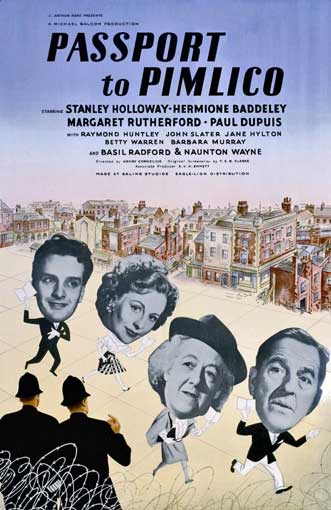
The Fabulous Forties #24: Passport to Pimlico (dir by Henry Cornelius)


Passport_to_Pimlico_film

The 24th film in Mill Creek’s Fabulous Forties box set was the 1949 British comedy, Passport to Pimlico!  Even though Passport to Pimlico is very much a British film (for instance, I had to use Wikipedia to discover the Pimlico is a neighborhood in London) and definitely a product of its time, it’s still a film that felt very relevant to some of the things that all of us in America are dealing with today.  If nothing else, Passport to Pimlico is definitely more memorable than Freckles Comes Home.

Passport to Pimlico opens in London.  World War II may be over but the city is still in the process of rebuilding.  War-time rationing is still in effect and all the residents of Pimlico regularly have to deal with the endless red tape of bureaucracy.  As well, there’s still unexploded German bombs littered around the neighborhood.  When a group of local children accidentally blow one of those bombs up, it leads to the discovery of a previously hidden cellar.  Inside the cellar is everything you could hope to find in a mysterious room: artwork, jewelry, and coins.  There’s also a parchment from the 15th Century, in which the king of England ceded the neighborhood to the final Duke of Burgundy.  Because no one knew that the charter existed, it has also never been revoked.  As a result, all of the citizens of Pimlico are actually citizens of dukedom of Burgundy.

That means two things: First off, the citizens are legally required to live under the laws of Burgundy, despite the fact that the dukedom no longer exists and those laws haven’t been changed since the 1400s.  Secondly, the neighborhood is no longer governed by the restrictive bureaucracy of postwar Britain.  In short, Pimlico — or Burgundy, as it is now called — is a free and independent state.

Soon, the nation of Burgundy is being overrun by greedy businessmen and enthusiastic shoppers.  The British respond by surrounding Burgundy with barbed wire and announcing that no one may cross the border.  The Burgundians react by demanding that anyone riding the underground through their country have a passport or run the risk being kicked off the train.

And things only escalate from there.  The British government is desperate to put Burgundy in its place while the citizens of Burgundy are determined to maintain their independence.  If Passport to Pimlico were made today, this is probably one of those situations that would either end in tragedy or with everyone learning not to question the whims of the government.  Fortunately, Passport to Pimlico was made in 1949 and, as a result, it is a genuinely warm-hearted comedy that celebrates both individual freedom and patriotism.

And really, it’s an enjoyable little film.  The cast is full of British character actors, all of whom deliver their dialogue with just the right amount of snark.  I enjoyed it and I have to admit that I related to it a bit.  As I look at America today and I think about what it’s going to be like in 2017 (regardless of who wins the presidential election because, let’s be honest, they all suck), there’s a part of me that would love a chance to get out of this country and be a Burgundian.

Seriously, come 2017, I’m seceding!

Until then, I guess I can just watch Passport to Pimlico.