Retro Television Review: The American Short Story #16 “The Jilting of Granny Weatherall”


Welcome to Retro Television Reviews, a feature where we review some of our favorite and least favorite shows of the past!  On Saturdays, I will be reviewing The American Short Story, which ran semi-regularly on PBS in 1974 to 1981.  The entire show can be purchased on Prime and found on YouTube and Tubi.
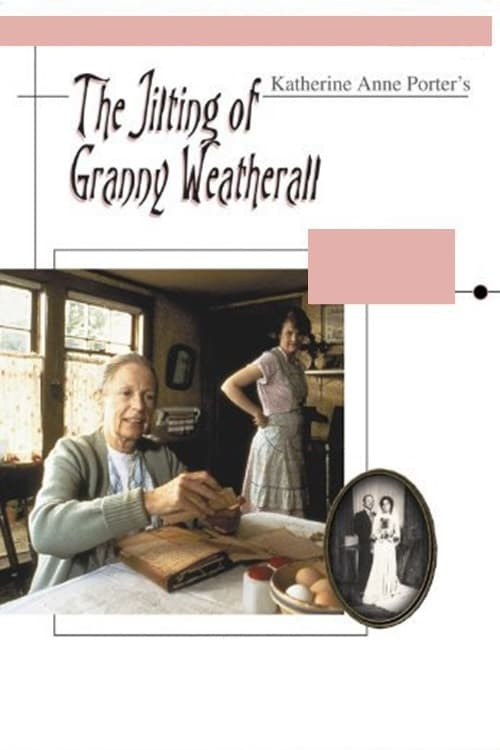
This week, The American Short Story adapts a short story by Katherine Anne Porter.

Episode #16 “The Jilting of Granny Weatherall”

(Dir by Randa Haines, originally aired 1980)

Granny Weatherall (Geraldine Fitzgerald) is dying.  While the doctor tries to comfort her and the priest tries to provide salvation, Granny obsesses on cleaning her house and getting everything in its proper place.  She thinks about how her adult daughter, Cornelia (Lois Smith), is incapable of keeping the house as clean as Granny Weatherall believes it should be.  Memories of the past and hallucinations of the present flood her mind and she remembers the time that she was jilted by a suitor and she thinks about how she has to live long enough to destroy the letters that he once wrote her.  But the coldness of death is always hovering in the background….

This episode moved a bit slowly but it was effective due to the performance of Geraldine Fitzgerald and also Randa Haines’s direction, which kept the viewer unsure of whether they were seeing reality or if they were just seeing Granny Weatherall’s dying thoughts.  The short story itself is written as a stream-of-consciousness and Haines does her best to capture that feeling in her adaptation.  One of the main problems with The American Short Story has been that most of the adaptations have struggled to capture the tone of the original stories.  The Jilting of Granny Weatherall’s visuals come very close to recreating the power of Katherine Anne Porter’s words.

Next week, The American Short Story wraps up with an adaptation of a James Thurber short story.
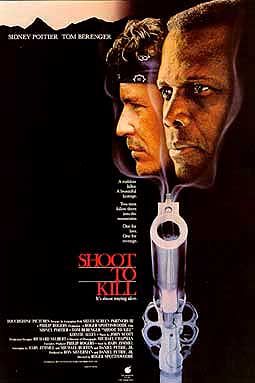
Film Review: Shoot to Kill (dir by Roger Spottiswoode)


I am not one for camping.

I’m actually kind of alone amongst my family as far as that’s concerned.  All three of my sisters enjoy spending the night outdoors, listening to sounds of nature and looking up at the stars.  They know how to set up tents and make campfires and they enjoy hiking and rafting and exploring the great outdoors.  Myself, I do enjoy occasionally spending the weekend up at Lake Texoma and I like the fact that, even though we live in the city, we still occasionally get to see wildlife running around.  I think possums are cute.  A few days ago, I squealed with delight when I saw that there was a raccoon hanging out in one of our backyard trees.  (“Don’t go near that thing, Lisa Marie!” Erin snapped as I reached for the den door.)  Growing up, I spent time in both the country and the city.  While I love living in the city, there’s still a part of me that’s still a country girl.  That said, I definitely prefer sleeping inside to outside.  The inside is safe.  The inside is comfortable.  The inside is free of creepy bugs that crawl on the ground.

Watching 1988’s Shoot to Kill definitely did not do much to change my opinion about camping.  In this thriller from director Roger Spottiswoode, Sidney Poitier plays Warren Stantin, an FBI agent who is obsessed with capturing a sadistic criminal who blackmails people into doing his work for him.  At the start of the film, the extortionist has forced a jeweler to break into his own jewelry store by taking the jeweler’s wife hostage.  Stantin’s attempt to capture the extortionist leads to the jeweler’s wife taking a bullet in the eye.  (AGCK!  Seriously, this guy is mean!)  Stantin traces the man to Washington State, where he discovers that the extortionist has committed another murder and stolen the victim’s identity.  The extortionist is now a member of a five-man fishing party that is being led by a local guide, Sarah Renell (Kirstie Alley).  Stantin teams up with Sarah’s partner, Jonathan Knox (Tom Berenger), and the two of them attempts to track down the group before the murderer among them makes his move.

The action cuts back-and-forth, between Sarah’s party and Knox and Stantin.  Most viewers will probably be able to quickly figure out which member of Sarah’s party is the killer but director Spottiswoode still creates a little suspense by casting actors like Richard Masur, Andrew Robinson, and Clancy Brown as the suspects.  All three of the actors have played their share of sinister characters.  (Andrew Robinson was the Scorpio Killer, for God’s sake!)  While Sarah leads the murderer though the wilderness, Knox teaches Stantin how to survive in the great outdoors.  As is typical with films like this, Knox and Stantin go from disliking each other to depending on each other.  Have you ever wanted to see Sidney Poitier get into a verbal altercation with a bear?  This is the film for you!

Shoot to Kill is a superior genre film.  The story’s predictable but it’s told so well that it doesn’t matter.  Kirstie Alley, Tom Berenger, and Sidney Poitier all give good performances as sympathetic characters.  As for the actor who turns out to be the killer, he gives a performance that is, at times, absolutely terrifying.  Shoot to Kill is an entertaining thriller.  Just don’t watch it if you’re going camping the next day.

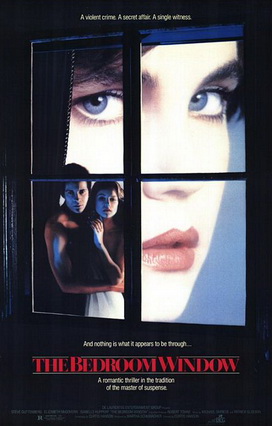
A Movie A Day #349: The Bedroom Window (1987, directed by Curtis Hanson)


The Bedroom Window opens with quite a quandary.  Sylvia (Isabelle Huppert) has just witnessed a woman named Denise (Elizabeth McGovern) being attacked by a serial rapist/killer named Carl (Brad Greenquist).  The problem is that the window that Sylvia’s standing at is located in the bedroom of Terry Lambert (Steve Guttenberg).  Sylvia is having an extramarital affair with Terry and she knows that there’s no way to tell the police what she saw without also exposing the affair.  Terry decides that he’ll go to the police and tell them what Sylvia witnessed but he will claim to have seen it himself.

Terry does well enough with the police that Carl gets arrested but, at Carl’s trial, Terry’s testimony falls apart when he is revealed to be so near-sighted that there was no way he could have seen what happened from his bedroom window.  Carl is not only acquitted but has now figured out that Sylvia was the one who witnessed him attacking Denise.  When the killings start up again, Terry becomes the number one suspect.

An underrated and overlooked thriller, The Bedroom Window was directed by the late and missed Curtis Hanson.  It’s not a perfect film.  Terry does an excessive amount of stupid things over the course of the movie.  But Hanson did a good job creating suspense and he got good performances from his entire cast.  Steve Guttenberg may seem like a strange choice to play the lead in a Hitchcockian thriller but he actually gives a credible performance and the fact that he is not a traditional hero creates some suspense.  Brad Greenquist is chilling as the killer and keep an eye out for the great Wallace Shawn in the role of Carl’s weaselly attorney.