Film Review: The Loves of Edgar Allan Poe (dir by Harry Lachman)


I have to admit that the 1942 film, The Loves of Edgar Allan Poe, turned out to be far different from what I was expecting.

Just based on the title, I was expecting it would be a highly fictionalized, borderline silly film about Edgar Allan Poe defeating his romantic rivals and winning the hand of the woman he loved while still finding time to write The Raven.  I figured that there would be at least a few gentlemanly fisticuffs, with Poe portrayed as a combination of Rhett Butler and Cary Grant.  Looking at the title, it was easy for me to imagine the film closing with Poe kissing his future wife and then looking straight at the camera.  “Quoth the Raven!” he would say and wink while romantic music swelled in the background…

But no.  The Loves of Edgar Allan Poe is actually a very conventional biopic.  With a running time of only 67 minutes, the movie often feels rather rushed but it still manages to include most of the better known details of Edgar Allan Poe’s short but eventful life.  (An ever-present narrator is always ready to fill us in on every thing that happens off-screen.)  The film doesn’t spend much time on what initially inspired Poe’s macabre imagination.  There’s a scene of Poe, as a child, standing on a desolate hill and looking at a raven perched in a dead tree.  With the exception of an extended section that deals with Annabel Lee, that’s about as deep as the movie is willing to get as far as Poe’s art is concerned.

When Poe grows up, he’s played by actor Sheppard Strudwick, who has a good mustache but never exactly comes across as being the type of tortured genius who would eventually end up both revolutionizing literature and drinking himself to death.  The majority of the film deals with Poe’s advocacy for copyright reform, which is an important issue but not exactly the most cinematic of concerns.  Poe survives college.  Poe tries to sell The Raven for $25.  Eventually, Poe marries Virginia Clemm (Linda Darnell) and her subsequent sickness and death leads to not only Poe’s greatest work but also his own tragic end.

Along the way, Poe meets both Thomas Jefferson and Charles Dickens.  Jefferson shows up long enough to tell a young Poe that he’s a good writer and that he needs to stop gambling.  Dickens meets Poe and encourages him to continue to advocate for better copyright laws.

It is known that Poe and Dickens actually did meet but did Poe also meet Thomas Jefferson?  Legend says that he did but no one knows for sure.   Here’s what we do know:

Poe attended the University of Virginia in 1826.  The University’s founder, former President Thomas Jefferson, was still alive in 1826 and would often invite promising students to Monticello.  Whether Jefferson was still doing that when Poe enrolled at the University of Virginia is questionable.  Jefferson died five months after Poe started his studies.

As for Dickens, Charles Dickens and Edgar Allan Poe admired each other’s writing and they met in Philadelphia during Dickens’s 1842 tour of North America.  No record has been kept of what they discussed, though some think that Dickens told Poe about his pet raven and perhaps inspired Poe’s best-remembered poem.  In the movie, they discuss copyright laws, which is nowhere near as much fun.

(When it comes to Poe’s meetings with both Jefferson and Dickens, it is perhaps best to remember the lesson of The Man Who Shot Liberty Valance and print the legend.)

The Loves of Edgar Allan Poe is a very short film and an obviously low-budget one as well.  When the presence of that somewhat pedantic narrator, The Loves of Edgar Allan Poe feels more like an educational special than a real movie.  It’s an okay introduction to Poe’s life but, ultimately, the best way to get to know Edgar Allan Poe is to sit down and start reading.

The Fabulous Forties #48: Pot O’ Gold (dir by George Marshall)


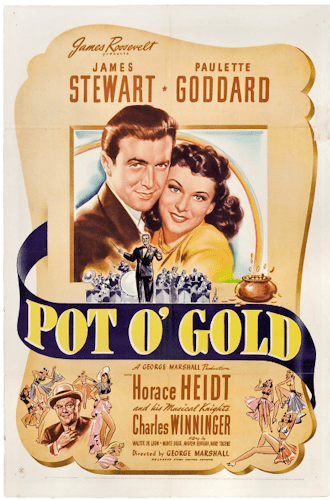
Pot_o_Gold-_1941-_Poster

The 48th film in Mill Creek’s Fabulous Forties box set was 1941’s Pot O’ Gold.  At first, I was really excited about watching Pot O’ Gold because it starred James Stewart, one of my favorite of the Golden Age stars.  “Wow,” I thought, “James Stewart never made a bad movie!  This is going to be great!”  However, before watching the film, I looked Pot O’ Gold up on Wikipedia and I discovered that apparently, James Stewart considered Pot O’ Gold to be the worst film that he ever made.

After having watched the film, I think that Jimmy may very well have been correct in his assessment.

Pot O’ Gold is a musical comedy.  Stewart plays Jimmy Haskell, the owner of a music store.  Jimmy loves music but he’s a terrible businessman.  Despite the fact that his store always seems to be full of quirky characters playing musical instruments, it still goes out of business.  Jimmy is forced to go to work for his uncle, C.J. Haskell (Charles Winninger).  C.J. not only owns a health food company but he also produces a radio show.

And, on top of all that, C.J. hates music!

Unfortunately, considering how much C.J. hates music, he lives right next door to the McCorkles, a family of Irish musicians.  The McCorkles are constantly practicing in front of C.J.’s store and, as a result, C.J. is constantly forced to call the cops to make them go away.

When Jimmy first arrives at the store, he befriends the McCorkles.  He even falls in love with Molly McCorkle (Paulette Goddard).  Unfortunately, none of the McCorkles know that he is C.J.’s nephew and C.J. doesn’t know that his nephew secretly continues to love music.  Meanwhile, C.J. is trying to catch the mysterious person who threw a tomato at him.  What he doesn’t realize is that the tomato was thrown by … JIMMY!

And it just keeps going on and on from there.  C.J. conspires to get rid of the McCorkles.  Jimmy tries to bring peace between the two sided without the Molly discovering that he’s related to C.J. and without C.J. realizing that Jimmy threw that tomato.  Jimmy eventually goes on C.J.’s radio show and soon, he’s using the show as a way to give away money to the needy.  Meanwhile, he struggles to forge peace between the McCorkles and C.J. without Molly discovering his true identity and without C.J. finding out he threw that tomato.  Will C.J. ever learn to love music and will it ever occur to anyone that this whole mess could easily be resolved by everyone making an effort not to randomly break out into song every time C.J. happens to be walking down the street?

Pot O’ Gold is an amazingly silly movie and I don’t mean silly in a good way.  This is one of those films where every issue could be resolved if people just showed a little intelligence.  It’s also a movie where everyone breaks into song every few minutes.  The key to a successful musical is that the songs have to feel like the grow organically out of the action.  The songs in Pot O’ Gold feel like they’re just there to be there.

Personally, I think James Stewart is one of those actors who can make any movie worth seeing.  He is his normal, likable self in this film but Pot O’ Gold never seems worthy of his famous persona.

Incidentally, Pot O’ Gold’s credited producer was James Roosevelt, FDR’s wastrel son.  I don’t know how much he had to do with the actual production but I’ve always wanted an excuse to use the word “wastrel” in a review.

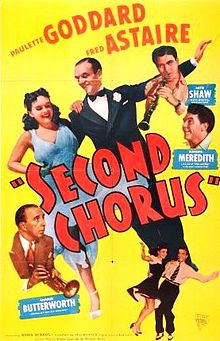
The Fabulous Forties #2: Second Chorus (dir by H.C. Potter)


I’m currently in the process of watching and reviewing all 50 of the films in Mill Creek’s Fabulous Forties DVD box set.  Yesterday, I got things started by reviewing Port of New York.  Today, I’m looking at the set’s 2nd film, 1940’s Second Chorus.

Second_Chorus_poster

As much as I love all of my Mill Creek box sets, watching Second Chorus reminded me of one of the drawbacks of watching a Mill Creek release.  Since Mill Creek specializes in films that have fallen into the public domain, a lot of their DVDs are more than a little rough.  The Mill Creek version was obviously transferred from a seriously deteriorated print.  As a result, the picture is often dark or blurry while the sound is occasionally iffy at best.  That’s a shame because Second Chorus is an entertaining little film.

In Second Chorus, Fred Astaire and Burgess Meredith both play college students.  (Burgess is the wacky one while Fred is … well, he’s Fred Astaire.  He’s confident, he’s suave, and he’s always ready to perform.)  Fred appears to be in his late 30s while Burgess looks closer to 50 but, fortunately, their age is meant to be a part of the joke.  Fred and Burgess have intentionally failed their final exams for seven years so that they can stay in school and continue to lead the college jazz band.  They are perennial college students and who hasn’t known a few of them?  (Apparently, in 1940, there was no such thing as academic suspension.)

When a debt collector comes looking for them (apparently, Burgess bought a set of encyclopedias that he never paid for), Fred manages to charm the collector’s secretary (Paulette Goddard) away from him.  Paulette agrees to serve as Fred and Burgess’s manager and even manages to get them a job with real-life band director Artie Shaw.  (Shaw plays himself and seems to be perpetually annoyed whenever he’s on screen.)  Will Fred finally accept some responsibility, act maturely, hold down a job, and maybe win the heart of Paulette Goddard?

Now, I should point out that, while I enjoyed Second Chorus, Fred Astaire apparently considered Second Chorus to be the worst film that he ever made.  While Second Chorus is definitely no Top Hat, I think that Fred Astaire was being a little too harsh in his assessment. The music is good, the dancing is fun to watch, and the plot … well, who really cares about the plot? It’s undoubtedly a silly film that has very little going on underneath the surface but Astaire and Meredith make for a surprisingly effective comedy team.

And while nondancer Paulette Goddard may not have had as effective a chemistry with Fred as Ginger Rogers (but then again, who did?), I still loved watching them perform the I Ain’t Hep To That Step But I’ll Dig It number.  This entire number was reportedly filmed in one take.  Goddard had little dance experience but it didn’t matter because her partner was Fred Astaire and Fred was so good that he could make anyone look like a natural.

Second Chorus is an entertaining little movie.  Just avoid the Mill Creek transfer.