Lisa Marie’s Six Favorite Charles Bronson Films


Brad listed his top Bronson films so I guess I should list mine!  Below are my six favorite Bronson films.  (Why 6?  Because Lisa doesn’t do odd numbers!)

Now, to make clear, I’m not the Bronson expert that Brad is so I will picking from a smaller pool of selections.  But no matter!  Let’s do this!
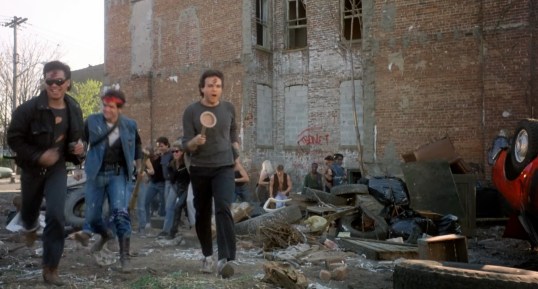
6. Death Wish III (1985, dir by Michael Winner) 

Yes, I have to start with Death Wish III.  The Death Wish sequels are definitely a mixed bag but Death Wish III was wonderfully over-the-top, a film that cheerfully dropped Bronson in the middle of an absurd circus and allowed him to tame the lions, as it were.  I will always love this film for the presence of Plunger Guy, a bad guy who heads into battle carrying a plunger.
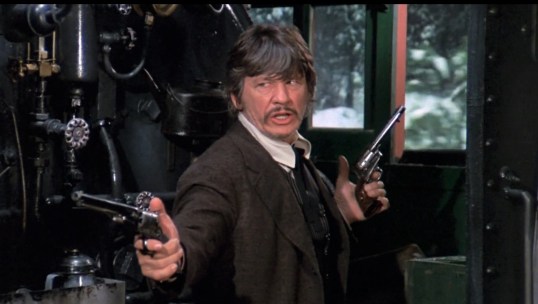
5. Breakheart Pass (1975, dir by Tom Gries)

This is an enjoyable mix of a western, a murder mystery, and an adventure film.  Charles Bronson is a mysterious man on a snowbound train.  Charles Durning, Ben Johnson, Richard Crenna, Jill Ireland, and Ed Lauter co-star and everyone — especially Johnson and Durning — bring a lot to their roles.  This may not be one of Bronson’s best-known films but it is one of his most enjoyable and Bronson himself is at his most likable.
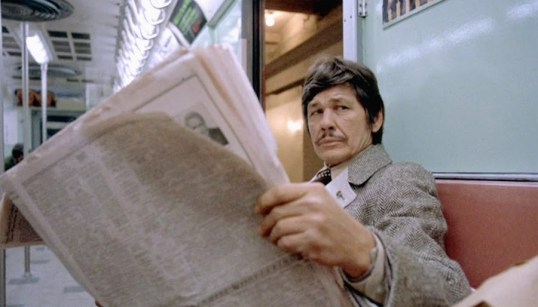
4. Death Wish (1973, dir by Michael Winner)

“My heart bleeds a little for the less fortunate,” Bronson’s Paul Kersey says at the start of the film and those of us watching immediately say, “C’mon, Charlie, really?”  That said, one reason why Death Wish works as well as it does is because Bronson actually gives a very good and very emotionally honest performance as a man who finally snaps and starts to take the law into his own hands.  (I love the barely veiled contempt that’s present whenever Paul talks to his son-in-law.)  Not surprisingly, considering that it was directed by Michael Winner, Death Wish is an often-sordid film that doesn’t have a hint of subtlety.  But it’s also brutally effective, a film that captures the way a lot of people feel when they hear about reports of out-of-control crime.  Even today, it’s easy to see why Death Wish was the film that finally Bronson a star in the United States.
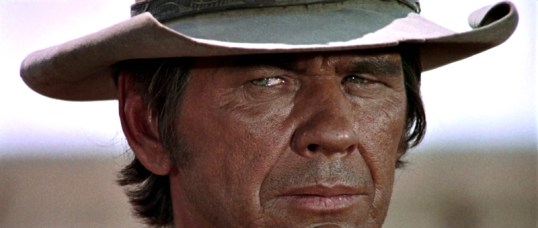
3. Once Upon A Time In The West (1968, dir by Sergio Leone)

Bronson plays Harmonica in the most epic of all of Sergio Leone’s spaghetti westerns.  Leone pays homage to the American western while also gleefully subverting it.  The quiet and unemotional Bronson is the film’s hero.  Henry Fonda is the sadistic villain who guns down a child.  Jason Robards is an outlaw.  While I don’t consider it to be quite as good as either The Good, The Bad, or the Ugly or Once Upon A Time In America, Once Upon A Time In The West is still one of Leone’s masterpieces.
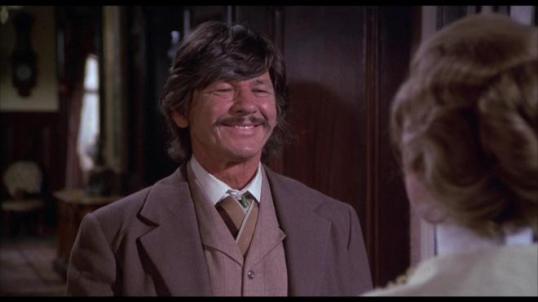
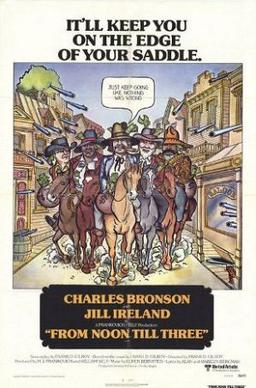
2. From Noon Till Three (1976, dir by Frank D. Gliroy)

For all of his reputation for being a tough guy who didn’t show much emotion, there was no denying Bronson’s love for his second wife, Jill Ireland.  From Noon Till Three brings Bronson and Ireland together in a film that is a third western, a third romantic comedy, and a third social satire.  It’s a film that gives Bronson a chance to show off his romantic side and it might leave you surprised!  The film also featured Jill Ireland’s best performance in a Bronson film.  I always highly recommend this one.  It’s proof that there was more to Bronson than just shooting the bad guys.
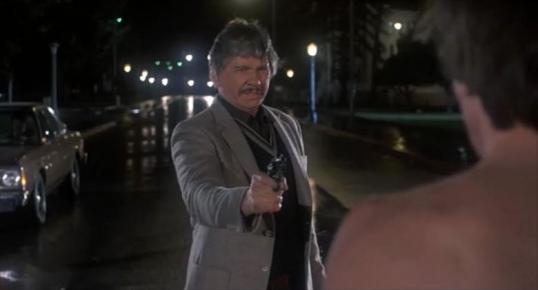
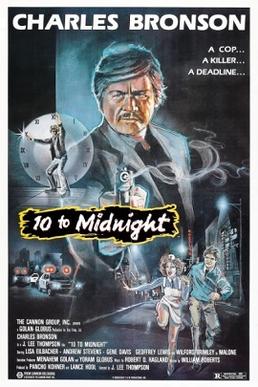
  1. Ten To Midnight (1983, dir by J. Lee Thompson)

This is the ultimate 80s Bronson film and one that I like for a reason that might surprise you.  On the one hand, you’ve got Bronson as a tough cop, Andrew Stevens as his liberal partner, and Gene Davis as the disturbingly plausible serial killer, Warren Stacy.  Bronson is great as the world weary cop.  His scenes with Stevens are amusing and, at times, even poignant.  (It helps that Stevens was the rare co-star that Bronson liked.)  Davis is terrifying and the film’s final moments are very emotionally satisfying.  (“No, we won’t.”)  But the reason why I love this film is because of the relationship between Bronson’s cop and his daughter, who played by Lisa Eilbacher.  Their scenes together — testy but loving — are well-acted by both actors and they always make me think of me and my Dad.  Ten To Midnight is the Bronson film that actually makes me cry.
FROM NOON TILL THREE (1976) – Charles Bronson, the comedian??!


During the height of his popularity in 1976, Charles Bronson tried something quite different with this romantic comedy costarring his wife Jill Ireland. And to be honest, he’s darn funny in the role.  This movie has grown on me over the years. 

Bronson plays Graham Dorsey, a bank robber who spends an afternoon with the lonely widow Amanda Starbuck (Ireland) while his gang is robbing a bank in town.  After his gang is all killed during the robbery, Dorsey must take off and go into hiding, eventually being arrested for impersonating a quack dentist. While he’s in jail, and through a variety of circumstances, a book is written about their afternoon together and it becomes an international sensation.  As soon as Dorsey gets out of jail, he goes back to Starbuck’s home to rekindle their affair. Unfortunately for Dorsey, the book has created such a legend of him and their affair that Ms. Starbuck doesn’t even recognize the man he really is.  His method of convincing her that he’s the “real” Graham Dorsey is the funniest moment in Bronson’s entire filmography. 

Charles Bronson & Jill Ireland are clearly having a wonderful time making this movie together, which is one of the main reasons I enjoy the film.  He may not have done it often, but Bronson could play comedy and he’s excellent in this film cast completely against his normal type.  Jill Ireland is also very good as the widow Starbuck and her rendition of the song “Hello and Goodbye” was even nominated for a Golden Globe for Best Song.  We had the privilege of interviewing Jill Ireland’s niece, Lindsay Ireland, and she told us of singing this song with her aunt Jill and her cousin when she would spend summers with them in Vermont in the 70’s. It’s so fun for me to hear firsthand about those times when the Bronson’s were one of the biggest celebrity couples of the world!  The best part, Bronson valued his time with his family over anything else. They were everything to him.

**BONUS CONTENT** – I’ve included a link to the “This Week in Charles Bronson” podcast episode where Lindsay Ireland describes her time with her aunt Jill Ireland, and how they would sing “Hello & Goodbye,” the song that was in FROM NOON TILL THREE, while they were driving down the roads in Vermont. It’s a really nice insight into Jill Ireland.

From Noon till Three (1976, directed by Frank D. Gilroy)


Graham Dorsey (played by Charles Bronson) is an outlaw in the Old West who is eager to get out of his gang’s plan to robb a bank in a small town.  He’s been having nightmares in which he and his entire gang are wiped out by the townspeople.  However, the other members of the gang insist on trying to rob the bank.  Because Graham needs a new horse, they stop off at a ranch owned by the widowed Amanda Starbuck (Jill Ireland).  Both because he doesn’t want to die and also because he wants to spend time with the beautiful Amanda, Graham lies to the gang and tells them that Amanda doesn’t have a horse.  The gang leaves Graham behind, saying that they’ll return for him in a few hours.  The gang, of course, ends up getting captured by the townspeople while Graham and Amanda make love three times over the next three hours.

When Graham learns that the other members of the gang have been arrested, he’s content to just allow them to hang so that he can spend the rest of his life with Amanda.  However, Amanda insists that Graham go into town and rescue his fellow outlaws.  Graham agrees, even though he’s planning on actually just laying low for a few hours until the others have been executed.  Through a series of events that are far too complicated to even try to recount here, Graham ends up switching clothes with a traveling dentist.  When a posse guns down the dentist, Amanda believes that Graham has been killed.  Meanwhile, Graham is arrested for practicing dentistry without a license and is put in prison for a year.

While Graham is away, Amanda writes an idealized account of the three hours that she spent with Graham.  A play is produced.  Songs are written.  Tourists flock to Amanda’s ranch.  Amanda becomes a celebrity and even she begins to believe that, instead of being a cowardly and uncouth outlaw, Graham was actually a tall, handsome, and cultured gentleman.  When Graham finally gets out of jail, he heads for the ranch.  Graham thinks that Amanda will be happy to learn that he’s alive and to see him but instead, there’s another surprise waiting for him.

Speaking of surprises, who would have though that one of Charles Bronson’s best films would be a romantic comedy?  Bronson pokes fun at his own image in From Noon Till Three, playing a laid back outlaw who would rather catch a few extra hours of sleep than spend his time robbing people and seeking vengeance.  The film’s entire third act, in which Amanda is reminded that the real-life Graham is far different from her idealized memory, feels like a commentary on Bronson’s entire film career.  Just as Graham isn’t a typical romantic hero, Charles Bronson was never a typical movie star but, like Graham, he never gave up his dream.  This is one of Bronson’s most likable and appealing performances.  From Noon Till Three also features one of Jill Ireland’s best performances.  She was, of course, Bronson’s wife at the time and their chemistry in this film goes a lot towards making the film’s complex story credible.  Ireland’s best moments come at the end of the film, when she reveals how far she’ll go to maintain the myth of what happened between noon and three.

“When the legend becomes fact, print the legend,” the newspaper editor said at the end of The Man Who Shot Liberty Valance and that also describes the main theme of From Noon Till Three, a clever romance that will be appreciated by even by those who would normally watch a Charles Bronson film.