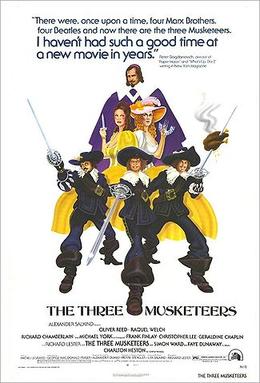
 In 1973, director Richard Lester and producer Ilya Salkind decided to try to get two for the price of one.
Working with a script written by novelist George McDonald Fraser, Lester and Salkind had assembled a once-in-a-lifetime cast to star in an epic film adaptation of Alexandre Dumas’s The Three Musketeers. Michael York was cast as d’Artagnan, the youthful swordman who goes from being a country bumpkin to becoming a King’s Musketeer. His fellow musketeers were played by Oliver Reed, Richard Chamberlain, and Frank Finlay. Faye Dunaway and Christopher Lee were cast as the villains, Milady and Rochefort. Charlton Heston played the oily Cardinal Richelieu. Geraldine Chaplin played Queen Anne while Simon Ward played the Duke of Buckingham. Comedic relief was supplied by Roy Kinnear as d’Artagnan’s manservant and Raquel Welch as Constance, d’Artagnan’s klutzy love interest. The film was a expensive, lushly designed epic that mixed Lester’s love of physical comedy with the international intrigue and the adventure of Dumas’s source material.
The only problem is that the completed film was too long. At least, that’s what Salkind and Lester claimed when they announced that they would be splitting their epic into two films. The cast and the crew, who had only been paid for one film, were outraged and the subsequent lawsuits led to the SAG ruling that all future actors’ contracts would include what was known as the Salkind clause, which stipulates that a a single production cannot be split into two or more films without prior contractual agreement.
But what about the films themselves? Both The Three Musketeers and The Four Musketeers are currently available on Tubi. I watched them over the weekend and, of the many films that have been made out of Dumas’s Musketeer stories, Richard Lester’s films are the best. Lester captures the swashbuckling spirit of the books while also turning them into two films that are easily identifiable as Lester’s work. There’s a lot physical humor to be found in Lester’s adaptation, especially during the first installment. d’Artagnan runs through the streets of Paris, convinced that he has been insulted by the haughty Rochefort. d’Artagnan manages to get challenged to three separate duels, all to take place on the same day. After his first swordfight as a member of the Musketeers, d’Artagnan tries to tell the men that he wounded about an ointment that will help them with their pain. Raquel Welch also shows a genuine flair for comedy as Constance, which makes her fate in the second film all the more tragic.
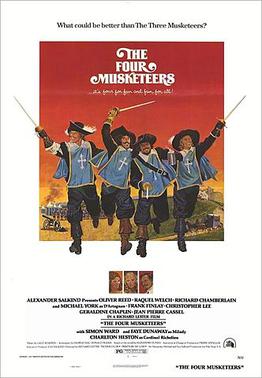 For all the controversy that it caused, splitting the story into two films was actually the right decision. If The Three Musketeers is an enjoyable adventure film, The Four Musketeers is far more serious. In The Four Musketeers, Oliver Reed’s melancholic Athos steps into the spotlight and his story of his previous marriage to the villainous Milady casts his character in an entirely new light. In The Four Musketeers, the combat is much more brutal and the humor considerably darker. Likable characters die. The Musketeers themselves commit an act of extrajudicial brutality that, while true to Dumas’s novel, would probably be altered if the film were made today. From being a naive bumpkin in The Three Musketeers, The Four Musketeers finds d’Artgnan transformed into a battle weary soldier.
The cast is fabulous. This is a case of the all-star label living up to the hype. Oliver Reed, Frank Finlay, and Richard Chamberlain all seems as if they’ve been riding and fighting together for decades. Christopher Lee plays Rochefort as being an almost honorable villain while Faye Dunaway is a cunning and sexy Milady. What truly makes the film work, though, is the direction of Richard Lester. Lester stay true to the spirit of Dumas while also using the material to comment on the modern world, with the constant threat of war and civil uprising mirroring the era in which the films were made. Interestingly enough, Richard Lester first became interested in the material when Ilya Salkind reached out to the Beatles to try to convince them to play the Musketeers. While the Beatles were ultimately more interested in a never-produced adaptation of The Lord of the Rings, Richard Lester was happy to bring Dumas’s characters to life.
Both The Three Musketeers and The Four Musketeers are currently on Tubi, for anyone looking for a truly great adventure epic.

 Through the Shattered Lens