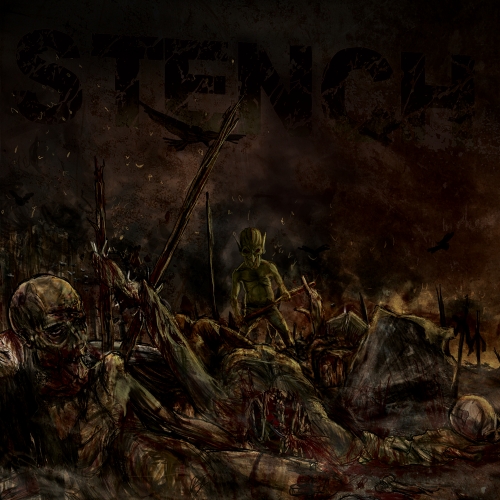
Up until late July, Nekrogoblikon were a nearly forgotten gimmick. Their first and only previous album, Goblin Island, was released in 2006, and that was the last I ever heard of them. Aside from telling the story of an extra-terrestrial goblin invasion of the most heinous sort (they even ruin Christmas), it featured, among other things, sound clips of the band screaming like little girls, an actual stereotypical Christmas song, a cover of In Flames’ Artifacts of the Black Rain with all the lyrics substituted for banter about goblins, and a dance beat chiptune outro. Musically, it was simultaneously a mockery of a lot of the bands that probably influenced them and a pretty decent, enjoyable imitation of them. But it was never funny in say, a GWAR or Alestorm sort of way. It was more like a Weird Al thing–a novelty. You laugh, but you really don’t want your friends to know you listen to it, and you never play through it twice in a row.
Goblin Box
Their new album is a very different beast. Over the past five years they’ve actually matured into really good song-writers. Don’t get me wrong, Goblin Island had some really catchy tracks, but in the music just as in the lyrics there was a sort of audible immaturity, by design of course, that made light of the bands they were imitating. On Stench this notion is more internal. That is, they’re still parodying Children of Bodom, Finntroll, and just about anything in between, but instead of hearing a bunch of kids making a joke you hear a bunch of goblins being goblins. The immaturity is no longer in the execution; it’s encased in really solid music that, given better production value, could rival many of the very same albums it pokes and prods.
Basically, on Stench the line between a musical parody and a successful cross-genre epic metal masterpiece is very grey indeed. Yet the lyrics are just as blatantly whimsical as ever. The result is hard to swallow, because it’s so good and so bad at the same time. I imagine the spoken ending of this song is a rip on Rhapsody of Fire’s infamously lame spoken lines; it goes approximately “The humans had opened the box to torture and maim all kinds of magical creatures, but the goblins were not to be trifled with. No, not to be trifled with at all. And as the humans laid there, a pulsating mound of bone and flesh, dead and mutilated beyond all hope and reason, the goblins feasted upon their rotting corpses, filling the halls with the shrill sound of chilling laughter….. Forever!” And yet when you listen to it, beneath the cheese you get the feeling that it’s a really badass ending.
It took quite a while for me to get sufficiently passed the fact that it’s a parody to enjoy it in its own right. That was Stench’s initial impact: a part of me was left feeling like I’d been cheated out of something awesome on par with Ensiferum and Equilibrium, but the more I listened to it the more I wanted to click repeat, plant my hand firmly in the center of my face, and grin from ear to ear underneath it. At this point I can safely say I love it unconditionally.
Gallows & Graves
There’s something of a third dynamic going on here as well, and it’s what really tips the scale towards greatness. In some odd capacity this really is, well, goblin metal. If we think of them as those short, mischievous little tinkers that are a good bit like gnomes with the added plus of being spawns of Satan, you can actually hear something of this in the music. Goblins ARE both comical and evil, and while Goblin Island was too much of a joke (albeit a good one) to capture this, Stench pulls it off. Trolls and vikings and pirates have all acquired a sort of musical imagery, much of which isn’t meant to be taken entirely seriously. The idea of a goblin is a good deal less serious than all of those to begin with, and if I was going to “seriously” create a metal sound to capture them, well, Stench seems pretty on the mark. The frantic intro/chorus melody of Gallows & Graves and the kind of childish clear vocals really do call to mind some small, obnoxious, vicious little bugger hopping around your feet, and this same musical imagery reoccurs throughout Stench with a consistency that Goblin Island lacked.
A Feast
It’s really hard to talk about what Nekrogoblikon “accomplished” on this album with a straight face, but the fact of the matter is Stench is really damn good. They manage to successfully combine elements of more metal sub-genres than I can count. It’s also got the clever bonus of thematically justifying all of its potential negatives. Goblins are as obnoxious as they are evil, right, so if they’re mocking a bunch of their metal predecessors musically it’s only natural. This is goblin metal.
 Through the Shattered Lens