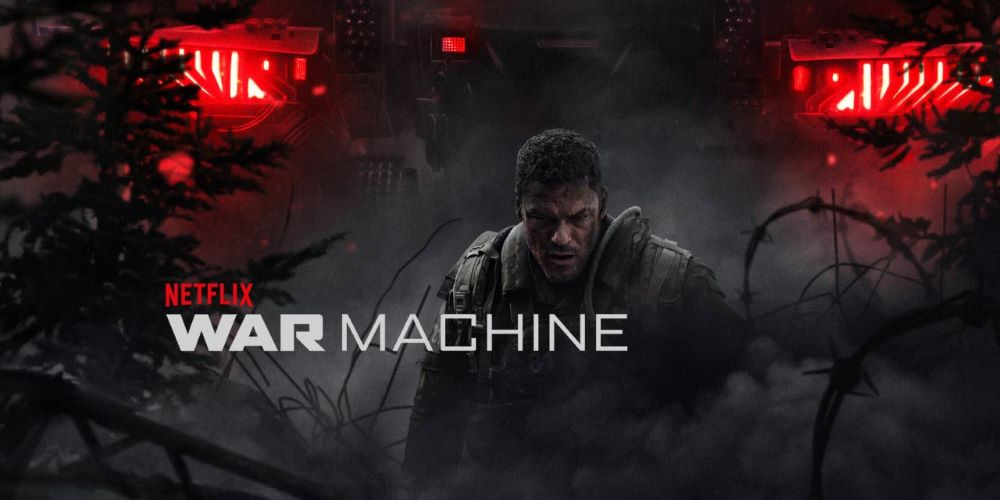
“It’s not about us anymore. It’s warning everybody that thing’s coming.” — Staff Sergeant 81
War Machine is a slick, mid-budget sci-fi actioner that mostly does exactly what it promises: put Alan Ritchson in a killbox with something inhuman and let the cameras roll. It is also a film that keeps bumping up against more interesting ideas than it has time—or maybe courage—to fully explore.
Set around a Ranger Assessment and Selection Program (RASP) training exercise, War Machine drops a squad of U.S. Army candidates into what should be a controlled simulation and then twists the dial from “routine” to “existential threat” in a single, nasty turn. Patrick Hughes uses the military-training frame as a clean, modular structure: we get the briefing, the banter, the march into the woods, and then the sense that something is just off before the real problem reveals itself. That problem, teased heavily in marketing, is a non-human adversary that pushes the movie from grounded war-games thriller into full-on sci-fi horror-action.
On a pure premise level, the film is almost aggressively simple: what if you locked a handful of Rangers-in-the-making in with an advanced, alien threat and watched them improvise their way out? The script never strays far from that line. It moves briskly from beat to beat—contact, casualties, regroup, “this isn’t part of the exercise,” reveal—without a lot of digressions. That tightness keeps the pacing snappy, but it also means character work often comes in shorthand: a line about a family here, a rivalry there, enough to suggest depth without really digging for it.
Ritchson is easily the film’s biggest asset, and the filmmakers know it. Coming off Reacher, he arrives with a built-in persona: the big, capable, slightly sardonic soldier who you just instinctively trust to solve violent problems. War Machine leans into that, but it also asks him to play a little more vulnerability than his Amazon series typically allows. There are moments—usually between set-pieces—where you see the strain and confusion creeping in, and the performance keeps the movie from turning into a pure pose-fest.
Most of the supporting cast is drawn in broad strokes but works well enough in the moment. You get the expected squad dynamics: the true believer, the skeptic, the joker, the one who freezes when things get ugly. The film rarely surprises you with what these people do, but the actors sell the camaraderie, and when bodies start dropping, the losses feel at least momentarily sharp instead of purely mechanical. Still, if you walked out of the movie and had trouble naming more than two characters, that would be understandable; the movie cares more about how they move than who they are.
Hughes’ direction sits in that modern streaming-action pocket: clean, serviceable, with a couple of standout moments but nothing that radically redefines the genre. The early training beats are shot with a straight military grit that grounds the later sci-fi escalation; you can feel the weight of gear, the slog of the environment, the tight focus on lines of advance and retreat. When the alien threat fully enters the frame, the film shifts into a more stylized mode, with harsher lighting, heavier VFX integration, and some nicely framed silhouette shots that emphasize size and speed over detailed anatomy.
Action-wise, War Machine is at its best when it uses geography and tactics instead of just spraying bullets into darkness. A mid-film set-piece in a partially collapsed structure, where the squad tries to funnel the creature into a kill zone, shows how much more interesting the movie becomes when the characters think rather than simply react. You get coordinated movement, overlapping lanes of fire, and the sense of a plan barely holding together. Other sequences lean more on chaotic spectacle, with quick cuts and digital mayhem that get the job done without really sticking in your memory.
The creature itself—both in concept and in execution—is solid, if not iconic. Hughes has mentioned that his original instinct was to completely hide the sci-fi angle in marketing and even within the film for as long as possible, turning the reveal into a full-on genre pivot. You can feel that tension: the movie is structured like a long-burn mystery, but the way it’s framed assumes you already know there is some kind of alien or advanced threat in play. As a result, the first half can feel like it is coyly dancing around a surprise that you walked in expecting, which blunts some of the intended impact.
Once revealed, though, the alien threat has a tactile, physical presence that helps sell the danger, especially when Ritchson is forced into close-quarters encounters. The effects and practical elements blend reasonably well, particularly in dim environments where the film smartly avoids overexposing any weaknesses in the design. You’re never watching the thing and thinking “instant classic,” but you also rarely feel like you’re staring at a dated video-game cutscene, which is no small feat at this budget level.
Where War Machine wobbles is in its relationship to its own ideas. The RASP setting, the simulated-mission-gone-wrong structure, and the presence of an unprecedented threat all hint at questions about how militaries adapt to non-traditional warfare, how much human soldiers matter in a future of machines, and what “training” even looks like when the enemy doesn’t follow any known playbook. Every so often, the screenplay brushes up against those questions—usually in a line about command decisions or acceptable losses—and then quickly retreats back into “shoot, move, communicate.”
There is also a thread about trust in authority and the expendability of trainees that could have turned this into a sharper, more cynical film. Instead, War Machine opts for a more earnest, almost old-fashioned faith in individual bravery and brotherhood. The movie clearly admires these soldiers and wants you to admire them too, so it stops short of really indicting the system that put them in harm’s way. That choice keeps the tone accessible and avoids turning the movie into a lecture, but it also leaves some dramatic meat on the bone.
In terms of craft, this is very much a “Friday night streamer” movie—for better and worse. It looks good enough on a living room screen, with clean sound design that makes each impact and gunshot feel beefy without blowing out your ears. The editing rarely confuses basic spatial relationships, which already puts it ahead of a lot of action on the platform, but it also seldom lingers long enough on a moment to let you fully savor the choreography or the creature’s movement. You get the sense of a film that has been trimmed for pace and attention-span metrics more than for rhythm or mood.
There has already been talk of this being a “spectacle worth watching” if you like Ritchson and sci-fi action, paired with the caveat that it is a decent, familiar entry in a crowded space whose lead performance carries it over the line. That feels about right. War Machine is not trying to be the next genre landmark; it is trying to give fans of Reacher a chance to see their guy punch, shoot, and strategize his way through a different kind of nightmare. On that level, it mostly delivers.
The ending leaves the door open for more, without dunking you in a full-on cliffhanger. You can watch this, feel like you got a complete story, and still understand why the creative team is already floating sequel ideas and talking about “War Machines” in the plural. Whether that happens will depend on the usual streaming calculus—completion rates, social buzz, how long people keep it in their “Recently Watched.” Creatively, there is room to expand the world and dig into the implications that this first film mostly uses as background texture.
If you come to War Machine looking for tight, character-driven military sci-fi with big thematic swings, you’ll probably walk away thinking about what could have been. But if you want a solid, competently staged sci-fi shoot-’em-up anchored by a physically commanding lead turn, this is a pretty easy recommendation—especially if you are already waiting for the next season of Reacher and need something in the same physical, bruising register to fill a couple of hours.
 Through the Shattered Lens