TV Review: The Dropout Episodes 1, 2, and 3 (dir by Michael Showalter)


On Thursday, I binged the first three episodes of Hulu’s The Dropout.

The Dropout is Hulu’s miniseries about the rise and fall of Elizabeth Holmes (played by Amanda Seyfried), the enigmatic Stanford dropout who founded Theranos and became a billionaire before she turned 30. She promised that Theranos would revolutionize both the way that blood was tested and the world of health care in general. She was known for black turtlenecks, her deep (and possibly fake) voice, and her habit of not blinking. Of course, as common sense should have made obvious to just about anyone, it turned out that Elizabeth Holmes was lying about the blood testing machinery that her company was marketing. She and her business partner and former lover, Sunny Balwani (played, in The Dropout, by Lost‘s Naveen Andrews) were eventually charged with defrauding their investors. At trial, Holmes argues that her intentions were good and that she was trapped in an abusive relationship with Balwani. While Balwani’s trial is scheduled to being later this month, Elizabeth had already been convicted and currently await sentencing. Theranos, of course, no longer exists.

After the first three episodes, I would say that I’m cautiously optimistic. Seyfried and Andrews seem to be perfectly cast as Elizabeth and Sunny and the story itself is an interesting one. The miniseries format seems like a good one for director Michael Showalter’s trademark mix of dark comedy and drama. Much as with Showalter’s The Eyes of Tammy Faye, there were a few moments that felt a bit too cartoonish, most of which involved William H. Macy as Elizabeth’s former neighbor and eventual business rival but, for the most part, the first three episodes managed to establish and maintain a consistent tone. Before she lowers her voice and dons her black turtleneck, Elizabeth comes across as being socially awkward but likable. It’s only towards the end of the 3rd episode that we really start to see her as being the villainous figure that she eventually began. The first 3 episodes are like an origin story.

Of course, the fact that it took 3 hours to tell her origin story is one reason why I’m cautious in my optimism. Streaming services are currently full of miniseries that all take stories that should be interesting but then drag them out to such a length that it’s hard not to eventually lose interest. (If you need an example of what I’m talking about, go check out Netflix’s Inventing Anna.) The Dropout‘s first three episodes were well-done but it’s still hard not to feel that the story told in those three hours could have just as easily been told in 20 minutes, without denying the viewer anything that they needed to know to understand Elizabeth and Sunny. There are five more episodes to go. Can the story of Elizabeth Holmes and Theranos remain interesting for 8 hours? I’m hopeful but I’m not totally sure.

With all that in mind, I’m recommending The Dropout, on the basis of the first three episodes. But remember …. I was originally pretty enthusiastic about Pam & Tommy as well.
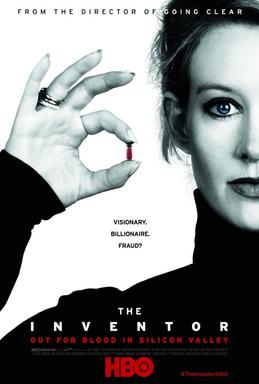
Film Review: The Inventor: Out For Blood In Silicon Valley (dir by Alex Gibney)


Oh my God, this was such a creepy documentary!

The Inventor tells the story of the rise and fall of Elizabeth Holmes, who, at one point, Forbes named the wealthiest self-made female billionaire in America, and who is currently facing criminal charges of defrauding not only her investors but also a countless number of doctors and patients.  After dropping out of college, Elizabeth Holmes founded Theranos, a Silicon Valley-based company that claimed it had devised a method that would revolutionize how blood was tested and which would lead to people leading longer and healthier lives.  (“No one will have to say an early goodbye,” as Elizabeth put it.)  It all had to do with a blood-testing device called the Edison, a device that Holmes designed, patented, and made a fortune by licensing.  That the Edison didn’t actually do what Holmes claimed that it did put lives at risk and ultimately led to her downfall.

So, what makes The Inventor such a creepy documentary?  A lot of it has to do with the fact that Elizabeth Holmes herself comes across as being so creepy.  With her endless supply of black turtlenecks and her rather monotonous (not to mention notably deep) voice, she comes across as being a cult leader in the making.  When we see archival footage of her being interviewed or of her giving a speech to her worshipful employees, she has the type of demented gleam in her eye that one would normally associate with a particularly enthusiastic Bond villain.  When her former employees talk about her, they not only mention her drive and her dedication but they also mention the fact that she rarely blinked.  In fact, she so rarely blinked that other people also felt as if they shouldn’t blink in her presence.  Theranos was a company full of people with thousand-yard stares.

Despite the fact that, as many people point out, Elizabeth Holmes had no experience in the medical field and that the majority of her lies were easily exposed, she still had little trouble getting wealthy and powerful men to invest in her company.  Among those who invested in Theranos and sat on its board of directors: two former secretaries of state, one former and one future secretary of defense, and several prominent businessmen.  Though the documentary doesn’t explore this angle as perhaps it should have, it’s interesting to note that the majority of Holmes’s backers and defenders were 1) elderly and 2) male.  The one female investor that Holmes tried to bring in easily saw through Holmes’s lies.  On the other hand, former Secretaries of State Henry Kissinger and George Shultz became enthusiastic backers of Holmes and her “vision.”  Meanwhile, attorney David Boies — who was best-known for being Al Gore’s personal attorney and who later was hired to head up Harvey Weinstein’s defense team — is on hand to intimidate any Theranos employees who might be on the verge of turning into a whistleblower.  Elizabeth Holmes may currently be an indicted pariah but, before that, she spent many years as a proud member of the American establishment.

In fact, several other members of the Establishment makes cameo appearances in The Inventor.  At one point, we see Holmes being interviewed by Bill Clinton.  At another point, Joe Biden stops by Theranos and praises the company.  We see pictures of Elizabeth Holmes in the Oval Office, visiting with Barack Obama.  Holmes is put on the covers of magazines.  Numerous publications declare her to be the next Steve Jobs.  She’s held up as the future of not just blood testing but also the future of business.  It’s only after one reporter has the courage to actually investigate her claims and two employees risk their futures to tell the truth about what they saw at Theranos that Elizabeth Holmes is revealed to be a fabulist and a con artist.  Was she ever sincere in her desire to make the world a better place or was that just another part of her carefully constructed persona?  The Inventor is full of people still struggling to answer that question for themselves.

The Inventor was directed by Alex Gibney.  Gibney previous directed the Going Clear, an expose of Scientology.  Watching The Inventor, it’s hard not to make comparisons between Scientology and the cults of Silicon Valley.  Watching Elizabeth Holmes give a speech to her employees is like watching that infamous video of Tom Cruise pay homage to L. Ron Hubbard.  And just as Scientology takes advantage of those with a need to believe in something bigger than them, Elizabeth Holmes did the same thing.  Everyone wanted the promises of Homes, Theranos, and the Edison machine to be true.  They wanted it to be true so much that they became blind to the reality that was right in front of them.

The Inventor is a fascinating documentary about power, wealth, fraud, and the prison of belief.  It can currently be seen on HBO.