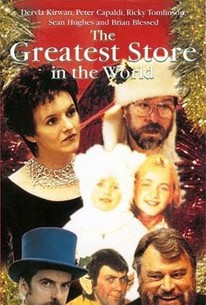
Here to help you get in the holiday spirit, we’ve got a British film from 1999!
The Greatest Store In The World tells the story of a single mother and her two daughters. When the film begins, they’re living in a van but, after the van catches on fire, they upgrade things by moving into a luxurious London department store. Along with coming together as a family and celebrating the holidays, they also thwart an attempt to rob the store. It’s a good-natured little movie, one that reminds the viewer of how fun the world once was. It was filmed in Harrods, though the name itself is not actually uttered in the film. Fans of Doctor Who will want to keep an eye out for Peter Capaldi while fans of larger-than-life actors will be happy to see the great Brian Blessed.
(I should admit that, when I was little and my family was constantly moving from one state to another and I was always having to say goodbye to whatever new friends I had made, I used to fantasize about living in a big mall. Perhaps that’s one reason why this sweet-natured film brought a tear to my mismatched eyes.)
Here to help you get in the holiday spirit, we’ve got a British film from 1999!
The Greatest Store In The World tells the story of a single mother and her two daughters. When the film begins, they’re living in a van but, after the van catches on fire, they upgrade things by moving into a luxurious London department store. Along with coming together as a family and celebrating the holidays, they also thwart an attempt to rob the store. It’s a good-natured little movie, one that reminds the viewer of how fun the world could be before the rise of COVID-fueled authoritarianism. It was filmed in Harrods, though the name itself is not actually uttered in the film. Fans of Doctor Who will want to keep an eye out for Peter Capaldi while fans of larger-than-life actors will be happy to see the great Brian Blessed.
(I should admit that, when I was little and my family was constantly moving from one state to another and I was always having to say goodbye to whatever new friends I had made, I used to fantasize about living in a big mall. Perhaps that’s one reason why this sweet-natured film brought a tear to my mismatched eyes.)
After watching Break-Up Nightmare, I watched one more film that was sitting on my DVR. That film was 1940’s The Letter. I had recorded it off of TCM and, up until last night, I had never seen it before. I’m happy to say that I’ve seen it now because it’s a great movie, featuring a fascinating mystery, feverish atmosphere, excellent supporting performances, and a ferociously brilliant performance from the great Bette Davis.
Filmed in a dream-like noir style by William Wyler, The Letter opens on a rubber plantation in Malaysia. It’s night and the camera pans over the native workers all trying to sleep through the hot night. Eventually, the camera reaches the big house, where the plantation’s wealthy and, of course, white manager lives. (The contrast between the wealthy Europeans interlopers and the natives who work for them is a reoccurring theme throughout The Letter.) A gunshot rings out. A man stumbles out of the house. Following after him is Leslie Crosbie (Bette Davis). She is carrying a gun and, as we watch, she shoots the man a few more times. She shoots him until she’s sure that he’s dead.
Leslie is the wife of Robert Crosbie (Herbert Marshall, who also played Davis’s husband in The Little Foxes) and the man that she just killed is Geoff Hammond, a respected member of Malaysia’s European community. When the police arrive, Leslie explains that Hammond “tried to make love to me” and that she was forced to kill him in self-defense. Leslie is arrested for the crime and will have to face trial but everyone knows that she will be acquitted. After all, Leslie and her husband are members are well-connected members of the upper, European class.
However, Leslie’s lawyer, Herbert Joyce (James Stephenson), has doubts about Leslie’s story. He points out that she sounds just a little too rehearsed. His suspicions are confirmed when his clerk, Ong Chi Seng (Sen Yung), tells him about the existence of a letter that Leslie wrote on the day that Hammond was killed. In the letter, Leslie orders Hammond to come see her and threatens to reveal the details of their relationship if he doesn’t. Ong explains that he only has a copy of the letter. The original is in the hands of Hammond’s widow (Gale Sondergaard) and she’s willing to sell the letter for a substantial price.
Not surprisingly The Letter is dominated by Bette Davis but, for me, the most memorable character is the outwardly obsequies but inwardly calculating Ong Chi Seng. Sen Yung plays him with such a polite manner and a gentle voice that it’s actually incredibly shocking when he reveals his true nature. And yet, even after he’s been exposed as a potential blackmailer, his manner never changes. Meanwhile, Gale Sondergaard only appears in a handful of scenes but she steals every one of them with her steely glare.
In order to get the letter away from Ong and Mrs. Hammond, Leslie and Joyce have to convince Robert to give them the money without allowing him to learn the letter’s content. But, what neither one of them realizes, is that Mrs. Hammond has plans that go beyond mere blackmail.
The Letter is an atmospheric melodrama that plays out almost like a fever dream and it also features one of Davis’s best performances. It was nominated for best picture but it lost to another atmospheric melodrama, Alfred Hitchcock’s Rebecca.

 Through the Shattered Lens