The year is 1953. The place is Croydon. Derek Bentley (Christopher Eccleston) is 19 years old but has the mental capability of an 11 year-old. Unable to hold down a job and judged unfit for the national service, Derek drifts into a gang led by 16 year-old Christopher Craig (Paul Reynolds). When Derek and Craig are caught burglarizing a warehouse, it leads to a tense rooftop confrontation between Craig and the police. Derek has already been captured by the time that the police demand that Craig hand over his gun. Bentley shouts, “Let him have it, Chris!” Craig opens fire, killing one officer.
Because he’s a minor, Craig is only facing a prison sentence for killing the police officer. But, as a legal (if not mental) adult, Derek will be hung if he’s found guilty. Under the common purpose doctrine, it doesn’t matter that Derek didn’t actually shoot the gun. The only thing that matters is what Derek meant when he said, “Let him have it, Chris!” Derek says that he was telling Craig to hand over his gun. The Crown says that Derek was ordering Craig to open fire.
Let Him Have It is based on a true story. The case of Derek Bentley was one of the many cases that eventually led to the death penalty being abolished in the UK. Let Him Have It was released at the height of a long campaign to secure a pardon for Derek. That pardon was finally issued in 1998, though it was too late to help Derek Bentley.
Let Him Have It is a powerful and angry docudrama, one that reveals in searing detail how Derek was railroaded by the British legal system. In his film debut, Eccleston gives a powerful performance as Derek and he is ably supported by both Paul Reynolds and, in the role of Derek’s father, Tom Courtenay. Let Him Have It leaves little doubt as to why the case of Derek Bentley remained a cause célèbre for 45 years after his initial trial.
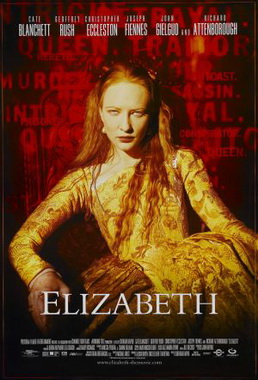
— Queen Elizabeth I (Cate Blanchett) in Elizabeth (1998)
I have to admit that I always feel guilty about the fact that I love movies about British royal history. After all, I have roots in Northern Ireland and I was raised Catholic. If anything, I should refuse to watch films about British royalty on general principle. I should be writing more reviews of films like Bloody Sunday.
But I can’t help myself. Whether it’s because I enjoy looking at all of the costumes or I just have a thing for movies set in drafty old castles, I have a weakness for films about British royalty. (And I will also admit that I sat through the entire royal wedding and I have a bit of a girlcrush on both Pippa and Kate Middleton. As I said, I just can’t help myself.)
Of course, some of it definitely has to do with the fact that I’m an unapologetic history nerd. I am fascinated with how people lived in the past. And, of course, anyone who shares my obsession understands that, when it comes to history, there’s both the official story and the truth. The official story is something that’s passed down over the centuries. It’s what we learn in school. The truth, however, is always far more obscure. The truth is what historians piece together from what little gossipy evidence has managed to survive the passage of time.
We all know that the official story of Queen Elizabeth I is that she was England’s greatest Queen, she defeated the Spanish Armada, and she never married. She was the “Virgin Queen,” forsaking love to serve her nation. That’s the official story but is it the truth?
That’s the question at the heart of the 1998 Best Picture nominee Elizabeth. Now, don’t get me wrong. I’m not arguing that Elizabeth represents the truth. Historically, the film is messy and full of speculation that is less based on evidence and more on the desire to keep things cinematic. But still, Elizabeth is an interesting film specifically because it takes a historical figure and dares to suggest that she may have been human before she became an icon.
Cate Blanchett gives a great performance in the role of Elizabeth. When we first meet her, she’s a somewhat silly girl who is less concerned with politics and religion and more concerned with her boyfriend, Robert Dudley (Joseph Fiennes). Elizabeth is also the protestant half-sister of Catholic Queen Mary (Kathy Burke). Mary is planning on ordering Elizabeth’s execution but dies of stomach cancer before she gets around to singing the order.
Suddenly, Elizabeth is Queen of England. Young and insecure, she is, at first, manipulated by advisors like William Cecil (Richard Attenbrough), who pressures her to marry the cross-dressing Henry III (Vincent Cassel) of France. Meanwhile, the Pope (John Gielgud) signs an order calling for Elizabeth’s death. Catholic nobleman Thomas Howard (Christopher Eccleston) and mysterious priest John Ballard (Daniel Craig) conspire to assassinate Elizabeth. With even Robert Dudley giving her reason to distrust him, Elizabeth discovers that her only ally is the enigmatic and ruthless “spymaster,” Francis Walsingham (Geoffrey Rush). It all ultimately ends in a sequence that basically transports the finale of The Godfather to the Elizabethan era.
I really should not like Elizabeth. It’s undoubtedly an anti-Catholic film, though it’s nothing compared to the histrionic anti-Catholicism of its sequel, Elizabeth: The Golden Age. But I can’t help myself, I enjoyed Elizabeth. It was impossible for me not to relate to Cate Blanchett’s passionate performance. (And there was just something so incredibly hot about the way Joseph Fiennes, with his intense eyes, would stare at her.) When you ignore the film’s protestant bias and just concentrate on the performances and the gorgeous production design, you can’t help but love Elizabeth.
For today’s horror on the lens,we have a film from 1977. I recently watched this film very late at night and — OH MY GOD! Seriously, I had nightmares for two nights straight!
Full Circle opens with the horrifying death of Kate (Sophie Ward), the daughter of Julia (Mia Farrow) and Magnus (Keir Dullea). After Kate’s death, Julia and Magnus divorce and Julia moves into a new house. However, she is haunted by visions of a little girl who looks just like Kate. As well, the house is full of odd noises, creepy toys, and appliances that turn on by themselves. Is Julia seeing the ghost of her daughter or something far more dangerous?
Full Circle is a truly haunting and disturbing haunted house film. Mia Farrow gives a great performance as Julia and the entire film is dominated by a palpable atmosphere of dread. And that final scene — AGCK!

 Through the Shattered Lens