Welcome to Retro Television Reviews, a feature where we review some of our favorite and least favorite shows of the past! On Sundays, I will be reviewing the made-for-television movies that used to be a primetime mainstay. Today’s film is 1972’s The Glass House! It can be viewed on YouTube.

The Glass House starts with three men arriving at a location that will define the next few months of their lives.
Brian Courtland (Clu Gulager) is a veteran of the Vietnam War. He spent part of his service working as a guard in the brig. Now that he’s back in the United States and in need of a regular paycheck, he has gotten a job working as a prison guard. Courtland is not naive about where he’s going to be working or who he is going to be working with. But he is an idealist, one who tries to treat everyone fairly and who hopes that he will be able to do some sort of good in his new position.
Alan (Kristoffer Tabori) is a young man who has been arrested for selling marijuana. He is quiet and just hoping to serve his time and then get on with his life. His fellow prisoners have different plans for him.
Finally, Jonathan Paige (Alan Alda) is a liberal professor who, in a moment of rage, accidentally killed a man in a fight. Convicted of manslaughter, Paige enters the prison in a daze and cannot stop flashing back to the one moment that changed his life forever. Paige is assigned to work in the pharmacy, where he meets a prisoner-turned-activist named Lennox (Billy Dee Williams). Paige struggles to retain his humanity despite the harsh conditions.
All three of the men find themselves having to deal with the attentions of Hugo Slocum (Vic Morrow), the predatory “king” of the prison. Slocum expects Paige to help him run drugs though the the pharmacy. Slocum preys on Alan and sends his gang to punish him when Alan refuses Slocum’s advances. And Slocum expects that Courtland will just be another corrupt guard who agrees to look the other way when it comes to Slocum’s activities. Courtland, however, turns out to have more integrity than anyone was expecting.
The Glass House opens with a title card, informing the viewer that the film was shot at an actual prison and that the majority of the people in the film were actual prisoners. Not surprisingly, The Glass House does feel authentic in a way that a lot of other films about incarceration does not. The prison is claustrophobic and dirty, with every crack in the wall reminding the prisoners and the viewer that no one cares about what happens there. The extras have the blank look of men who understand that showing any emotion will be taken a sign of a weakness. Made in 1972, at a time when America was still struggling to integrate, The Glass House takes place in an almost totally segregated world. The black prisoners stick together. The white prisoners stick together. Everyone understands that’s the way that it will always be and, as we see by the end of the film, that’s the way the guards and the warden (Dean Jagger) prefer it because that means almost any incident can be written off as a being “a race riot.”
The real actors amongst the population do a good job of blending into the surroundings. Alda, Williams, and Tabori all give good performance while Vic Morrow is truly menacing in the role of the vicious Slocum. Slocum may not be particularly bright but, because he has no conscience, he is uniquely suited to thrive in a world with no morality. The film’s best performance comes from Clu Gulager, who does a great job of portraying Courtland’s growing disgust with how the system works.
Though it’s over 50 years old, The Glass House is a still a powerful look at life on the fringes. Society, for the most part, doesn’t really care much about what happens to the incarcerated. This film makes a strong case that we probably should. One is left with little doubt that, even if relatively harmless prisoners like Paige and Campbell survive being locked up with men like Slocum, they’ll still be incapable of returning to the “real world” afterwards. The viewer, like Brian Courtland, is left to wonder how much corruption can be tolerated before enough is enough.
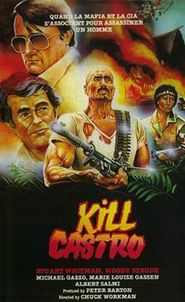 One of my earliest memories of staying up late and watching cheesy movies on local television was the sight of Robert Vaughn standing on a beach and cursing, “Damn you, Kennedy!” An echo effect kicked in, making the line: “Damn you, Kennedy Kennedy Kennedy Kennedy Kennedy!”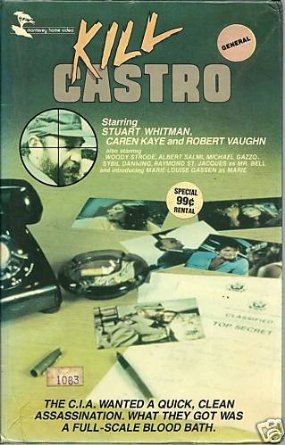
 Through the Shattered Lens