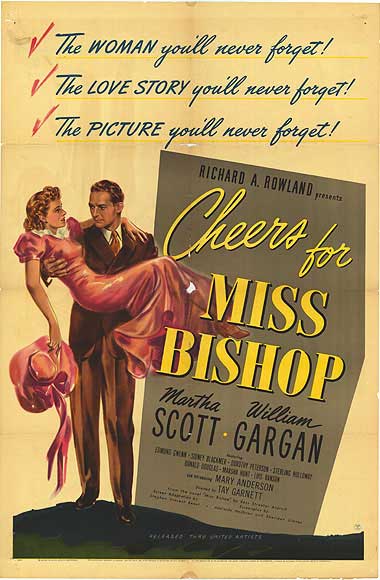
The Fabulous Forties #30: Cheers for Miss Bishop (dir by Tay Garnett)


cheers1

The 30th film in Mill Creek’s Fabulous Forties box set is the 1941 melodrama, Cheers For Miss Bishop.  Cheers For Miss Bishop is a bit like an Americanized version of Goodbye, Mr. Chips.  The story of Cheers For Miss Bishop, largely told via flashback, deals with a retired teacher who never quite got what she wanted out of life but still had a profound impact on all of her students.

The film opens with elderly Miss Bishop (played by Martha Scott) alone in her house.  The time is the 1930s and Miss Bishop is nearing retirement and somewhat bitter over ending her years having never married.  Prominent businessman Sam Peters (William Gargan) comes to the house and they start to recollect.  We flashback to the 1880s, when Miss Bishop was preparing to go to college and Sam was just the local grocery boy.  Sam was in love with Miss Bishop and, it’s suggested, that she loved him as well.  But she was determined to go to college whereas Sam was determined to go straight into business.

With the support of the kindly Prof. Corcoran (Edmund Gwenn, giving a performance that pretty much epitomizes what we mean when we call someone a kindly professor), Miss Bishop got a job teaching English at Midwestern College.  She was a popular teacher, one who not only inspired her students but who was also willing to stand up for them.  Eventually she met and became engaged to a local lawyer, Delbert Thompson (Don Douglas).  However, her heart was broken when Delbert ran off with another woman.  Years later, she fell in love with another professor (Sidney Blackmer), with the only problem being that he happened to be married.

But that’s not all that Miss Bishop had to deal with.  She also ended up adopting and raising Hope (Marsha Hunt) after Hope’s mother died in childbirth.  As she got older, she became frustrated when the younger college administrators demanded that she adapt with the times.  Miss Bishop also had to deal with her frequent romantic rival and cousin, the impulsive Amy (Mary Anderson).

Amy, I should mention, was my favorite character in Cheers For Miss Bishop, even though I don’t think that was the film’s intention.  Some of that is because Mary Anderson totally embraced the melodramatic potential of her character, often going totally over-the-top in a way that still seemed perfectly natural.  But there’s also the fact that Amy, as opposed to the often painfully inhibited Miss Bishop, had no boundaries.  She knew what she wanted and she went for it, without apology.  Amy may not have been a big role but she still dominated every scene that she appeared in.  Amy demanded attention and good for her!

That said, the title of the film is Cheers For Miss Bishop and not Cheers For Amy.  Ultimately, it’s a tribute to Miss Bishop and to teachers everywhere.  It’s an extremely predictable and sentimental film but it does what it does fairly well.  Occasionally, I got frustrated with Miss Bishop as a character (she was always so prim, proper, and respectable!  Plus, there’s a scene where she gives a student from North Carolina some trouble about his accent, saying that he needs to take her English class and, if you know how I feel about actors from up north trying too hard to sound like they’re from the South, you can imagine how I felt about that scene) but Martha Scott gave a good performance.  In the end, it’s a sweet little movie.  And you can watch it below!
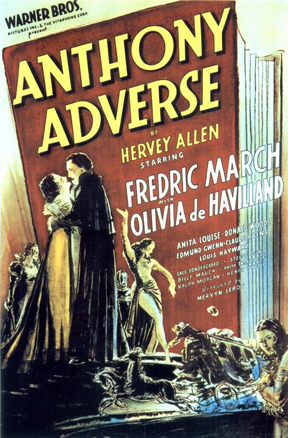
Cleaning Out The DVR: Anthony Adverse (dir by Mervyn LeRoy)


AnthonyAdverse

Late last night, I continued to clean out my DVR by watching the 1936 film, Anthony Adverse.

I recorded Anthony Adverse off of TCM, where it was being shown as a part of that channel’s 31 Days of Oscars.  Anthony Adverse was aired because it was nominated for Best Picture of 1936.  That’s significant because, if not for that nomination, I doubt that anyone would ever have a reason to watch Anthony Adverse.  It’s certainly one of the more obscure best picture nominees.  Despite a prestigious cast and being directed by the respectable Mervyn LeRoy, Anthony Adverse only has a handful of reviews over at the imdb.  And most of those reviews were written by Oscar fanatics like me.

Anthony Adverse is an epic historical film, one that tells the story of Anthony Adverse (Frederic March).  Anthony is the illegitimate son of Denis Moore (Louis Hayward) and Maria (Anita Louise), the wife of evil Spanish nobleman, Don Luis (Claude Rains, convincing as a nobleman but not as someone from Spain).  Luis murdered Denis and Maria died giving birth so Luis abandons the baby at an Italian convent.  Anthony is raised by nuns and priests and then, 10 years later, is apprenticed to an English merchant named John Bonnyfeather (Edmund Gwenn).  Bonnyfeather just happens to be Anthony’s grandfather!  Though Luis told him that Anthony died as soon as he was born, Bonnyfeather quickly figures out that Anthony is his grandson.  However, Bonnyfeather doesn’t share that information with Anthony and instead, he gives Anthony the surname “Adverse.”

Bonnyfeather raises Anthony as his own son.  Anthony grows up to be Frederic March and ends up falling in love with and marrying the beautiful Angela (Olivia De Havilland).  However, Anthony is suddenly called away on business to Havana, Cuba.  He doesn’t even have a chance to tell Angela that he’s leaving.  He does leave her a note but it blows away.  Assuming that she’s been abandoned, Angela goes to France, becomes an opera singer, and is soon the mistress of Napoleon.

Meanwhile, in Cuba, Anthony becomes convinced that Angela has intentionally abandoned him.  Consumed by grief, he ends up running a slave trading post in Africa.  He takes one of the slaves, Neleta (Steffi Duna), as his mistress and becomes known for his cruelty.  However, he eventually meets Brother Francois (Pedro de Cordoba) and starts to reconsider his ways.

(The film’s treatment of the slave trade is …. well, it’s awkward to watch.  The film is undoubtedly critical of slavery but, at the same time, it’s hard not to notice that the only slave with a prominent part in the film is played by a Hungarian actress.  Anthony may eventually reject cruelty but it’s left ambiguous as to whether or not he rejects the slave trade as a business.  If Anthony Adverse were made today, one imagines that this section of the film would be handled much differently.)

Meanwhile, back in Europe, Bonnyfeather is dying and his housekeeper, Faith (Gale Sondergaard, who won the first ever Oscar awarded for Best Supporting Actress for her performance here), plots to claim his fortune.

After I watched the movie but before I started this review, I did some research and I discovered that Anthony Adverse was based on a 1,222-page best seller that came out in 1933.  I’m going to guess that the film’s long and ponderous story may have worked better on the page than it does on the screen.  As a film, Anthony Adverse clocks in at 141 minute and it feels even longer.  Despite the impressive cast, the film just never clicks.  It’s never that interesting.

At the same time, I can understand why it was nominated for best picture.  It’s a big movie, full of characters and extravagant sets and ornate costumes.  You can tell it was an expensive movie to make and there’s enough philosophical dialogue that you can pretend there’s something going on underneath the surface.  In the 1936, Anthony Adverse may have been quite impressive but seen today, it’s forgettable.

Anthony Adverse lost best picture to another overproduced extravaganza, The Great Ziegfield.  Personally, I would have given the award to the unnominated My Man Godfrey.

http://www.youtube.com/watch?v=c_OyZlSCpo4

Lisa Reviews An Oscar Nominee: Foreign Correspondent (dir by Alfred Hitchcock)


ForeignCorrespondent

Before watching a film like 1940’s Foreign Correspondent, it helps to know a little something about history.

Nowadays, when we think about World War II, there’s a tendency to assume that, from the minute that Hitler came to power in Germany and started to invade the rest of Europe, the entire world united against the Nazis.  The truth is actually far more complex.  The world was still recovering from World War I and throughout the 1930s, even as the Axis powers were growing more and more aggressive, respected intellectual leaders and politicians continued to argue that peace must be maintained at all costs.  Pacifism was such a popular concept that otherwise intelligent people were perfectly willing to make excuses for Hitler and Mussolini.  For five years, the UK followed a policy of appeasement towards Nazi Germany.  Even after war broke out between Britain and Germany, the U.S. remained officially neutral.  In the 1940 presidential election, President Franklin D. Roosevelt — running on a platform of neutrality — was overwhelmingly reelected over internationalist Wendell Willkie.

Foreign Correspondent, an American film made by a British director, opens before the start of World War II.  An American newspaper editor, Mr. Powers (Harry Davenport), is frustrated because none of his foreign correspondents seem to be able to understand the truth of the situation in Europe.  They all claim that there is going to be no war in Europe but Mr. Powers feels differently.  He also feels that the newspaper’s most celebrated and respected foreign correspondents are just a bunch of out-of-touch elitists.  Instead of sending another upper class academic, Mr. Powers decides to send a hard-boiled crime reporter to cover the situation in Europe.  Johnny Jones (Joel McCrea) has never been to Europe and that’s exactly why Mr. Powers decides to send him.  In one of the film’s more clever moments, he does, however, insist that Johnny write under the more distinguished sounding name of “Huntley Haverstock.”

(Foreign Correspondent‘s pointed criticism of out-of-touch elitists repeating the establishment line remains just as relevant today as it was in 1940.)

From the minute the brash and tough Johnny arrives in Europe, he finds himself caught up in a huge conspiracy.  He’s been assigned to report on a group known as the Universal Peace Party and, since this film was directed by Alfred Hitchcock, we automatically know that any organization with the word “Peace” in its name has to be up to something shady.  The Universal Peace Party has been founded by Stephen Fisher (Herbert Marshall), who appears to sincere in his desire to avoid war.  Johnny meets and falls in love with Fisher’s daughter, Carol (Laraine Day).

From the minute that Johnny witnesses the assassination of distinguished Dutch diplomat Von Meer (Albert Bassermann), he suspects that things are not how they seem.  Working with Carol and a British journalist named Scott ffolliot* (delightfully played by the great George Sanders), Johnny discovers that Von Meer was not killed at all.  Instead, a double was assassinated and Von Meer was kidnapped by a group of spies.

But who are the spies?  After nearly getting killed by one of Fisher’s bodyguards, Johnny starts to suspect that Stephen Fisher might not be as into world peace as was originally assumed.  Complicating matters, however, is the fact that Johnny is now engaged to marry Carol…

Foreign Correspondent is a wonderfully witty thriller, one that has a very serious message.  While the film is distinguished by Hitchcock’s typically droll sense of humor (eccentric characters abound and the scene where Edmund Gwenn keeps getting interrupted before he can attempt to push Joel McCrea off of a tower is both funny and suspenseful), the film’s message was that America could not afford to stay neutral as war broke out across Europe.  As the all-American Johnny Jones says at the end of the film:

“All that noise you hear isn’t static – it’s death, coming to London. Yes, they’re coming here now. You can hear the bombs falling on the streets and the homes. Don’t tune me out, hang on a while – this is a big story, and you’re part of it. It’s too late to do anything here now except stand in the dark and let them come… as if the lights were all out everywhere, except in America. Keep those lights burning, cover them with steel, ring them with guns, build a canopy of battleships and bombing planes around them. Hello, America, hang on to your lights: they’re the only lights left in the world!”

Foreign Correspondent was nominated for best picture of 1940 but it lost to another far different Hitchcock-directed film, Rebecca.

http://www.youtube.com/watch?v=LMDJnTKotxo

——

* Yes, that is how he spells his last name.  As he explains, his family dropped the capital name in his surname after an ancestor was executed by Henry II.  Since it was George Sanders doing the explaining, it somehow made perfect sense.