A Christmas Film Review: Scrooge (dir by Ronald Neame)


There have been many good film versions of the Charles Dickens novella, A Christmas Carol.  Several of them could even be called classics.  Everyone from Bill Murray to James Earl Jones to Tori Spelling to Fredric March has taken a turn at playing a version of the famous miser who, after being visited by three ghosts on Christmas Eve, changes his ways and becomes the most generous man in London.  This holiday season, I watched quite a few old TV shows and I was somewhat surprised to discover just how many sitcoms have featured an episode where one of the characters has A Christmas Carol-like experience.

Though actually, I shouldn’t have been surprised.  A Christmas Carol is a universal tale and it’s one that continues to be appealing 174 years after it was originally written.  You don’t have to be rich, British, greedy, or even a man to relate to what Ebenezer Scrooge goes through.  We’ve all be haunted by the past.  We’ve all wondered what we’re missing out on in the present.  And we all fear how we’ll be remembered in the future.  In fact, I would say that A Christmas Carol is probably as close to perfect you can get.  The only problem is that Bob Cratchit’s son is named Tiny Tim and any work of fiction that features a character named Tiny has to be docked a few points.

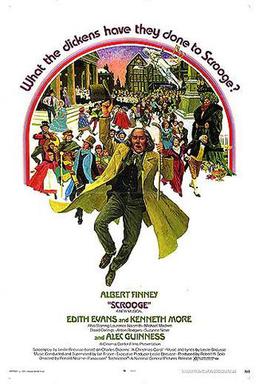
With all that said, my favorite film version of A Christmas Carol is the 1970 musical, Scrooge.

http://www.youtube.com/watch?v=g7xb1uSDxZ4

Scrooge sticks to the original details of the story.  Ebenezer Scrooge is played by Albert Finney.  (Finney was only 34 when he made Scrooge but was made up so that he looked closer to 120.)  The men, women, and spirits in Scrooge’s life are all played by a collection of distinguished British thespians.  Edith Evans is the stately Ghost of Christmas Past.  Kenneth More is the Ghost of Christmas Present, a decadent figure who drinks wine and travels around with two frightening-looking children.  Alec Guinness is a heavily chained Jacob Marley and he plays the role with just the right combination of sarcasm and concern.  (“No one else wanted to come,” Marley says when he greets Scrooge at the entrance of Hell.)  An actor named Paddy Stone is credited as playing the silent and shrouded Ghost of Christmas Future.  Let me just say that the Ghost of Christmas Future always scares me to death whenever I watch Scrooge.  I imagine little children in the 70s were traumatized by his skeletal visage.

What sets Scrooge apart is that it has singing and dancing!  That’s right, this is a musical version of A Christmas Carol, featuring songs composed by Leslie Bricusse.  Now, the overall quality of the songs is open to debate.  There’s 11 of them and really, only three of the songs are particularly memorable.  (Those songs are: I Like Life, I Hate People, and the Oscar-nominated Thank You Very Much.)  But, honestly, who cares?  The cast performs them with so much energy and enthusiasm that it’s impossible not to get swept up in it all.

(Admittedly, Albert Finney doesn’t really sing.  He just kinda growls the lyrics.  But that’s appropriate for the character of Scrooge.)

Scrooge is an outstanding production of a timeless tale.  It came on TV at least four different times this holiday season and I watched each time.  And I’ll do the same next year!

And as Tiny Tim, who did not die, said, “A Merry Christmas to all!  God Bless us, everyone!”
Cleaning Out The DVR #20: Tom Jones (dir by Tony Richardson)


(For those following at home, Lisa is attempting to clean out her DVR by watching and reviewing 38 films by this Friday.  Will she make it?  Keep following the site to find out!)

220px-Poster_-_Tom_Jones_01

Oh, how I wanted to love Tom Jones!

http://www.youtube.com/watch?v=NjEE_1U0-8s

No!  Not that Tom Jones.

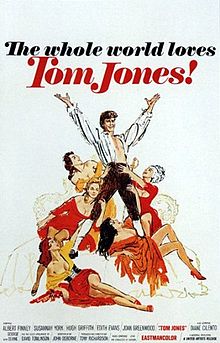
I’m talking about Tom Jones, the British film from 1963.  Based on a novel by Henry Fielding, Tom Jones was a huge box office success and it was one of the few comedies to ever win the Oscar for best picture.  Whenever you watch a documentary about the British invasion of the early 60s, chances are that you’ll see at least a clip or two from Tom Jones.  The film (or perhaps I should say the film’s box office success) is a part of 60s pop history, right up there with The Beatles on The Ed Sullivan Show and Sean Connery shooting that guy in cold blood in Dr. No.

Up until last night, I had heard about Tom Jones but I had never seen it.

And I really wanted to love it.

The film takes place in 18th century England and it tells the story of young Tom Jones (Albert Finney).  It starts with a lengthy sequence that plays out like a silent film, complete with title cards.  Upright Squire Allworthy (George Devine) comes home and discovers that a baby has been left in his bed.  He assumes that the child was born to two of his servants and declares that he will raise Tom Jones to be a good and worthy man.

Two decades later, Tom Jones has grown up and now he’s being played by Albert Finney (who, it must be said, was quite a handsome man when he was young).  Because Tom is good-looking and kind-hearted, every woman in England lusts after him.  But Tom is in love with innocent Sophie Western (Susannah York).  However, Sophie is a member of the upper class and Tom is a “bastard,” at a time when that actually means something.

Indeed, Sophie’s aunt and uncle (played by Edith Evans and Hugh Griffith) demand that Sophie have nothing to do with Tom Jones.  They decide that she will marry Blifil (David Warner, young but already typecast as a villain).  Through clever lies and manipulations, Blifil convinces Squire Allworthy that Tom has turned bad and must therefore be exiled from his home.  Does Blifil want to get rid of Tom just so he can marry Sophie or is it possible that there’s more to Blifil’s scheming?

Before we get the answer to that question, we spend a while following the exiled Tom as he wanders around England and attempts to prove himself worthy of Sophie.  Along the way, Tom serves briefly in the army, gets into numerous fights, and has several affairs.  One of those affairs is with Mrs. Walters (Joyce Redman), who he briefly thinks might be his mother.  Eventually, Tom ends up as the lover to the decadent Lady Bellaston (Joan Greenwood).  Through Blifil’s scheming, he also ends up framed for attempted murder and facing the gallows…

And, as melodramatic as that may all sound, Tom Jones is definitely a comedy.  It doesn’t take itself seriously and there’s hardly a single scene that isn’t played for laughs.  Director Tony Richardson goes out of his way to make sure that you never forget that you’re watching a movie.  There are freeze frames.  There’s plenty of characters around to supply sarcastic commentary.  There’s even a few cases of fourth wall breaking.

As I watched Tom Jones, it was hard for me not to compare it to Stanley Kubrick’s Barry Lyndon.  After all, both films take place during the same period of time and both deal with a young man making his way through European society.  I would even argue that, in its way, Barry Lyndon is far more satirical than Tom Jones.  The main difference between the two films is that Barry Lyndon is all about subtext whereas everything that happens in Tom Jones happens right on the surface.

As I said, I really wanted to like Tom Jones but, seen today, the entire film seems to be trying a little bit too hard.  Tony Richardson’s direction is so manic that it gets a bit exhausting after a while.  That said, I can understand why the film was such a success when it was first released.  I’m sure in 1963 — after having to deal with decades of pompous costume dramas — viewers probably found Tom Jones to be a breath of fresh air.  Not only was it a British film released at a time when all things British were in style but it was also a film that, by the standards of 1963, dealt frankly with sex.  In short, Tom Jones is definitely a film of its time.  If it doesn’t hold up as well today, that’s because it wasn’t made for 2016.  It was made for 1963.

And obviously, if the judgment of the Academy is to be trusted, Tom Jones was the perfect film for 1963.  That said, I would have given best picture to another British film, From Russia With Love.

Film Review: Crooks and Coronets (1969, directed by Jim O’Connolly)


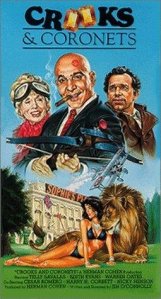
Crooks and CoronetsAfter taking off the month of October, I am now back on my Warren Oates kick.  The latest Oates film that I watched was Crooks and Coronets, a heist comedy that stars Oates and Telly Savalas as two career criminals plotting a robbery in England.
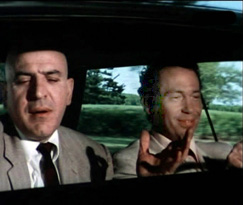
Crooks and Coronets starts with Herbie Haseler (Telly Savalas) getting released from prison.  Waiting for him is his partner-in-crime, Marty Miller (Warren Oates).  Because Herbie wants to go straight and doesn’t want to do any more time, he is not happy to learn that Marty stole a car just so he could pick Herbie up from prison.  Leaving the car behind, Herbie and Marty walk to a meeting with their old boss, New York gangster Nick Marco (Cesar Romero).  Nick reminds Herbie and Marty that they owe him money and tells them that they can not go straight until they pay him back.  Nick sends them to England to rob the estate of Lady Sophie Fitzmore (Edith Evans).

Crooks Coronets 03After arriving in the UK and meeting with Nick’s English counterpart, Frank Finley (Harry H. Corbett), Herbie and Marty infiltrate the Fitzmore estate.  Marty pretends to be a security expect while Herbie says that he is a librarian who is interested in cataloguing the Fitzmore library.  However, once they meet the kindly and eccentric Lady Sophie, neither one of them can bring themselves to rob her.  Instead, Marty helps Sophie fly an old World War I airplane while Herbie turns Fitzmore mansion into a tourist attraction.  When Nick and Frank show up and demand to know what the hold up is, Herbie and Marty have to find a way to stop the robbery.
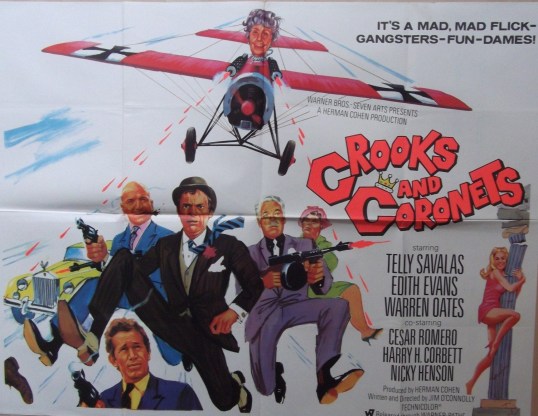
Crooks and Coronets is never exactly memorable but it is amusing throughout.  The main reason to watch it is for the performances of Edith Evans, Telly Savalas and Warren Oates.  Though this is not one of Warren’s better-known films, it was a personally significant one for him.  It was while filming Crooks and Coronets that Oates met British actress Vickery Turner.  Turner played the role of Annie, a tour guide who helps to protect the mansion from Nick and Harry.  She did not have a big role but she did look great in a miniskirt.  She and Warren Oates were married in 1969 and, after they were divorced in 1974, she went on to have a very successful career as a novelist.

crooks-and-coronets-original-uk-quad-poster-telly-savalas-cesar-romero-69-1246-p

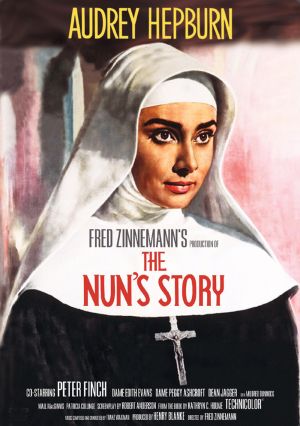
Lisa Watches An Oscar Nominee: The Nun’s Story (dir by Fred Zinnemann)


Nun_story

Happy Ash Wednesday!

So, earlier today, I got off work early so I could go to Noon Mass with my sister and we both got our ashes.  And I’m sure that will take some people by surprise because I’m not exactly the most faithful or devout of Catholics.  But what can I say?  I love the ornate ritual of it all.

And, as a part of my own personal ritual, I washed my forehead before I left the church.  Erin and I had a great vegetarian lunch at Cafe Brazil and then we came home and I turned on the TV and what should be finishing up on TCM but the 1959 best picture nominee, The Nun’s Story.  Fortunately, I had already set the DVR to record The Nun’s Story and so, on this most Catholic of days, I was able to watch this most Catholic of best picture nominees.

The Nun’s Story tells the story of Gaby (Audrey Hepburn), the daughter of a famous Belgian doctor (Dean Jagger).  At the start of the film, Gaby has entered a convent because she wants to become a missionary nursing sister in the Belgian Congo.  However, before Gaby can go to the Congo, she has to learn to give up her own rebellious streak and individual independence.  Taking the name Sister Luke, she excels at her medical training but, because it is felt that she is still too independently minded, she is not sent to the Congo but instead assigned to work in a mental hospital.  It’s there that her independent streak nearly gets her killed when she is fooled by a dangerous patient who claims to be the Archangel Gabriel.  It is only after she takes her final vows that Sister Luke is finally sent to the Congo and it is there that she’s forced to work with the abrasive agnostic Dr. Fortunati (Peter Finch).  Of course, as Sister Luke goes through her own spiritual struggles, the world inches closer and closer to the start of a second world war.  When war does break out, Sister Luke finds herself torn between her vow of obedience (which includes remaining political neutral) and the realities of living in a country that’s been occupied by the Nazis.

1959 was apparently a good year for religious films.  Not only did Ben-Hur win best picture, but The Nun’s Story also received 8 nominations.  Reportedly, The Nun’s Story was the most financially successful film to be released by Warner Bros, up to that point.  If Wikipedia is to be believed, it was also Audrey Hepburn’s personal favorite of the many movies that she made.

When seen today, probably the first thing that people notice about The Nun’s Story is that it’s extremely long and occasionally rather slow.  The film follows Gaby from the minute she enters the convent to the moment that she makes her final choice about whether to be obedient to herself or to her vows and, during that time, it examines every single detail of her life in glorious Technicolor.  A lot of emphasis is put on the rituals that Sister Luke goes through on her way to taking her final vows.  Now, if you’re like me, all of the rituals are fascinating to watch and produce a whole host of conflicting emotions.  Even as I found myself admiring Sister Luke’s dedication and her sacrifice, I still kept wondering — much as she did —  if it was all really worth giving up her independence.  But, I also have to admit that I found myself wondering if someone from a Protestant background would feel the same way.

To a certain extent, I really hate to say that you probably have to come from a Catholic background to truly enjoy any film.  But I certainly think that’s the case with The Nun’s Story.  But, even Protestants and skeptics will appreciate Audrey Hepburn’s wonderful lead performance.  She keeps this film grounded and makes her mostly internal conflict of faith compelling.  In a career that was full of great performance, this is one of Audrey’s best.