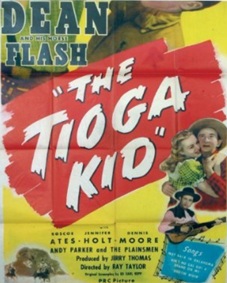
The Tioga Kid (1948, directed by Ray Taylor)


Singing Ranger Eddie Dean (played by the same-named Eddie Dean) and his sidekick, Soapy Jones (Roscoe Ates), are sent to track down the Tioga Kid, an outlaw who happens to look just like Eddie.  Soapy suggests that The Tioga Kid could be a long lost twin brother.  Eddie isn’t sure because his parents were killed in an Indian ambush when he was just a baby.  This seemed to be the backstory for many of Poverty Row’s favorite western heroes.

Dean plays both Eddie and the Tioga Kid.  You can tell them apart because the Tioga Kid doesn’t sing and always dresses in black while Eddie dresses in white and won’t stop singing.  Twin rivals were another big thing when it came to B-westerns.  Thanks to then revolutionary split-screen technology, matinee audiences could enjoy the sight of their favorite heroes shooting at themselves.  Eddie Dean was usually cast as a mild-mannered hero so he really seems to enjoy the chance to be bad as the Tioga Kid.

The Tioga Kid is a film that will be appreciated by those who are already fans of B-westerns.  The Tioga Kid was made late in the B-western cycle and there are a lot signs that it was made in a hurry.  There’s a scene involving a stunt man where he’s not even wearing the same shirt as the person he’s standing in for.  Matinee audiences probably didn’t mind.  They were too busy watching Eddie Dean shoot at himself and cheering him on during the movie’s big fist fight scene.  Eddie Dean may not have been a great actor but he could throw a punch with the best of them.

Rainbow Valley (1935, directed by Robert N. Bradbury)


In the early 1900s, the town of Rainbow Valley is trying to complete a road that will connect it to another town.  Outlaw Rogers (LeRoy Mason) doesn’t want that road finished because he wants to buy up all the land around Rainbow Valley.  He brings in a hired gun named Galt (Jay Wilsey) to intimidate the townspeople.  When a traveler named John Martin (John Wayne) saves mail carrier George Hale (George “Gabby” Hayes) from the outlaws, the townspeople ask Martin to serve as their marshal and to help finish the road.  Martin agrees but it turns out that he and Galt have a history.

This was one of the B-westerns that John Wayne made before Stagecoach made him a major star.  Wayne gives a confident performance as John Martin.  It’s about as close to a traditional John Wayne performance as you are likely to find in his early films.  It’s a good and short western, with enough gunfire and tough talk to appeal to fans of the genre.

The most interesting thing about this film is that it takes place at the turn of the century, when the old west was being replaced by the modern world.  Everyone in town is amazed that George Hale drives a car.  John says that it’s the first car that he’s ever actually seen.  Of course, this is a western and all the important work is done on horseback.  The best part of the movie is when George realizes that he and Miss Eleanor (Lucille Brown) can’t drive to warn John about an ambush because the car is out of gas and there’s not a filling station to be found.  Eleanor can’t ride a horse so he does the next best thing.  He has the horses pull his Model T like a wagon!

Four years after this movie came out, John Wayne starred as The Ringo Kid in Stagecoach.  In Rainbow Valley, he showed that he was already a star.

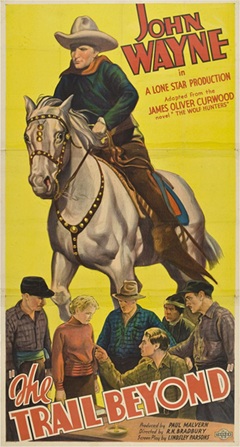
The Trail Beyond (1934, directed by Robert N. Bradbury)


Falsely accused of murder, Rod Drew (John Wayne) and his buddy Wabi (Noah Beery, Jr.) jump off a train and end up in the Canadian wilderness, where they eventually find a deserted cabin, a map to a gold mine, and plenty of trouble when French-Canadian outlaw Jules LaRocque (Robert Frazer) decides that he wants the map and kidnaps Wabi’s girlfriend, Felice (Verna Hillie), to get it.

This was one of the many B-westerns that John Wayne made in between 1930’s The Big Trail and 1939’s Stagecoach.  The film finds the youngish Wayne playing a slightly less upright character than usual.  He’s still the hero but he’s also wanted by the police and spends much of the film fleeing from them.  The movie is only 55 minutes long and the action moves quickly.  The film’s Canadian locations and Robert Frazer’s over-the-top villain gives The Trail Beyond a slightly different and quirkier flavor than most the Duke’s 1930s output.  I think this might be the only film to feature Wayne working with the Mounties.  Even in this low-budget production, John Wayne is a strong hero who just looks like he belongs on a horse and traveling across the frontier.  For someone who was the president of his high school’s Latin Club., Wayne had an automatic authenticity when it came to playing cowboys, even in the years before Stagecoach made him one of the biggest stars in the world.  This is also one of the few films to feature both Noah Beery Sr. and Noah Beery Jr.  While Beery Jr. plays Wayne’s sidekick and is in the film almost as much as John, Berry Sr.’s role is much smaller.  He’s the store owner who is also Felice’s father.

Obviously, this is a film for fans of the genre only but it’s a good example of how John Wayne could make even his Poverty Row productions entertaining and watchable.

The Lucky Texan (1934, directed by Robert N. Bradbury)


After graduating from college, Jerry (John Wayne) travels down to the ranch owned by his uncle, Grandy (George “Gabby” Hayes).  Jerry wants to look after the cattle but it turns out that Grandy doesn’t have any more cattle.  They’ve all been stolen by rustlers.  What Grandy does have is a dog, some horses, and a granddaughter named Betty (Barbara Sheldon) who Jerry is eager to marry even though the two of them are related.  Things start to look up when Grandy and Jerry discover gold in a nearby creek.  When a crooked assayer named Mr. Harris (Lloyd Whitlock) and a rustler named Joe Cole (Yakima Canutt) find out about the creek, they scheme to steal both it and the ranch from Grandy.  It’s up to Jerry to save the ranch and to expose the bad guys, even after they attempt to frame him for murder.  Fortunately, both Jerry and Grandy have a few tricks up their sleeves.

This was one of the many B-westerns that John Wayne did for the poverty row studios in the years before Stagecoach made him a star.  (Though the film is a western with its ranches and its search for gold, the climax features Gabby Hayes driving a car so it’s hard to say for sure when it’s supposed to be taking place.)  Though he seems too old to be playing a recent college graduate (John Wayne was 27 when he starred in The Lucky Texan but he looked closer to 40), Wayne gives a relaxed and likable performance as Jerry.  Watching him in this film, it’s possible to see hints of the screen presence that led to John Ford casting him as the Ringo Kid in Stagecoach.  As always, Yakima Canutt is on hand to do some impressive stuntwork during the film’s many chase scenes and Gabby Hayes provides the comic relief.  Like most of the poverty row productions, the film can seem more than a little creaky by today’s standards but fans of John Wayne will not be disappointed with either his performance or the film’s action.