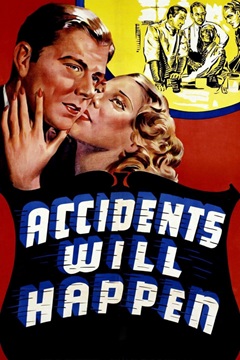
Accidents Will Happen (1938, directed by William Clemens)


Eric Gregg (Ronald Reagan) is an insurance claims adjuster who works hard, always has a cheerful attitude, and is inexplicably married to a greedy, dishonest woman named Nona (Sheila Gregg).  When Nona, sick of not being able to afford to live like a rich person, starts claiming to be a witness to accidents that didn’t really happen, it leads to Eric losing his job.  Eric is also dumped by Nona, who heads off to Reno.  Luckily, Patricia (Gloria Blondell), who works as the candy counter clerk at Eric’s office building, is just as eager to hook up with Eric and he is with her.

But what’s this?  Soon, Eric and Patricia are running insurance scams of their own and Eric is being recruited into a gang of fraudsters that’s led by Blair Thurston (Addison Richards).  Has Eric gone bad or does he have something else up his sleeve?

Accident Will Happen is one of the many B-movies that Ronald Reagan made before he briefly became a star as the result of Knute Rockne — All American and Kings Row.  It’s only 62 minutes long and the story moves quickly. The plot features a pretty obvious twist and it ends with some courtroom theatrics that I doubt anyone could have gotten away with in real life.  As with most of his B-performances, Reagan is likable even if there’s not much depth to his character.  Watching him hit bottom and then climb back up is satisfying because Reagan is so affable in the role.  Accidents Will Happen also stands out for its portrayal of an unhappy marriage, with Eric not realizing how miserable and greedy Nona is until she leaves him when he needs her the most.  Luckily, Gloria Blondell (who was the sister of Joan Blondell) is cute and perky and a far better match for our Reagan.  In the end, Ronald Reagan defeats insurance fraud as surely as he defeated the Soviets in the Cold War.
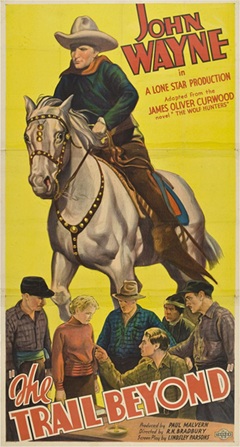
The Trail Beyond (1934, directed by Robert N. Bradbury)


Falsely accused of murder, Rod Drew (John Wayne) and his buddy Wabi (Noah Beery, Jr.) jump off a train and end up in the Canadian wilderness, where they eventually find a deserted cabin, a map to a gold mine, and plenty of trouble when French-Canadian outlaw Jules LaRocque (Robert Frazer) decides that he wants the map and kidnaps Wabi’s girlfriend, Felice (Verna Hillie), to get it.

This was one of the many B-westerns that John Wayne made in between 1930’s The Big Trail and 1939’s Stagecoach.  The film finds the youngish Wayne playing a slightly less upright character than usual.  He’s still the hero but he’s also wanted by the police and spends much of the film fleeing from them.  The movie is only 55 minutes long and the action moves quickly.  The film’s Canadian locations and Robert Frazer’s over-the-top villain gives The Trail Beyond a slightly different and quirkier flavor than most the Duke’s 1930s output.  I think this might be the only film to feature Wayne working with the Mounties.  Even in this low-budget production, John Wayne is a strong hero who just looks like he belongs on a horse and traveling across the frontier.  For someone who was the president of his high school’s Latin Club., Wayne had an automatic authenticity when it came to playing cowboys, even in the years before Stagecoach made him one of the biggest stars in the world.  This is also one of the few films to feature both Noah Beery Sr. and Noah Beery Jr.  While Beery Jr. plays Wayne’s sidekick and is in the film almost as much as John, Berry Sr.’s role is much smaller.  He’s the store owner who is also Felice’s father.

Obviously, this is a film for fans of the genre only but it’s a good example of how John Wayne could make even his Poverty Row productions entertaining and watchable.

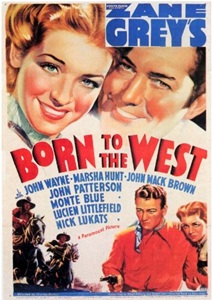
Born To The West (1937, directed by Charles Barton)


John Wayne plays Dare Rudd, a friendly rogue who aspires to be the best poker player west of the Mississippi.  When he and his sidekick, Dinkey Hooley (Syd Saylor), ride into Montana, they meet up with Dare’s cousin, Tom Filmore (Johnny Mack Brown, billed as John here).  Filmore needs some help on his cattle drive and Dare sure does like Tom’s girl, Judy (Marsha Hunt).  Dare replaces Lynn Hardy (John Patterson) as head of the cattle drive and Lynn teams up with rustler Bart Hammond (Monte Blue) to try to get revenge.  While Dinkey tries to sell lightning rods, Dare moves the herd and even finds time to play poker with notorious gambler Buck Brady (James Craig).

This is another one of the B-westerns that John Wayne made before John Ford made him a stars by casting him in Stagecoach.  This one is interesting because Wayne is not playing his usual stolid do-gooder or even an expert marksman.  Instead, Dare is impulsive and reckless and he’s ultimately not as smart a card player as he thinks he is.  It’s rare to see John Wayne need help from anyone but that’s what he gets from Johnny Mack Brown, who shows up in time to reveal that Dare is getting cheated in his poker game.  For fans of the genre, this short oater is worth watching for the chance to see two western icons acting opposite each other.  Johnny Mack Brown and John Wayne would both go on to appear in a countless number of westerns.  Wayne became a superstar, appearing in big budget studio films.  Brown remained a mainstay on the B-circuit.  They’re amusing to watch in this film as they bounce dialogue off of each other and continually try to steal scenes from one another.  Brown is playing the type of no-nonsense, hard-working westerner who would later become John Wayne’s trademark character.

Based on a novel by Zane Grey, Born to the West is a fast-paced western featuring two of the best to ever ride a horse.

Idaho Kid (1936, directed by Robert F. Hill)


When the wife of rancher Clint Hollister (Earl Dwire) died in childbirth, Clint was so distraught that he rejected his son, Todd.  Todd was raised by a rival rancher, John Endicott (Lafe McKee).  Hollister resented Endicott for taking his son and a feud developed between the two families.  Hoping the end the feud, 15 year-old Todd ran away from home and made a new life for himself as a frontier scout named Idaho.

15 years later, Idaho (Rex Bell) returns home with his sidekick, a reformed outlaw known as The Kid (David Sharpe).  Neither Hollister nor Endicott recognize Idaho and, without revealing his identity, Idaho tries to stop their feud.  Hollister’s men want to keep the feud going and they manipulate Hollister into challenging his own son to a duel.

Idaho Kid is one of the better B-westerns that Rex Bell made between 1928 and 1936.  Though the film has its share of action scenes, Idaho Kid‘s intelligent script puts more emphasis on character development than most B-westerns, with Hollister especially being portrayed as a complex character as opposed to just a stock western villain.  Rex Bell always seemed authentic whenever he was riding a horse or shooting a gun.  Idaho Kid shows that he could also play more than just a standard western hero.

Though he was being pushed for stardom by Fox Film, Rex Bell voluntarily retired from the film industry in 1936 and instead pursued a career in politics.  He was the Lieutenant Governor of Nevada when he died of a heart attack in 1962.


The Lucky Texan (1934, directed by Robert N. Bradbury)


After graduating from college, Jerry (John Wayne) travels down to the ranch owned by his uncle, Grandy (George “Gabby” Hayes).  Jerry wants to look after the cattle but it turns out that Grandy doesn’t have any more cattle.  They’ve all been stolen by rustlers.  What Grandy does have is a dog, some horses, and a granddaughter named Betty (Barbara Sheldon) who Jerry is eager to marry even though the two of them are related.  Things start to look up when Grandy and Jerry discover gold in a nearby creek.  When a crooked assayer named Mr. Harris (Lloyd Whitlock) and a rustler named Joe Cole (Yakima Canutt) find out about the creek, they scheme to steal both it and the ranch from Grandy.  It’s up to Jerry to save the ranch and to expose the bad guys, even after they attempt to frame him for murder.  Fortunately, both Jerry and Grandy have a few tricks up their sleeves.

This was one of the many B-westerns that John Wayne did for the poverty row studios in the years before Stagecoach made him a star.  (Though the film is a western with its ranches and its search for gold, the climax features Gabby Hayes driving a car so it’s hard to say for sure when it’s supposed to be taking place.)  Though he seems too old to be playing a recent college graduate (John Wayne was 27 when he starred in The Lucky Texan but he looked closer to 40), Wayne gives a relaxed and likable performance as Jerry.  Watching him in this film, it’s possible to see hints of the screen presence that led to John Ford casting him as the Ringo Kid in Stagecoach.  As always, Yakima Canutt is on hand to do some impressive stuntwork during the film’s many chase scenes and Gabby Hayes provides the comic relief.  Like most of the poverty row productions, the film can seem more than a little creaky by today’s standards but fans of John Wayne will not be disappointed with either his performance or the film’s action.