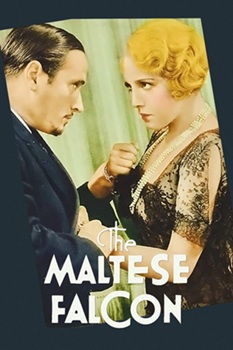
The Maltese Falcon (1931, directed by Roy Del Ruth)


Detective Sam Spade (Ricardo Cortez) may be an immoral lech but when his partner, Miles Archer, is murdered, Sam sets out to not only figure out who did it but to also eliminate himself as a suspect.  Sam was having an affair with Miles’s wife, Ivy (Thelma Todd).  Sam’s investigation leads to him falling for the mysterious Miss Wonderly (Bebe Daniels) and getting involved with a trio of flamboyant criminals who are searching for a famous relic, the Maltese Falcon.  Dudley Digges plays Casper Gutman.  Otto Matieson plays Dr. Joel Cairo.  Dwight Frye plays the gunsel, Wilmer, who Gutman says he “loves … like a son.”

The first film adaptation of Dashiell Hammett’s classic detective novel is overshadowed by the version that John Huston would direct ten years later.  That’s not surprising.  There’s a lot of good things about the first version but it’s never as lively than John Huston’s version and neither Dudley Digges nor Otto Matieson can compare to Sydney Greenstreet and Peter Lorre.  Of the supporting cast, Dwight Frye makes the best impression as the twitchy Wilmer and Bebe Daniels and Thelma Todd are both sexy as the story’s femme fatales.  That doesn’t mean that they’re better than their counterparts in John Huston’s film.  It just means they all bring a different energy to their roles and it’s interesting to see how the same story can be changed by just taking a slightly different approach.  Elisha Cook, Jr. was perfect for Huston’s version of the story.  Dwight Frye is similarly perfect for Roy Del Ruth’s version.

Needless to say, Ricardo Cortez can’t really compare to Humphrey Bogart.  But, if you can somehow block the memory of Bogart in the role from your mind, Cortez actually does give a good performance as Spade.  Because this was a pre-code film, Cortez can lean more into Spade’s sleaziness than Bogart could.  Also, because this was a pre-code film, the first Maltese Falcon doesn’t have to be as circumspect about the story’s subtext.  Spade obviously tries to sleep with every woman he meets and is first seen letting a woman out of his office.  (The woman stops to straighten her stockings.)  Gutman and Cairo’s relationship with Wilmer becomes much more obvious as well.  What’s strange is that, even though this Maltese Falcon is pre-code, it still ends with the type of ending that you would expect the production code to force onto a film like this.

If you’re going to watch The Maltese Falcon, the Huston version is the one to go with.  But the first version isn’t bad and it’s worth watching for comparison.
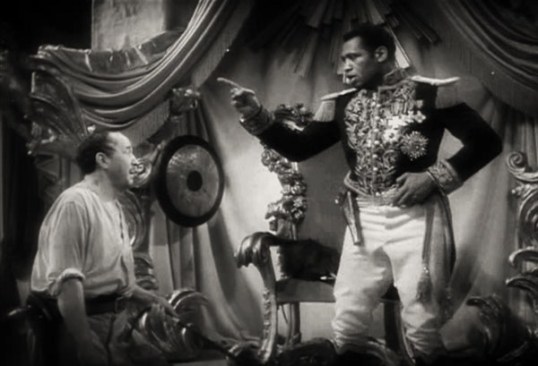
Cleaning Out The DVR Yet Again #23: The Emperor Jones (dir by Dudley Murphy)


(Lisa recently discovered that she only has about 8 hours of space left on her DVR!  It turns out that she’s been recording movies from July and she just hasn’t gotten around to watching and reviewing them yet.  So, once again, Lisa is cleaning out her DVR!  She is going to try to watch and review 52 movies by the end of Sunday, December 4th!  Will she make it?  Keep checking the site to find out!)

emperor-jones

On November 8th, I recorded the 1933 film The Emperor Jones off of Retroplex.

Based on a play by Eugene O’Neill, The Emperor Jones tells the story of Brutus Jones (Paul Robeson).  When we first meet Jones, he’s at a small Baptist church.  He has recently gotten a job as a Pullman Porter and the church’s congregation has gathered for his send off.  He shows off his uniform.  He sings a spiritual.  The congregation blesses him and Jones swears that he will make them proud.  However, soon after he starts working for the railroad, he finds himself in the city.  Though he’s a hard worker, he makes the wrong friends.  He falls for the beautiful but cold-hearted Undine (Fredi Washington).  A fight at a craps gang leads to Jones accidentally stabbing his friend, Jeff (Frank H. Wilson).

Jones is sentenced to hard labor and finds himself working on a chain gang, where he’s watched over by sadistic and racist guards.  Jones attempts to serve his time but, eventually, he’s driven to violence by the sight of a white guard beating another prisoner.  Jones attacks the guard and then flees.  Eventually, he escapes on a steamer ship.  Quickly growing tired of shoveling coal in the ship’s engine room, Jones jumps overboard and swims to a nearby island.

On the island, Jones meets Smithers (Dudley Digges).  Smithers is an alcoholic merchant who also happens to be the only white man in the island.  Working with Smithers, Jones convinces the natives that he has magical powers and overthrows the island’s previous dicttor.  Now thoroughly corrupted, Jones declares himself to be the Emperor Jones…

Interestingly enough — and this was probably especially revolutionary in 1933 — almost all of Jones’s corruption is learned from dealing with the white world.  It’s through dealing with the condescending and wealthy passengers on the train that Jones comes to understand that money equals power.  It’s from dealing with the white guards on the chain gang that Jones learns how people can be controlled through fear and brutality.  By the time Jones arrives on the island, he no longer has anything to learn from the white world.  Hence, Smithers becomes his servant.

(One thing I found particularly interesting, as I did research for this review, was that The Emperor Jones was banned in cities in both the North and the South.  In the North, the film was often banned for its frequent use of the n-word.  In the South, it was largely banned because of a scene in which Jones orders Smithers to light his cigarette.)

Seen today, The Emperor Jones is something of an oddity.  On the one hand, it’s a very stagey film.  The film’s origin as a stage play is obvious in almost every scene.  On the other hand, it’s also one of the few films from the 1930s to actually feature black characters as something other than comic relief.  If just for that historical reason, The Emperor Jones is still worth watching today.

It’s also worth watching for Paul Robeson’s performance in the lead role.  Robeson, whose career was derailed by both his political activism and his refusal to accept roles that he considered to be demeaning, gives a powerful and empathetic performance.  Towards the end of the film, Robeson gives a 12-minute monologue as he runs through the jungle.  For 12 minutes, it’s just the viewer and Robeson (and the menacing sound of drums in the distance).  As Robeson delivers his final monologue, he takes us on a journey through the Emperor’s mind, alternative between periods of delusion and moments of sudden clarity.  Even 83 years after it was first filmed, it remains a truly impressive performance.

Keep an eye out for this fascinating historical document.

Horror Film Review: The Invisible Man (dir by James Whale)


the-invisible-man

The 1933 Universal horror film, The Invisible Man, never seems to get as much attention as Frankenstein, Dracula, The Wolf Man, or The Mummy.  Perhaps it’s because the invisible man really isn’t a supernatural monster.  He’s just a scientist who has turned himself invisible and is now going mad as a result.  Or maybe it’s because there have been so many crappy films that have used invisibility as a plot point that the reputation of the original Invisible Man suffers by association.

For whatever reason, The Invisible Man never seems to get spoken about in the same breathless, gleeful manner as some of the other Universal monsters.  But I have to admit that, though I usually can’t stand movies about invisibility, I rather like The Invisible Man.

Based on a novel by H.G. Wells, The Invisible Man opens with a mysterious man (played by Claude Rains) arriving in a small English village.  He checks into a small inn and soon, everyone in the village is scared of him.  It’s not just his haughty attitude or his habit of ranting about his own superiority.  There’s also the fact that he is literally covered, from head to toe, in bandages.  He always wears gloves and dark glasses.  He insists that he’s doing important research and demands to be left alone.

The inn keeper (Forrester Harvey) and his histrionic wife (Una O’Connor) put up with the mysterious man until he falls behind on his rent.  However, once confronted, the mysterious man announces that he’s not going anywhere.  When the police and a mob of villagers arrives, the man starts to laugh like a maniac.  He unwraps the bandages around his head and…

THERE’S NOTHING UNDERNEATH!

Well, there is something there.  It’s just that the man is invisible so no one can see what’s underneath.  It turns out that the man is Dr. Jack Griffin, a chemist who has been missing for several days.  He’s created an invisibility serum but he can’t figure out how to reverse the effects.  Even worse, the serum is driving him insane.  Griffin’s fiancée, Flora (Gloria Stuart), and her father, Dr. Cranley (Henry Travers), are searching for Jack but Jack doesn’t particularly want to be found.  Jack is more interested in exploring how he might be able to use invisibility to conquer the world…

The Invisible Man is historically important because it was the film that brought Claude Rains to Hollywood.  Rains has previously made films in the UK but this was his first American film.  Think of how different film history would have turned out if The Invisible Man had, as originally planned, starred Boris Karloff.  Without Claude Rains coming to America, who would have played Louis in Casablanca?  Who would have played Sen. Paine in Mr. Smith Goes To Washington or Alex Sebastian in Notorious?  Of course, we don’t really see Claude Rains’s face until the very end of The Invisible Man.  Instead, we just hear his voice but what a voice Claude had!  He delivers his dialogue with just the right amount of malicious sarcasm.

I like The Invisible Man.  For modern audiences, it’s not particularly scary.  (Though I do find the idea of being unknowingly followed by an invisible person to be a little unnerving…)  However, unlike a lot of other old horror films, you can watch The Invisible Man and see why it would have been scary to an audience seeing it for the very first time.  In 1933, a time when film was still a relatively new medium and audiences had yet to become jaded by special effects, here was a man unwrapping his bandages to reveal that there was nothing underneath!  That had to have freaked people out!

The Invisible Man was directed by James Whale and the film features the same demented sense of humor that distinguished The Bride of Frankenstein.  The villagers are portrayed as being so hysterical that you can’t help but think that maybe Griffin has a point about being surrounded by fools.  By the time the local constable declares, “What’s all this then?,” you can’t help but start to sympathize with Jack Griffin.

There’s been a lot of  bad invisibility movies made but The Invisible Man is not one of them.  It may not be as well remembered as some of the other Universal horrors but it’s definitely one worth seeing.