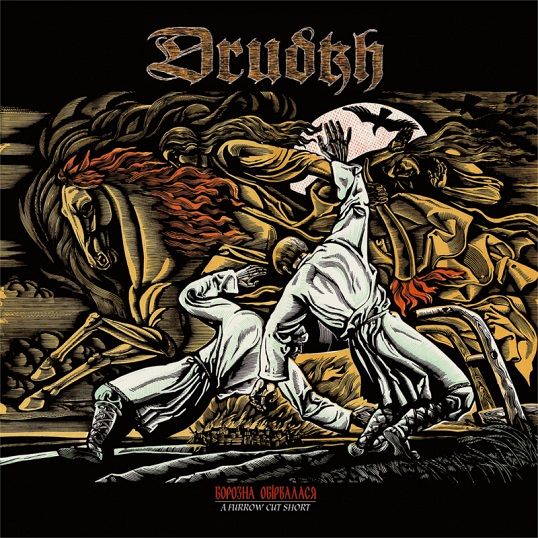
Review: Drudkh – A Furrow Cut Short


When I fired up Drudkh’s tenth studio album yesterday, A Furrow Cut Short, I was holding my breath in the dim hope that something awesome would slam into my brain from the get-go. After all, this is Drudkh. Not all of their releases have been met with equal acclaim, but they always seem to carry hype on their side.

The album began interestingly enough, with some bending tremolo guitar that kind of brought to mind Blut Aus Nord, and then I waited a bit and moved the play bar ahead. A pretty cool groove picked up around 1:50, and I rode it for a while. The song began to repeat an earlier passage with vocals tossed into the mix, and I moved the play bar ahead. There was that groove from 1:50 again. I rode it. I moved the bar ahead…

Greatness did not grace my ears in a neatly wrapped box, and that was fine. It was just a distant hope. At that point, my immediate instinct was to browse through the sixty minutes of content for all of the gripping moments that would surely rise out of the long black metal grind to knock my head around. A few came. Should I count them? Was that how best to measure this album’s worth? I started to feel a bit silly. This sort of fast-forward treasure hunt has been my subconscious approach to Drudkh for some time now. Here was a band that used to keep me wide-eyed through ten minute tracks as I waited for the peaks to overwhelm me, and over the course of ten albums the appeal had been reduced to skimming. What changed?

The production changed. That’s for certain. Since Microcosmos, Drudkh have been presenting a more deep and refined sound, and I don’t think it did them any favors. It was a technical improvement at the expense of the unique aesthetic appeal of their sound. They also largely left the world of folk music behind. On Songs of Grief and Solitude (2006), Drudkh reworked a variety of earlier melodies from their metal albums into a collection of instrumental folk tracks. It worked really well, and it’s something they would never be able to do with the tunes of Eternal Turn of the Wheel or A Furrow Cut Short.

Song: Cursed Sons I

<@Shad> One day
<@Shad> I will tell my children
<@Shad> That I started the Drudkh wikipedia page.

And there has been one other change. It’s something far beyond the band’s control, but it is significant: historical context. This first dawned on me when I was glancing over the reviews of A Furrow Cut Short already popping up on Encyclopaedia Metallum. One guy started off by writing “Ukraine is not a country where heavy metal thrives like in the UK or Scandinavia”. I stumbled over the words. I suppose fifteen years is a long time when you’re talking music. There are high school kids enjoying A Furrow Cut Short who weren’t born yet when Kharkiv was carving out its claim on the map of metal. That’s a little… weird for me, but it probably has a real impact on how I perceive this music too.

I will never really appreciate thrash metal, because I was never there. I encountered the genre as a prim and proper, cookie-cutter devolution of its original glory. I lacked the contextual sense that something new and monumental was overriding the standards of metal as I’d formerly known them. To me, thrash is just that sound Metallica pioneered, and I have no doubt that this perspective is woefully misguided. This same sort of historical misconception might be taking root on Ukrainian black metal. The reviewer I quoted… his statement would have been a reasonable introduction to Lunar Poetry or Goat Horns in the mid-90s, but by the time Drudkh started to gain attention, Kharkiv was no heavy metal backwater. It was a placename that you gobbled up. “Ukrainian” meant there was no need to sample an album first. You knew you wanted to hear it.

Nokturnal Mortum put Kharkiv on the map, and Knjaz Varggoth’s brainchild still stands leagues above anything else east of Prussia in my book. But Knjaz is also a racist piece of shit, and I can’t say I feel bad that the history books have been rewritten to regard Drudkh as the mother of all Ukrainian black metal. Still, we can’t forget the pre-existing spirit in which this band emerged. Standardized black metal was all about LaVeyan Satanism back then, its music a sort of declaration against society’s disposition to enforce religious values. “Satan” was a shallow facade, and once the point was made, the scene stagnated. Nokturnal Mortum ignited something novel by merging second-wave black metal’s counter-cultural rage with a sort of Bathory-esque true reverence for the old gods. Their music was as hateful as anything Mayhem or Emperor had produced, but it was also rabidly pagan. NeChrist slaughtered the tenets of modern society, smeared their blood across its chest, and danced naked on the pyre.

And that, to me at least, was the spirit of Ukrainian black metal entering the 21st century. It was not merely violent and destructive, but also highly contemplative. The means varied from band to band, but the idea was to bring a bygone spirituality to life. Musically, the tremolo and blast beats found themselves in the company of massive, sweeping auras of sound that might at any minute break into traditional melodies more savage and tribal than anything the co-emerging folk metal scene had to offer. Astrofaes and Hate Forest were two of the earliest bands to emerge from Kharkiv in this new tradition. Astrofaes, headed by Thurios, was the more melodic of the two, with forlorn chord progressions and folk allusions comparable to early Drudkh. Hate Forest, on the other hand, remains one of the most brutal bands I’ve ever heard. It was Thurios’ original collaboration with Roman Saenko, and it was so uncompromisingly violent and minimalistic that it made the most hellish Norwegian offerings feel tame. Yet it was entirely meditative. If Varg Vikernes popularized the notion of black metal as a trance-inducing journey, Hate Forest went leaps and bounds towards perfecting it.

When Thurios and Saenko went on to form Drudkh, the product was more tame than either of their parent projects. Thurios brought the folk and raw melody-crafting via Astrofaes, while Saenko added the trance state and fine touch for aesthetics. At least, that’s how I’ve interpreted it. I certainly can’t offer any informed view into their song-writing process. In any case, what they crafted, not so much on Forgotten Legends but definitely on Autumn Aurora, The Swan Road, and Blood in Our Wells, was totally unique and beautiful. But it did not feel unique to perhaps the extent that it really was. It felt like a brilliant addition to a scene that entailed so much more. (In more than one sense, and not all positive. I am sure the reviewer I mentioned must find it bizarre that almost every summary of Drudkh begins with a preface that they disavow all ties to racism/extremist ideologies.)

Song: To the Epoch of Unbowed Poets

I take two things from this. One is that Drudkh’s earlier sounds float on a cloud of nostalgia. An album that sounded a hell of a lot like Autumn Aurora would really excite me even if it was not half as good, because it would transport me back to a special place and time. The other is that a once unprecedented sound has become pretty common fair. Atmospheric black metal was not invented in Ukraine, but its modern roots run deep there. A lot of bands around the world have since come along and done more with it. They’ve taken it other places–incorporated it into other, equally novel sounds. Saor is a good recent example. In heaping praise on Andy Marshall’s solo project last year, I passively mentioned that it accomplishes its goal “without ever really breaching any new territory beyond the tried and true boundaries of pagan metal”. Well, Drudkh and the Ukrainian scene in general established a lot of those boundaries. And other bands took it further still, to the point where I could speak of an album like Aura without ever thinking “wow, this is original”.

A Furrow Cut Short has some really stand-out tracks. The two I sampled here especially struck me. But it is also lost in time. Changes to production and an abandonment of folk render the modern Drudkh incapable of reaching to the same plain of aesthetics that they once knew. I don’t think it incorporates anything new, either, that might allow me to hear it as a great example of where metal stands today. This album must stand or fall exclusively on its in-born aesthetic value, while competing with the vibe that it is a watered down version of what the band used to be.

That value is, well, average. You can get into the album if you try, but it will not sweep you off your feet. I am not one of these people who cling to the past and expect a band or style to sound exactly like it used to. I am always willing to humor “where are they headed now”, and I have a good deal of respect for what Drudkh did on Handful of Stars even if it didn’t much move me (or seemingly anybody else). At least they were trying to do something. Even Eternal Turn of the Wheel showed motion. A shying away from change, but motion at least, and I modestly enjoyed it for that. A Furrow Cut Short goes nowhere, and that fact drives home the feeling that this band’s sound has grown really stale.

I am a bit torn about A Furrow Cut Short. A part of me thinks “why did they bother?”, but a wiser side enjoys tracks like “Cursed Sons I” and “To the Epoch of Unbowed Poets” way too much to pretend I’d be better off without them. Still, I’m probably never going to listen to this album again. Maybe a quick revisit at the end of the year. There are just too many other bands doing something more original. And too many classics I’d rather rehash, for that matter. It’s strange, because Thurios, Saenko, and the rest of the crew haven’t lost their touch at all. They are doing great things with Blood of Kingu, and Dark Star on the Right Horn of the Crescent Moon would have definitely made my top albums list for 2014 if I had caught it in time. But considering every single member of Drudkh is in that band, I don’t get why Drudkh continue to sound so… redundant.

The album’s available via Season of Mist.
Ten Years #37: Drudkh


Decade of last.fm scrobbling countdown:
37. Drudkh (841 plays)
Top track (67 plays): Fate, from The Swan Road (2005)

Ukraine was my gateway into black metal. My earliest exposure to bm in general was met with a closed mind; I remember picking up IX Equilibrium not long after it came out, hearing nothing but distortion and blast beats, and wondering what all the fuss was about, as if its brilliant classical component was non-existent. But somehow Nokturnal Mortum’s Goat Horns blew my mind on first exposure, when I was still a teenager rocking out to In Flames, Opeth, Iced Earth and the like. That pagan spirit screaming murder beneath a wall of chaos struck me with more force than “satanic” or “progressive” bm ever would, then or now. I spent a substantial chunk of my paychecks at The End Records in the years that followed, and I was not searching for “black metal” so much as “Ukraine”. The consequence was that I got to enjoy bands like Drudkh, Hate Forest, and Astrofaes before it was “cool” to do so. (Let’s face it, hype always influences our perspective on a band in one way or another, whether we like to admit it or not.)

Drudkh quickly became my second favorite band in that scene after Nokturnal Mortum, and what I have heard in them over the years is nothing like the steady degradation from Forgotten Legends downward that supposedly “old school” fans are inclined to proclaim. I don’t know why so many people see Drudkh as a one-track band. Perhaps it is because the rate at which they release new material softens perception of the major shifts in their evolution as artists. Handful of Stars (2010) was the only album on which fans actually had to stop and go “wait, is this still Drudkh?”, and the band answered that question decisively with the Slavonic Chronicles EP. But if you listen to Drudkh as a band who played the same solid thing for four or five albums and then got too successful and lost their touch, you’re fairly misguided. It’s true that their first three albums have a lot of similarities. I sort of feel as though their vision on all three was roughly the same, with Swan Road (2005) marking the point at which they had enough recording experience to really make their sound fully capture that vision. The band has rarely repeated the same sound since. Blood in Our Wells (2006), my personal favorite, was a tremendous shift in favor of their pagan undertones, with songs like “Solitude” and “Eternity” crushing the listener through anthems more than atmospherics. Songs of Grief and Solitude (2006) was perhaps the best folk interlude album in black metal since Ulver famously did it, and Estrangement (2007) completely revisioned their sound, replacing characteristic deep plods with rabid, shrill blast beats and grittier production. Microcosmos (2009) was a significant change in production towards the other end of the spectrum, and I rather doubt the gut-wrenching quality of “Ars Poetica” (a song I still think has an almost screamo vibe to it at the climax) would have hit home so forcefully otherwise.

Drudkh’s trip to France on Handful of Stars (2010) may have left some fans disgusted, but it would be frankly stupid to call a band so consistently open to change “sell-outs” the moment their vision failed to reflect stereotypical expectations of aggression, masculinity, whatever the fuck tr00 cvlt dandies demand. And anyone who thinks Eternal Turn of the Wheel (2012) was some grand return to the good old days is in stark denial of the (I think quite intentional) persistent French influence underlining this newest chapter in their discography.

If I seem to be taking a defensive stance here, it might be in part because I’m arguing against my own initial inclinations. I’ve made the shallow mistake of blowing off Drudkh as washed up many times before, and I never fail to regret it once I’ve given the album in question substantially more time to grow on me. (My initial review here of Eternal Turn of the Wheel was cautiously negative. Today I would say it’s great.) I think over the years I’ve developed some boneheaded stereotype of Ukraine as a third world nation–an opinion based mainly on Ukrainian Americans whose pseudo-heritage reeks of self-debasing Cold War propaganda and “world music” zines. (“Only my American non-profit organization can preserve the endangered culture of our pathetic, eternally oppressed, utopianly pacifistic Slavic ancestors! I’ll give you a cultural awareness award and my new Carpathian-Caribbean fusion cd! Buy my shitty handicrafts! Send money!”) I try to forget about it and remind myself that these people are the ultimate American idiots with no actual connection to the people they pretend to represent, but I still find it hard at times to give Slavic musicians the intellectual credit they deserve. Roman Saenko and co are actually among the most intelligent musicians of our generation, and when I remind myself of that and revisit their discography, I realize again that it has been consistently solid from start to finish.

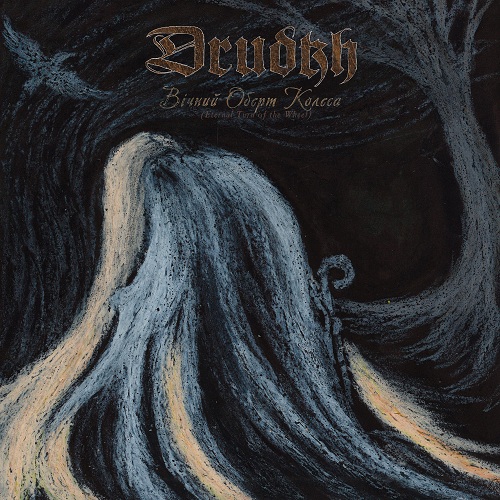
Review: Drudkh – Eternal Turn of the Wheel


Another year, another Drudkh album. It’s something we’ve come to expect from a band that’s pumped out 9 full length albums in the past decade. Their last release, Handful of Stars, was pretty universally denounced as their weakest album to date, and perhaps there is something to be said for the fact that they skipped over 2011 without a new one. Eternal Turn of the Wheel makes a clear shift away from the direction they had been heading in, returning to a style more in keeping with their earlier releases.

Breath of Cold Black Soil

The question is what they gained from that transition. The sound is certainly in touch atmospherically with the old vibe fans have been clamoring for a return to. If you’ve been following Drudkh from the get-go, there is definitely something refreshing about this one. I am instinctively inclined to engage it, whereas Handful of Stars kind of lost me and I never gave it the proper listening time a Drudkh album deserves.

But that’s not to say they’ve gotten better, nor that they were getting progressively worse before. Drudkh have always had their ups and downs. When you come close to releasing an album every year for a decade, it’s bound to happen. It’s difficult as a fan to even keep up with them. If the music doesn’t strike me pretty readily I put it off for a bit, and by the time I do get around to it the next release is already in the mail.

Eternal Turn of the Wheel will gain some attention because it presents at the surface what people have been looking for for a while now. I think if Drudkh had, alternatively, stuck to the same general sound all along, this one would be pretty readily forgotten.

Night Woven of Snow, Winds and Grey-Haired Stars

Beneath the surface, it’s just a little lacking in creative song writing. It’s quite nice by the standard of average atmospheric black metal, but from Drudkh I tend to expect a little bit more. On Swan Road and Blood in Our Wells especially they managed to merge this sound with absolutely superb song writing, and the latter was the selling point that really projected them from just another Ukrainian black metal band to legends of the genre.

I think the Microcosmos haters heard a stylistic watershed and immediately cashed in their opinions. The shift didn’t phase me at the time, because I think the song writing that really propels them was present in full form. The further changes on Handful of Stars were a bit more of an immediate turn-off, but I’ll venture to make the potentially bogus claim that the song-writing, not the style, ultimately accounts for my having never given it a good and thorough listen.

I’d argue that the song-writing on Eternal Turn of the Wheel is really not appreciably better, but in returning to an old school Drudkh sound they at least compelled me to leave it on repeat for a day. Don’t expect any of the tracks to overwhelm you the way Eternity or Solitude do, or Ars Poetica for that matter. It’s pretty cut-and-dry, generic Drudkh, and it’s crucially lacking any sort of subtle Ukrainian folk undertone. I would be lying if I pretended to not appreciate their return to black metal, but all in all this album is nothing special… at least by Drudkh standards. It will still rightfully go down as one of the better releases of 2012.

Review: Waldgeflüster – Femundsmarka: Eine Reise in drei Kapiteln


Here is an album that should appeal first and foremost to fans of Agalloch. Waldgeflüster is a rather recent creation. The one-man project was started by Winterherz in Germany in 2005 and released its second full length this past May. I can’t speak for his first album, but Femundsmarka definitely deserves more attention than it’s bound to get. A product of that marriage of black metal and ambient folk that has become rather common these days, it might not reach the very top but it certainly rises above the status quo.

Interlude II: Night

Unfortunately most of the folk and ambient tracks of the album aren’t available on youtube. This one, as much as I love it, is my least favorite of the four. Just consider that while the vibe this track offers is present throughout the album, the musical styles creating it vary. The intro and outro make use of acoustic guitar, and the first interlude is a beautiful ambient piano piece.

The concept of the album is pretty self explanatory, but requires a bit of German translation. Femundsmarka is a national park situated in the mountain range separating Norway from Sweden, and the album is a musical retelling of the artist’s travels there, translating literally as “Femundsmarka: A Journey in Three Chapters”. The track list, roughly, translates to:

Prologue: Departure
Chapter 1: Lakeland
Interlude: Rest
Chapter 2: Stony Deserts
Interlude: Night
Chapter 3: Spruce Grove
Epilogue: Homecoming

Generally speaking, the main chapters are black metal and the in-betweens are folk, but there is plenty of cross-over both ways.

Chapter 1: Lakeland

So if many of the metal portions of the album are as reminiscent of Drudkh as the folk bits are of Agalloch, it should come as no surprise that all three bands highlight nature as their main theme. I could go about comparing them all, but I don’t think it would be entirely fair. This isn’t some monumental standard-setting album like Swan Road or Pale Folklore, nor does it strive to be.

And any first impressions that Winterherz is just copying other artists’ styles should vanish around the 2:30 mark anyway. It commences the most descriptive movement of the album, as you can hear the traveler begin to comprehend the beauty that surrounds him, exploding in a final triumphal realization around 4:20.

The work certainly isn’t perfect. I struggled at times in Chapters 2 and 3 to remember that Winterherz was trying to show me something and not just writing another metal album. But its high points are pretty great, and the only standard you might say it falls short of at times is its own–it’s consistently good, just not consistently visual. The introduction, interludes, and outro are my favorite moments, and give the album a higher degree of stylistic variance than most metal of its kind. The more subdued entries aren’t sparse, either, filling up nearly half of the album.

In the absence of a full track list on youtube, someone took the effort to compile an eight minute sample of the album that covers a lot of ground without revealing too much. I’ll leave you with this. If you have to buy it to hear the rest, well, your money will be well spent. Not an album of the year contender, but a pleasant surprise from an artist you’ve probably never heard of.

A Celebration for the Death of Man…: Music for October (part 2)


Folk metal, pagan metal, viking metal, these terms all share a common root in black metal, starting with Bathory’s stylistic transition in the late 80s. I decided to break the rest of this down into my top 20 straight up black metal songs and this, my top 25 songs that extend beyond the genre without breaking from it wholesale. I’ve obviously taken a lot of liberties in determining what goes where. Don’t regard this as any sort of ordering of favorites so much as the order I happened to settle on after a number of considerations.

I think black metal is one of the most diverse genres to be found, and rather than trying to divide up a dozen sub-genres, I’d like to highlight through twenty five songs the vast world lying beneath blast beats and tremolo picking.


25. Ceremonial Embrace – Mysterious Fate
I know very little about this band. They appeared out of Finland in 2000 to release one fairly average album and then disappear back into obscurity. The opening track however, Mysterious Fate, is an impressive take on a sound you might associate with Windir – staccato synth supported by sweeping slower moments that focus heavily on melody without ever really ceasing to be black metal.


24. Enslaved – Clouds
One of the original “second wave” black metal bands, Enslaved (along with ex-Emperor frontman Ihsahn) really pioneered the transition from the raw style into something much more complex. I like to think of this song, off their 2008 release Vertebrae, as one of the better tracks to exemplify what you might call “post-black”, a prefix that, as in all other genres, can suggest a dozen different things and might be better seen as an approach to music than a stylistic trait. You might alternatively call this progressive black metal, though I like to restrict my usage of that term.


23. Astrofaes – Path to Burning Space
If black metal in the 90s meant Norway, black metal in the 2000s meant Ukraine. This, one of Astrofaes’s earliest works, really shows both the all-encompassing guitar and the folk elements that have come to define a lot of what is Ukrainian black metal. They weren’t the first to really capitalize on these – that credit belongs to a band I’ll be showcasing frequently herein – but in exploiting them they really helped to make “Ukrainian black metal” something distinct and recognizable.


22. Hellveto – Warpicture
When Poland’s Hellveto first started to make their mark in the early 2000s I remember hearing them described as “war metal”, a term that has since fallen into disuse. While this music would today be called pagan metal, with maybe an “orchestral” additive, at the time it was something really unique, and it still stands apart as decidedly different from the Russian bands, like Arkona and Pagan Reign, that helped pioneer the genre.


21. Nokturnal Mortum – Perun’s Celestial Silver
Welcome to the first of many entries I’ve slotted for what I consider to be the greatest black metal band of all time: Nokturnal Mortum. To merely credit them with the explosion of black metal in Ukraine is to miss how completely unique their music still is. No one has managed this sound before or since – primitivism in its ideal. The shrill, lo-fi guitars, the violent brutality of Russian and Ukrainian that Germanic languages don’t quite encompass, a folk sound that is both beautiful and enraged… This isn’t just a statement about the past, it is a violent declaration of war on the present. It is unfortunate that the band has yet to get over their stance on white supremacy and their virulent antisemitism (this song appears as track 88, a neo-nazi symbol for “Heil Hitler”), but it is also a testament to the authenticity of their sound.


20. Drudkh – Ars Poetica
Drudkh have put out eight albums and one EP since 2003, making them one of the most prolific metal bands on the market. Were that not enough, almost every member has played a role in at least one other prominent Ukrainian black metal band during this time. They’ve had their ups and downs, and 2009’s Microcosmos received its fair share of criticism, but I struggle to find any fault in this track. Dark, intense, reverent, in Drudkh can be heard the same renunciation of the present and praise for a distant past that characterizes Nokturnal Mortum (although without the racist undertones, though a sort of guilt by association has still landed them on many a list of nsbm bands.)


19. Triglav (Триглав) – The Warrior of Honour
Like Nokturnal Mortum, Drudkh, and Astrofaes, Triglav hail from Kharkiv, Ukraine. A lesser known band of the scene, having only released one album, theirs is a pagan metal sound that owes much more to black metal than most.


18. Ihsahn – A Grave Inversed
Enough with Ukraine. I take you now to Ihsahn, former Emperor front-man and possibly the most talented musician to emerge from black metal. “Progressive” anything in metal terms conjures to my mind an obnoxious, pretentious focus on esteeming technical skill over song writing (maybe I just heard way too much Dream Theater when I was in high school), but Ihsahn’s “prog black” indulgence is a glorious and rare exception. His 2010 release, After, might be his best work to date, and this track somehow manages to incorporate a saxophone into black metal and still be fucking awesome. I have ridiculous respect for this man, and I hope upon hearing what he’s done here you will too.


17. Altar of Plagues – Through the Collapse: Watchers Restrained
A lot of what I’ve come to think of as post-black metal feels to be founded in the depressive/atmospheric styles that characterize usbm. (If I may digress, Xasthur provides guest vocals on Agalloch’s monumental Ashes Against the Grain.) Having only really taken form over the past few years, there may be much more to come. If you don’t like what follows the first two minutes of this song, don’t bother listening through it. It doesn’t return to the opening sound. White Tomb as a full album though, and especially the introduction of this track, qualify Ireland’s Altar of Plagues as one of many promising new bands in the sub-genre. This was released in 2009.


16. Nokturnal Mortum – Kolyada
This first track, on the other hand, was released much earlier. Nokturnal Mortum’s third album, Goat Horns, was released in 1997 and showcases the high point in their early sound. The band has gone through three major phases, roughly from 1995-1997, 1998-2003, and 2004 to the present. The band has even on occasion re-recorded earlier songs to fit their updated sound, Perun’s Celestial Silver being an example. (That track, of 1999’s NeChrist, originally appeared in 1995 on Lunar Poetry in a very different form.) Their middle period is my favorite and the one I’ll be primarily sticking too, but I’ve provided a second song here, their 2007 re-recording of Kolyada, in case you’re curious what they currently sound like.


15. Enslaved – As Fire Swept Clean the Earth
I here return to Enslaved for their 2003 album Below the Lights. I throw the term post-black metal around loosely, and while this song might have next to nothing in common with Altar of Plagues, such is the case in other genres where the post- tag comes into play. Enslaved are significant both in their music and in the fact that, having been around since the early 90s, a whole lot of current musicians grew up listening to them and stuck with them over the years. This song can be seen as an early example of what became more common later in the decade, and I don’t think it’s a mere coincidence that this particular band wrote it.


14. Windir – Dance of Mortal Lust
Windir are so unique that I had a hard time figuring out how to fit them in here. Valfar froze to death on a mountain in Norway in 2004, and a tragedy though it may be, I don’t think the creator of this music could have been fated a more fitting end. I chose this song for its accessibility, but I encourage you to seek out his entire brilliant discography.


13. Emperor – The Tongue of Fire
By the final Emperor album, in 2001, it becomes difficult to think of them as “mere” black metal, or anything else for that matter. At this point Ihsahn was writing their music fairly independently from the rest of the band as I understand it, and you can here hear the full amalgamation of his black metal days and his transition into something far more complex.


12. Drudkh – Eternity
Blood in Our Wells, released in 2006, is my favorite Drudkh album, and this my favorite track on it. Their earlier albums receive more praise, and I encourage you to listen to them, but for me this is the apex of their accomplishments.


11. Klabautamann – October
If you’re thinking “this isn’t black metal at all”, you’re probably right, but in the context of the album it concludes it ought to be regarded as such. Der Ort was released in 2005, two years after Enslaved’s Below the Lights, and whether there was any direct influence there or not, I think Germany’s Klabautamann accomplished in this song the most beautiful thing to yet emerge from that extension of black metal.

I’ll be posting the remainder of this list, along with a few others, throughout the month. Hope you enjoyed.