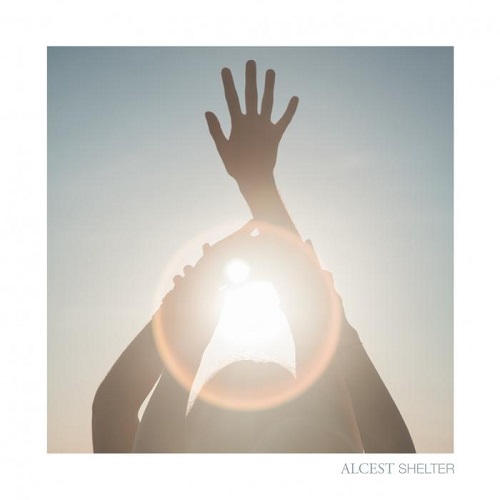
I have a bad habit of failing to keep up with bands in the years after their big breakthrough albums. As a consequence, I tend to be caught off guard when I find an old band doing something drastically different from their old sound. That is not the case with Alcest. I have eagerly gobbled up everything Neige has thrown out there since Le Secret (2005), and I was well aware ahead of time that Shelter was not going to be a metal album. That did not phase me. Neige’s sound has evolved dramatically over the years, and as early as Souvenirs d’un autre monde (2007) you could not detect a residual shred of the style he presented on Tristesse Hivernale (2001). A dream pop/shoegaze/post-rock album was a reasonable thing to expect given the general direction his music had been going. I clicked play on Shelter fully convinced that I would enjoy it.
Alcest – Wings and Opale, from Shelter
If I was going to have doubts, they might have been about the level of external influence surrounding Neige’s music of late. Was it going to show? Would this not quite sound like Alcest? Neige claimed no knowledge of shoegaze music when he recorded Le Secret and Souvenirs d’un autre monde. I remember his publicized surprise when an early release of Souvenirs‘ title track got plastered with the genre label all over the internet. Since then, Neige has developed quite the fondness for those classic bands to which he was compared. Shelter even features a guest appearance by Neil Halstead of Slowdive. If Shelter was not going to be metal, there was certainly a chance we would hear a lot more of that influence in place of Neige’s self-derived affinity to the sound.
I don’t think that is an issue here at all. I can’t say I have heard much classic dream pop or shoegaze outside of Loveless, but if Neige had continued to boast total ignorance of the genres, I think I would have believed him. Shelter sounds deliciously like Alcest, whether the style is a departure or not. The album opens with the angelic, echoed vocal chant that by Les Voyages de l’Âme had become a staple Alcest sound. For the first minute and thirty seconds, there is nothing to distinguish Shelter from another Alcest black metal album. The instant familiarity is a pleasant relief for any fan that had major doubts. You might still wonder whether he could pull off a full 46 minute album of “soft” Neige without ever using metal to vary the dynamics, but that question dissolves into air a minute and a half in, as the first full track, “Opale”, kicks off. It’s so vibrant that your speculation seems a petty distraction in the face of the musical moment.
Alcest – Voix sereine, from Shelter
This feeling definitely persists through the third track, “La nuit marche avec moi”, and on it Neige’s trending toward post-rock, audible on “Opale”, becomes substantially more apparent. “Voix sereine”, 11 minutes into the album, is the first time things really calm down from a pretty jubilee to get your mind wandering again. It kicks off slow and simple, rather dull really, and I for one had a hard time remaining attentive for the first three minutes. Was this the sort of “down time” I ought to have feared could come with a complete abandonment of metal? Perhaps it is, but 3 minutes of bore could be easily forgiven from most musicians. At the three minute mark, the song transforms into something substantially more palpable, and my second thoughts are largely forgotten. Much to my delight, I do find out that Neige fibbed a bit about the album’s contents. We might not encounter any blast beats or gut-wrenching screams on this album, but he did not forget how to turn on the distortion altogether. As the song gets heavier and substantially more… substantive, the boredom of the build-up fails to hold. It becomes a really great song. On a re-listen, knowing that something fairly aggressive will come of it, the lull is easier to swallow.
Alcest – Délivrance, from Shelter
The next song, “L’éveil des muses”, finds a more interesting starting point, but another slow build-up gives me serious doubts for the first time. What holds post-rock in the moment is the knowledge that something earth-shattering will come of it all. Knowing that “Voix sereine” is likely as heavy as the album is going to get, and without the instant gratification of the opening dream pop tunes, I struggle to give the song 100% of my attention. Track six, “Shelter”, is a much needed return to something more upbeat. It opens with the sort of pitch shifting distortion made famous by My Bloody Valentine, and from start to finish it’s an enjoyable ride. “Away”, the track featuring Neil Halstead on vocals, is a beautiful composition that, I think, would have been a thousand times better with Neige singing. Halstead kind of kills it for me–not because of the quality of his singing but because it sounds totally out of place on an Alcest album.
And then we close with “Délivrance”. The longest track by far at 10 minutes, it carried the weight of my overall opinion of the album. Shelter had so far offered a lot of stellar moments, but at its calmest it dangled dangerously on the edge of boredom. “Délivrance” needed to be a pretty epic piece of post-rock. At 3 minutes, a really classic post-rock guitar kicks off to confirm my hopes–at least to a point. It’s where the song heads from here that really disappoints me. We’re building, and we’re building, and it’s definitely a fun ride, but then right when you expect the song to really cast its shell aside and go all-out…. did it just end? Not a ten minute song after all, “Délivrance” concludes with a three and a half minute toned down outro.
It’s not common for me to speak of a song being too short, but “Délivrance” feels so incomplete to me. I accepted the first 3 minutes because I assumed we were going somewhere. I loved the next 4 because we were going somewhere. But we never really got there. Neige is the guy who made post-black metal a reality in the first place. Granted the full-fledged, conscientious post-rock/black metal cross-overs came later, I guess I expected such a hero of modern metal to aim a bit higher when confronting a fairly traditional post-rock sound. I can try to enjoy “Délivrance” for what it does offer, but I can’t help but think that he failed to see how much further he could have taken it. It’s something that would have sounded appealing in the late 90s but seems incomplete to me today, when post-rock bands are a dime a dozen and competition is a bit more formidable. I can’t quite get over that enough to fully enjoy it.
In the end, I guess you might say Shelter disappoints me. Maybe that’s because I came into it with really high expectations, where a lot of fans might have set the bar low when they found out there would be no black metal element. The first three tracks boosted my expectations all the more by offering a really novel sound that grabbed me and held on. But that dream pop vibe did not last, and the more he got back to sounds you might expect from an Alcest album of old, the more they felt depleted of the old energy rather than infused with a new one. Where the post-rock kick would normally give way to a black metal rockout, here it just fizzes away. Tracks like “Opale” set a precedent for how I wanted the entire album to sound. I got half of that, and half something that just makes me hope he goes back to his roots on the next release.


 Through the Shattered Lens