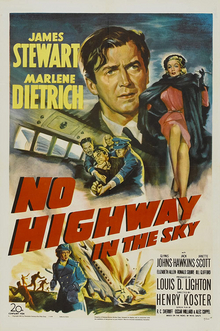
In 1951’s No Highway In The Sky, James Stewart stars as Dr. Theodore Honey.
In many ways, Theodore Honey is similar to the other roles that Stewart played after he returned from serving in World War II. Dr. Honey is intelligent, plain-spoken, and good-hearted. He’s eccentric and he sometimes has a difficult time relating to other people. He’s also deeply troubled. Dr. Honey is an engineer, one who specializes in determining how many hours an airplane can fly before it starts to fall apart. Dr. Honey is in England, working for an airline and testing his hypothesis that their newest model’s tail will fall off after the plane accumulates a specific number of hours. As is usually the case with these things, Dr. Honey’s employers are skeptical about his claims. There’s a lot of money to be made in air travel and the last thing they need is some eccentric American scaring everyone.
When Honey sets out to investigate a recent crash site, he finds himself on the same type of airplane that he’s been testing. After the plane takes off, Dr. Honey talks to the pilots and discovers, to his horror, that the plane is closing in on the time limit. While flight attendant Marjorie Corder (Glynis Johns) tries to keep him calm, Dr. Honey explains his theory to a film star named Monica Teasdale (Marlene Dietrich), who just happens to be a passenger on the flight. Both Marjorie and Monica find themselves falling in love with Dr. Honey and who can blame them? He may be an eccentric and it may be hard to follow what he’s talking about but he’s still Jimmy Stewart!
I’ve often thought that Stewart was “Jimmy” before World War II but he was definitely James afterwards. Stewart, unlike a lot of Hollywood stars who enlisted and were then used solely for PR purposes, actually flew several combat missions and saw firsthand the devastation of the war. He returned to America deeply disturbed by what he had seen and there’s a definite sense of melancholy to be found in all of Stewart’s post-war performances. That’s certainly the case here. Dr. Honey is a widower, his wife having been killed by a rocket attack during the war. He’s raising his 12 year-old daughter on his own and he deals with his sadness by throwing himself into his work. He’s someone who has seen and experienced great tragedy firsthand and it’s left him more than a little obsessed. There’s a very authentic sadness at the heart of Stewart’s performance and it elevates this film, making what could have been a by-the-book corporate thriller into a character study of a man standing at the dawning of a new age, the post-war era of commercial air travel, and saying, “Well, hold on one minute.”
Unfortunately, Honey’s obsessive nature makes it easy for some to dismiss him. When Dr. Honey purposefully sabotages the plane to keep it from flying again, he finds himself forced to defend his actions. Can he prove that his theory is true? And who will he end up falling in love with? You can probably guess the answers but it doesn’t matter if the latter half of the film is a bit predictable. James Stewart’s performance carries the film and keeps you watching.

 Through the Shattered Lens