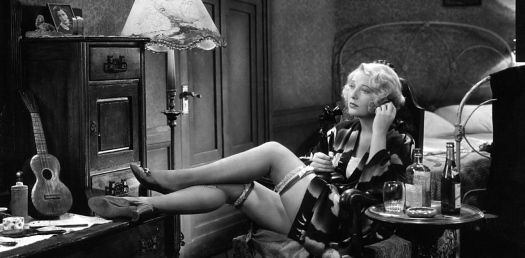
“Wild Bill” Wellman gave us some of the wildest movies of the Pre-Code Era: THE PUBLIC ENEMY, NIGHT NURSE, FRISCO JENNY, HEROES FOR SALE, WILD BOYS OF THE ROAD. But for sheer, unadulterated sleaze, you can’t beat SAFE IN HELL, chock full of lust, murder, shady characters, and a marvelous performance by the virtually forgotten Dorothy Mackaill.
Scantily clad Gilda Karlson (Mackaill) is a New Orleans prostitute, and there’s no doubt about it right from the get-go! We see her lounging around as she takes a call from her madam (Cecil Cunningham) to go out on a job and show a john a good time. That john turns out to be Piet van Saal (Ralf Harolde), the man she was caught in flagrante delicto with by his wife, leading to her current sordid life. Piet tries to rekindle that old flame (for a price, of course), but Gilda turns him…
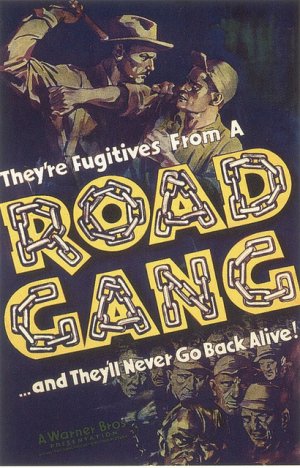
I was going to start this review with a quote from Gandhi: “A nation’s greatness is measured by how it treats its prisoners.” That was something that I first heard from a perpetually stoned ex-seminarian who used to live in a trailer park in Lake Dallas. I always figured that, being as stoned as he usually was, he probably knew what he was talking about but, upon doing research for this review, I have discovered that Gandhi actually didn’t say that. What Gandhi said was, “A nation’s greatness is measured by how it treats its weakest members.” Fortunately, it’s the same basic idea and, regardless of how you phrase it, it’s a quote that perfectly encapsulates the message of the 1936 film, Road Gang.
Road Gang tells the story of Jim (Donald Woods) and Bob (Carlyle Moore, Jr.). Bob is fun-loving. Jim is more serious and engaged to marry heiress Barbara Winston (Kay Linaker). Jim and Bob live in an unnamed Southern state (though I’m going to assume that the state is supposed to be Georgia, just because). Jim has just written an article that exposes the corruption of political boss, J.W. Moett (Joe King). The article is so good that both Jim and Bob have been offered jobs in Chicago! There’s a lot of corrupt political figures who can be exposed in Chicago!
However, while driving up north, Jim and Bob are arrested on trumped-up charges. At first, Jim and Bob laugh off Moett’s desperation but, unfortunately, another criminal happens to be breaking out of jail at the same time that Jim and Bob arrives for booking. That criminal kills the arresting officer and then forces Jim and Bob to drive him across the state. Eventually, the police recapture the three of them. However, the escaping criminal is killed and Jim and Bob are arrested as accessories. Under the advice of their lawyer, Mr. Dudley (Edward Van Sloan), they plead guilty and accept a deal. What they don’t know is that Dudley works for Moett and that, as a result of pleading guilty, they are going to be sentenced to five years in a prison camp.
Okay, so the film gets off to a pretty melodramatic start. And, to be honest, the entire film is extremely melodramatic. A lot of time is devoted to Barbara trying find evidence that Jim and Bob were set up, something that is made difficult by the fact that Barbara’s father, like Mr. Dudley, works for Moett. Fast-paced and not-always-logical, this is a B-movie, in every sense of the term.
And yet, as melodramatic as it is, Road Gang is deadly serious when it comes to portraying the brutality of the prison camp. From the minute that Bob and Jim arrive, they find themselves at the mercy of the corrupt warden and his sadistic guards. The prisoners are largely used as slave labor and subjected to punishments that are often arbitrary and extreme.
Road Gang doesn’t flinch when it comes to portraying why prison often not only fails to rehabilitate but also helps to transform minor offenders into hardened criminals. There’s a disturbing scene in which Jim, Bob, and the other prisoners are forced to listen as another prisoner is whipped. The crack of the whip and his howls of agony explode across the soundtrack in a symphony of pain and sadism. Jim and Bob have two very different reactions to being in prison. One survives. One allows himself to be killed rather than take one more day in confinement.
Road Gang is often compared to I Am A Fugitive From A Chain Gang. Actually, beyond the theme of a fatally compromised justice system, there is no comparison. The angry and fact-based I Am A Fugitive From A Chain Gang is a hundred times better and, quite frankly, Donald Woods was no Paul Muni. However, Road Gang still has its moments of power. Decades after it was made, the issues it raises continue to be relevant. Do we send people to prison to rehabilitate them or to punish them and are the two goals mutually exclusive? And how can we say that someone has “paid his debt to society” when, even after a prisoner serves his time, the stigma of having been imprisoned closes and locks most doors of opportunity?
Road Gang shows up occasionally on TCM. There’s where I recorded it on January 23rd of this year.
Now, William Castle was famous for his gimmicks. For instance, theaters showing The Tingler were wired to give electrical shocks to random patrons. He had a special gimmick for 13 Ghosts, a film about a house haunted by ghosts that you can only see while wearing special goggles. Since I’m a lazy film blogger, I’m going to quote the film’s Wikipedia article on this particular gimmick:
“For 13 Ghosts, audience members were given a choice: the “brave” ones could watch the movie and see the ghosts, while the apprehensive among them would be able to opt out of the horror and watch without the stress of having to see the ghosts. The choice came via the special viewer, supposedly “left by Dr. Zorba.”
In the theatres, most scenes were black and white, but scenes involving ghosts were shown in a “process” dubbed Illusion-O: the filmed elements of the actors and the sets — everything except the ghosts — had a blue filter applied to the footage, while the ghost elements had a red filter and were superimposed over the frame. Audiences received viewers with red and blue cellophane filters. Unlike early 3D glasses where one eye is red and the other is cyan or blue, the Illusion-O viewer required people to look through a single color with both eyes. Choosing to look through the red filter intensified the images of the ghosts, while the blue filter “removed” them. Despite Castle’s claims to the contrary, not many heart failures or nervous breakdowns were averted by the Illusion-O process; although the blue filter did screen out the ghostly images, the ghosts were visible with the naked eye, without the red filter.”
Personally, if I had been alive in 1960, I totally would have watched the whole movie through the red filter. Go ghosts go!
Anyway, 13 Ghosts is actually a lot of fun in a low-budget, 1960s drive-in sort of way. Watch it below and, as always, enjoy!
(For those following at home, Lisa is attempting to clean out her DVR by watching and reviewing 38 films by the end of today!!!!! Will she make it? Keep following the site to find out!)
OH MY GOD, LOUIS PASTEUR WAS THE DEVIL!
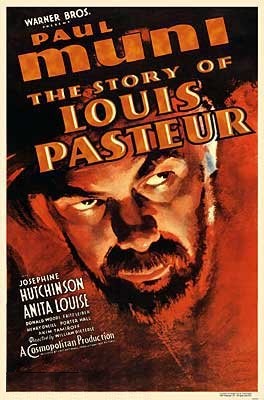
Okay, maybe not but that’s certainly the impression that you might get from looking at the one sheet for the 1936 film, The Story of Louis Pasteur. Seriously, Louis looks quite sinister!
As the movie starts, that’s certainly the view of the 19th century French medical establishment. A doctor has been murdered by a grieving husband and it’s believed that the murder was inspired by one of Pasteur’s incendiary flyers. What does the flyer demand? That doctors should wash their hands and sterilize their instruments before operating.
That’s right! Washing your hands before plunging them into a human body was once considered to be a controversial notion. Pasteur is put on trial, accused of inciting violence with his quackery. Even though Pasteur is acquitted, he finds himself a pariah. The autocratic and close-minded Dr. Charbonnet (Fritz Leiber) declares Pasteur to be guilty of great quackery and even the ducks are offended. That’s how hated Pasteur has become.
But, of course, we the audience know that Pasteur is not a quack. Not only do we know that he is responsible for discovering the process of pasteurization but he’s also apparently important enough to have his own 1930s Warner Bros. biopic. And he’s played by Paul Muni, who made a career out of playing great men in 1930s biopics.
The film follows Pasteur as he discovers cures for anthrax and rabies. Along the way, he yells at a lot of people and he gives a lot of speeches. This film might as well have been called The Paul Muni Show and … well, his performance is okay. It’s not great. If you’ve seen the very first version of Scarface, you know that Paul Muni was capable of giving a far better performance than he gives here. But then again, as written, all Louis does is bellow against everyone who disagrees with him. (And cure rabies, we shouldn’t overlook that.)
The Story of Louis Pasteur is one of those old-fashioned biopics that feels a bit creaky and stiff today. As I watched it, I kept thinking that it felt like something you might across on PBS at three in the morning. However, 1936 audiences disagreed with me. The Story of Louis Pasteur did quite well at the box office and was nominated for best picture, though it lost to another biopic, The Great Ziegfeld.
After I finished watching Around The World In 80 Days, I decided to watch the 1943 film, Watch on the Rhine. Though both films are immortalized in the record books as a multiple Oscar nominee, Watch on The Rhine might as well have taken place in a totally different universe from Around The World In 80 Days. Based on a play by the always politically outspoken Lillian Hellman, Watch On The Rhine is as serious a film as Around The World In 80 Days is frivolous.
It’s also somewhat infamous for being the film for which Paul Lukas won an Oscar for best actor. When Lukas won his Oscar, he defeated Humphrey Bogart, who was nominated for his iconic performance in Casablanca. This is justifiably considered to be one of the biggest mistakes in Oscar history and, as a result, there are people who will tell you that Watch On The Rhine is a totally undeserving nominee, despite having never actually seen the film and not being totally sure who Paul Lukas was.
Up until I watched the film yesterday, you could have included me among those people.
What’s interesting is that Watch On The Rhine almost feels like a companion piece to Casablanca. Both films were resolutely anti-fascist, both of them dealt with a member of the Resistance trying to escape from a German agent, and both films climaxed with a gunshot. The part played by Paul Lukas, a German engineer named Kurt Muller, feels like he could be an older version of Casablanca‘s Victor Laszlo. Finally, whereas Casablanca centered around “letters of transit,” Watch On The Rhine centers around money. Kurt is smuggling money to the Resistance. Teck de Brancovis (George Coulouris), a dissolute Romanian count, demands money in exchange for not informing the Germans of where Kurt’s location.
(Of course, both Casablanca’s letters and Watch on the Rhine’s money are an example of what Hitchcock called the MacGuffin. The letters and the money are not important. What’s important is that both films use the thriller format to inspire viewers to support the war effort.)
The film takes place in 1940, when America was still officially neutral. Kurt and his American wife, Sara (Bette Davis), have secretly entered the United States through Mexico. Officially, they are only visiting Sara’s brother (Donald Woods) and mother (Lucille Watson) in Washignton, D.C. Unofficially, they are looking for political sanctuary. However, Kurt still finds himself drawn back to Germany, especially after he finds out that one of his friends in the Resistance has been arrested by the Gestapo.
Not surprisingly, considering its theatrical origins, Watch On The Rhine is a very talky and a very stage-bound film. Almost all of the action takes place in one location and a good deal of the film’s running time is devoted to Kurt giving speeches. Don’t get me wrong, that’s not a complaint. Though the film may have been released at the height of the war, the play was written at a time when America was still officially neutral and many elected officials were adamant that, even if it meant Hitler taking over the entire continent, America should never get involved in the affairs of Europe. Watch On The Rhine was Hellman’s attempt to both expose what was happening in Germany and to rally them to the anti-fascist cause. Watch On The Rhine may be propaganda but its anti-Nazi propaganda and who can’t appreciate the importance of that?
When it was originally released, Watch On The Rhine was sold as a Bette Davis vehicle. To be honest, Davis doesn’t really do much in the film. She supports her husband and she has a few sharp words for Teck but, otherwise, her role is definitely secondary to Paul Lukas. Davis took the role because she believed in the film’s message. It’s a good message and, for that matter, Watch On The Rhine is a pretty good film. It’s well-acted, intelligently written, and perfectly paced.
But what about Paul Lukas’s Oscar? Well, let’s state the obvious. Humphrey Bogart should have won the award for Casablanca. That doesn’t mean that Paul Lukas doesn’t give a worthy performance. He originated the role on stage and he does a good job of bringing the character to life on film, bringing a sincere intensity to even the most stagey of Kurt’s monologues. Whenever Lukas speaks, he’s explaining to the filmgoers why the U.S. must take a stand against Hitler and his followers. Considering that Watch On The Rhine was released at the height of World War II, I imagine that this, more than anything, led to Lukas winning his Oscar.
Watch On The Rhine was also nominated for Best Picture. It was deserved nomination but, in this case, the Academy made the right decision and gave the Oscar to Casablanca.
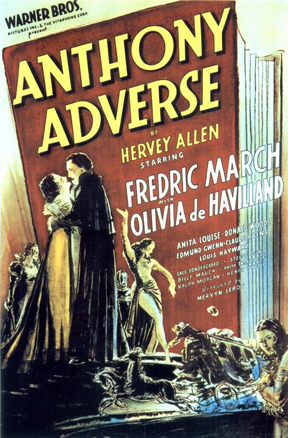
Late last night, I continued to clean out my DVR by watching the 1936 film, Anthony Adverse.
I recorded Anthony Adverse off of TCM, where it was being shown as a part of that channel’s 31 Days of Oscars. Anthony Adverse was aired because it was nominated for Best Picture of 1936. That’s significant because, if not for that nomination, I doubt that anyone would ever have a reason to watch Anthony Adverse. It’s certainly one of the more obscure best picture nominees. Despite a prestigious cast and being directed by the respectable Mervyn LeRoy, Anthony Adverse only has a handful of reviews over at the imdb. And most of those reviews were written by Oscar fanatics like me.
Anthony Adverse is an epic historical film, one that tells the story of Anthony Adverse (Frederic March). Anthony is the illegitimate son of Denis Moore (Louis Hayward) and Maria (Anita Louise), the wife of evil Spanish nobleman, Don Luis (Claude Rains, convincing as a nobleman but not as someone from Spain). Luis murdered Denis and Maria died giving birth so Luis abandons the baby at an Italian convent. Anthony is raised by nuns and priests and then, 10 years later, is apprenticed to an English merchant named John Bonnyfeather (Edmund Gwenn). Bonnyfeather just happens to be Anthony’s grandfather! Though Luis told him that Anthony died as soon as he was born, Bonnyfeather quickly figures out that Anthony is his grandson. However, Bonnyfeather doesn’t share that information with Anthony and instead, he gives Anthony the surname “Adverse.”
Bonnyfeather raises Anthony as his own son. Anthony grows up to be Frederic March and ends up falling in love with and marrying the beautiful Angela (Olivia De Havilland). However, Anthony is suddenly called away on business to Havana, Cuba. He doesn’t even have a chance to tell Angela that he’s leaving. He does leave her a note but it blows away. Assuming that she’s been abandoned, Angela goes to France, becomes an opera singer, and is soon the mistress of Napoleon.
Meanwhile, in Cuba, Anthony becomes convinced that Angela has intentionally abandoned him. Consumed by grief, he ends up running a slave trading post in Africa. He takes one of the slaves, Neleta (Steffi Duna), as his mistress and becomes known for his cruelty. However, he eventually meets Brother Francois (Pedro de Cordoba) and starts to reconsider his ways.
(The film’s treatment of the slave trade is …. well, it’s awkward to watch. The film is undoubtedly critical of slavery but, at the same time, it’s hard not to notice that the only slave with a prominent part in the film is played by a Hungarian actress. Anthony may eventually reject cruelty but it’s left ambiguous as to whether or not he rejects the slave trade as a business. If Anthony Adverse were made today, one imagines that this section of the film would be handled much differently.)
Meanwhile, back in Europe, Bonnyfeather is dying and his housekeeper, Faith (Gale Sondergaard, who won the first ever Oscar awarded for Best Supporting Actress for her performance here), plots to claim his fortune.
After I watched the movie but before I started this review, I did some research and I discovered that Anthony Adverse was based on a 1,222-page best seller that came out in 1933. I’m going to guess that the film’s long and ponderous story may have worked better on the page than it does on the screen. As a film, Anthony Adverse clocks in at 141 minute and it feels even longer. Despite the impressive cast, the film just never clicks. It’s never that interesting.
At the same time, I can understand why it was nominated for best picture. It’s a big movie, full of characters and extravagant sets and ornate costumes. You can tell it was an expensive movie to make and there’s enough philosophical dialogue that you can pretend there’s something going on underneath the surface. In the 1936, Anthony Adverse may have been quite impressive but seen today, it’s forgettable.
Anthony Adverse lost best picture to another overproduced extravaganza, The Great Ziegfield. Personally, I would have given the award to the unnominated My Man Godfrey.


 Through the Shattered Lens