Miniseries Review: Mike (dir by Craig Gillespie, Tiffany Johnson, and Director X)


“Who is Mike Tyson?” is question that’s asked by the new Hulu miniseries, Mike.

The answer to that question is that he’s a boring guy who did some interesting things.

For instance, he became a boxer and was briefly the world champion before he was brought down by his own hubris.  That’s interesting, largely because it’s something that seems to happen to quite a few people who suddenly find themselves on top of the world but don’t have the maturity necessary to handle it.  However, that, in itself, does not Mike Tyson an interesting human being.  It just makes him an example of how history repeats itself.

He bit off an opponent’s ear during a boxing match.  That’s interesting because it was such a savage act and it scandalized people who otherwise have no problem watching two men beat each other until one loses consciousness.  Causing brain damage is okay but God forbid you bite off a piece of someone’s ear.  But the fact that Mike bit off the guy’s ear does not, in itself, make Mike Tyson interesting.  It just makes him a jerk.

Mike Tyson has a facial tattoo that doesn’t really mean anything.  A lot of people have stupid tattoos.

Mike Tyson has a distinctive way of speaking.  So do a lot of other people.

Mike Tyson spent three years in prison after being convicted of raping a contestant in a beauty pageant.  Tyson was and is certainly more famous than the typical convict and, somehow, that conviction has not prevented him from becoming a beloved cultural institution in the United States.  The hypocrisy is interesting.  Mike Tyson is not.

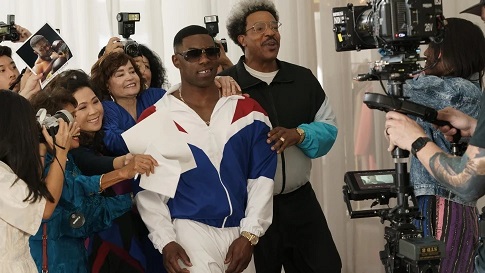
At least, that’s the impression that I got from this 8-episode miniseries.  Seven of the episodes feature Tyson (played by Trevante Rhodes) performing a one-man show in front of an audience in Indiana.  Believe it or not, this is based on fact.  Apparently, Mike Tyson did have a one-man show, in which he would discuss his career and his life.  (Jeff even wrote a review of it for this very site!)  We watch flashbacks as the show’s version of Tyson provides a self-serving narration and, to be honest, it seems like it would be the most boring one-man show ever.  Tyson talks about growing up poor and with a mother who alternated between hating and loving him.  He talks about his first trainer (played by Harvey Keitel, who often seems to be channeling Jonathan Banks) and his first marriage.  Mostly he talks about how he feels that almost everyone in his life betrayed him.  The first two episodes, which deal with Tyson’s youth, are effective because they examine how a childhood of mental and physical abuse can set the course of someone’s entire life.  However, once adult Tyson shows up, Mike becomes far less compelling.  It’s hard not to get tired of listening to him blame everyone else for his own increasingly poor decisions.

The one exception to the show’s format is episode 5, which is told from the point of view of Desiree Washington (Li Eubanks), the woman who Tyson was convicted of raping.  This is a powerful stand-alone episode, both because of Eubanks’s performance and because it’s the only episode to not be seen through Tyson’s eyes.  It’s the episode that allows the viewer to see Tyson the way the rest of the world saw Tyson.  And yet it’s difficult to feel that, when viewed in the context of the entire miniseries, this episode is a bit of a cop-out.  It’s the only episode to focus on someone who was hurt by Tyson but it’s surrounded by episodes that once again portray Tyson as being a victim of his managers, his fans, and society at large.  Desiree is given one episode and then disappears from the narrative whereas the show’s version of Tyson is given seven episodes to justify himself.  One gets the feeling that the show’s producers knew that they had to include Desiree but they also knew that revealing Tyson’s version of the events would have also meant revealing that he continues to insist that he was the victim and that would have totally messed up the show’s final redemption arc.  And so, the narrative burden is temporarily placed on Desiree and Tyson only returns once it is time to discuss what it was like being in prison.

Mike was produced by Craig Gillespie, who also directed I, Tonya.  Like I, Tonya, Mike features characters frequently breaking the fourth wall and talking directly to the audience.  In fact, it happens so frequently that it gets to be kind of annoying.  Breaking the fourth wall really wasn’t even that original when it happened in I, Tonya.  In Mike, it becomes a trick that’s used to try to make Mike Tyson into a more interesting character than he is.  But it feels empty, largely because it doesn’t tell us anything that we don’t already know or couldn’t have guessed on our own.

The miniseries itself was made without the participation of the real-life Mike Tyson.  Tyson condemned the show as being an attempt to make money off of his life and he actually does have a point.  Unfortunately, the miniseries itself doesn’t have anything new to add to the story of Tyson.  It’s an 8 episode Wikipedia entry.  At some point, the streaming services may need to realize that not every celeb needs to be the subject of a miniseries.  Simply being famous does not always make for a compelling story.
Music Video of the Day: Work From Home by Fifth Harmony ft. Ty Dolla $ign (2016, dir. Director X)


I thought it would be fun to get out of my comfort-zone for a bit. That’s why I have picked out six music videos to feature over the next six days that are from 2016. That’s it. I just went with whatever music video YouTube recommended after picking out this one.

First things first, despite anything else I say about this music video, I am grateful for the beginning that tells me who the director is, along with the song title and artists. I think this “featuring” thing is as stupid as when they used to list people as “guest stars” in a movie.

I basically stopped listening to new music around 2005 or so. I came across this by accident. However, bands like this are nothing new. They go back at least as far as barbershop quartets. Let’s be fair, and compare them to similar 90s bands. Comparing this to Lollipop by Chordettes wouldn’t be right.

Based solely on this music video, do they hold up to a comparison with TLC or En Vogue? No, they most certainly don’t. Those are apt comparisons. I hear this song and My Lovin (You’re Never Gonna Get It) by En Vogue pops into my head. So does No Scrubs by TLC.

As for the music video…*shrugs*. I’m assuming the intended message is that you don’t have to go out there cheating because your woman at home (???) is horny and needs your attention if you intend to stay together. Hence the chorus about you not having to go to work, but still having to work, and letting their bodies do the work. Work away from home being a metaphor for cheating and working from home being about maintaining a relationship. I’m also assuming that Dolla $ign carrying around a sledgehammer is a reference to their song Sledgehammer, and I have no doubt that Director X was also referencing the Peter Gabriel song of the same title.

According to Wikipedia, the music video was well-received by at least two critics who praised it for the usual things having to do with men and them coming into their own with this video.

I can say that the first is superficial, but if it makes any women feel empowered, then great. I don’t see it acting as a gateway to better groups in that area such as Girlschool, The Donnas, Bikini Kill, and Joan Jett & The Blackhearts.

The second I really can’t speak to seeing as this is my first exposure to them. Taking a quick glance at their other music videos doesn’t help. I watch them, and a group like Dream, with their song He Love U Not, comes to mind. Just add more sex and clearly more success.

There isn’t much more unless I want to get snarky about the references to penis size and doggie-style.

Will this go into my collection of pop songs that I like? No. I will remember how the lyrics say the one lady is submissive, but the music video has her pulling out a tape measurer. I will also remember that people are still getting worked up over repetitious lyrics for reasons beyond me.

Director X seems to have been making music videos since the late-90s with around 200 credits to his name.

Since I brought them up, I’ll end this on a song by Girlschool. I don’t like to include other music videos in these posts, so here is just the song Don’t Call It Love by Girlschool.

https://www.youtube.com/watch?v=0IvephluzKM

Cleaning Out The DVR, Again #38: Center Stage: On Pointe (dir by Director X)


(Lisa is currently in the process of trying to clean out her DVR by watching and reviewing all 40 of the movies that she recorded from the start of March to the end of June.  She’s trying to get it all done by the end of July 11th!  Will she make it!?  Keep visiting the site to find out!)

CSOP

The 38th film on my DVR was Center Stage: On Pointe, which premiered on Lifetime on June 25th.

Center Stage: On Pointe is the third film in the Center Stage series.  The first film, which was released in 2000, is one of those films that, at the time, you pretty much had to see if you were into ballet.  The second film, Center Stage: Turn It Up, aired on the Oxygen Network in 2008 and laid much of the groundwork for what happens in On Pointe.

At the start of On Pointe, Jonathan Reeves (Peter Gallagher), the head of the American Ballet Academy, has a problem.  The Academy is still doing great work but it’s not bringing in much money.  Unfortunately, the ABA has developed a reputation for being stodgy.  It needs to be shaken up.  It needs new dancers who are going to challenge the teachers even as the teachers challenge them.  Over the objections of just about everyone else at the ABA, Reeves decides that it’s time to bring modern dancers into the Academy.

Reeves and his choreographers (including Kenny Wormald’s Tommy Anderson, the male lead from Turn It Up) set out to recruit dancers to compete at a camp where the winners will be invited to join the Academy.  Among those dancers: Bella Parker (Nicole Munoz).  Bella is the younger sister of Kate Parker (Rachele Brooke Smith), whose story was previously told in Turn It Up.  Seeking to escape from her famous sister’s shadow, Bella auditions under a false name.  However, everyone immediately knows who she is.  It’s not easy being Kate Parker’s sister.

The camp turns out to be absolutely beautiful (even if it did remind me a bit of Camp Crystal Lake from Friday the 13th) but the dance world is a competitive and often unforgiving one.  Not only is there tension between the ballet students and the modern dancers (and that tension is one of the most realistic aspects of the film) but one of the instructors appears to be obsessed with trying to destroy Bella.  Will Bella and her fellow dancers survive the grueling camp?  Will Bella ever escape her sister’s shadow?  And will the ABA manage to change with the times?

You already know the answers.  There’s not a surprising moment to be found in Center Stage: On Pointe but the film is well-shot, the music is great, and the dancing is amazing.  Yes, some of the performances could be better but when you’ve got dancers who can move as well as the ones in this cast, it really doesn’t matter whether or not they’re the greatest actors in the world.  This is a dance movie, after all.  The dance scenes are amazing and that’s what is important.

(By the way, fans of Dance Moms may be interested to know that Chloe Lukasiak has a small role in Center Stage: On Pointe.  And, though she may no longer be a member of ALDC, she’s still a great dancer.)