Film Review: Exodus (dir by Otto Preminger)


First released in 1960 and based on a novel by Leon Uris, Otto Preminger’s Exodous is two films in one.

The first half of the film takes place in Cyprus in the days immediately following World War II.  A young war widow named Kitty (Eva Marie Saint) is sightseeing when she learns of the Karaolos Internment Camp, where the British are interning thousands of Jewish refugees who demand to be allowed to go to the land that will eventually become the State of Israel.  Kitty visits with General Sutherland (Ralph Richardson), who oversees the camp and who is rumored to secretly be Jewish because of his relatively benevolent attitude towards the internees.  Disgusted by the anti-Semitism displayed by many of the British officers (one of whom is played by Kennedy in-law Peter Lawford), Kitty volunteers at the camp and learns about the Holocaust from those who survived it.  She also meets Ari Ben Caanan (Paul Newman), a former officer in the British army.  Ari manages to get control of a cargo ship, one that is renamed Exodus.  Six hundred refugees stage a hunger strike, vowing that they will willingly starve to death rather than be returned to Europe.

The second part of Exodus takes place in what will become the modern State of Israel.  It follows Ari, Kitty, and several of the passengers of the Exodus as they adjust to life and continue to fight for a land of their own, despite the opposition of the British and much of the rest of the world.  Karen (Jill Haworth) is a young woman who searches for her father, a brilliant man who has been driven into a nearly catatonic state by the horrors of the Holocaust.  Dov Landau (Sal Mineo) is an explosives expert who survived Auschwitz as a Sonderkommando and who was repeatedly raped by the guards at the camp.  Dov joins the Irgun, a paramilitary organization that the British consider to be terrorists.  Leading the Irgun is Ari’s uncle, Akiva (David Opatoshu), and Dov soon finds himself being targeted by both the British and the Arabs who, despite the moderating efforts of men like Taha (John Derek, who would later direct Ghosts Can’t Do It), want to violently force the Jews out of the land.

Legend has it that, after a private screening on Exodus, comedian Mort Sahl turned to director Otto Preminger and said, “Otto, let my people go.”  And it’s true that Exodus is a very long film.  Preminger, who started out making film noirs like Laura, spent the latter part of his career making “important” epics and, like many Golden Age directors struggling to compete with television and the 60s counterculture, he tended to make long, star-studded films that dealt with current events and which pushed the envelope just enough to be controversial without actually being radical.  However, I would argue that the three-hour running time of Exodus is justified.  To understand why Ari, Dov, Karen, and the other passengers of the Exodus would rather risk their lives by staying in what will become the State of Israel, one has to understand both what they went through to get there and also the anti-Semitism that they faced even in post-World War II Europe.  If Exodus were made today, it would be a mini-series.  Since it was made in 1960, it was instead a 3-hour film with an intermission.

Exodus holds up relatively well, with the sprawling action anchored by the presence of a cast of familiar faces.  Paul Newman and Eva Marie Saint bring a good deal of movie star glamour to scenes that would have otherwise just been dry exposition.  The film’s heart truly belongs to Jill Haworth and Sal Mineo, both of whom bring two life characters who have very differing views of the world.  Karen remains an optimist, one who is convinced that people can live together.  Dov, fueled by his own guilt and anger, has no room for negotiations and compromises.  Mineo received his second and last Oscar nomination for his performance in Exodus, though he lost to Peter Ustinov’s showy turn in Spartacus.  Exodus itself was clearly made with a hope for Oscar glory.  While Exodus did pick up a handful of nominations, it was left out of the five movie Best Picture slate.  The Academy only had room for one historical epic and they went for John Wayne’s The Alamo.  The eventual winner was The Apartment, the best of the nominated films.  (Indeed, even if Exodus had taken the Alamo’s spot, The Apartment would still be the best of the nominees.)  The Oscars aside, Exodus remains a good example of the type of epic filmmaking that once defined the Hollywood studios.
Horror on TV: One Step Beyond 2.17 “Earthquake” (dir by John Newland)


Tonight’s episode of One Step Beyond deals with a bellboy named Gerald Perkins (David Opatoshu).  Gerald keeps telling everyone that there’s going to be an earthquake but no one’s willing to listen to him.  Everyone knows that Gerald is a recovering alcoholic so they assume that he’s just drinking again.  Needless to say, it’s far easier to fire someone than to listen to his insane ramblings, right?

Well, considering that this story takes place in San Francisco in 1906, perhaps they should have listened.

According to host John Newland, this is a true story.  It originally aired on January 12th, 1960!

Enjoy!

Retro Television Reviews: Fantasy Island 2.4 “Best Seller/The Tomb”


Welcome to Retro Television Reviews, a feature where we review some of our favorite and least favorite shows of the past!  On Tuesdays, I will be reviewing the original Fantasy Island, which ran on ABC from 1977 to 1986.  The entire show is currently streaming on Tubi!

Fantasy Island has a desert?  Read on to find out more.

Episode 2.4 “Best Seller/The Tomb”

(Dir by George McCowan, originally aired on October 14th, 1978)

Fantasy Island can be a strange place.

Just consider the fantasy of Neville Marlowe (Barry Sullivan).  Marlowe is an archeologist who has devoted his life to seeking the tomb of a lost Egyptian pharaoh who is believed to have been King Tut’s twin brother.  His fantasy is to finally find the tomb and to explore it with his wife (Shelley Fabares) and his associate (David Opatoshu).  He wants to do this even though the tomb, if it does exist, is said to be cursed.

Mr. Roarke informs Marlowe that he’s in luck.  There’s an archeological dig currently taking place on the island and there’s a good chance that it might finally lead to the discovery of the tomb….

Now, this brings up some interesting issues.  First off, the dig is taking place in the desert.  Since when has Fantasy Island, a tropical paradise, had a desert?  Secondly, even if you accept that idea that Fantasy Island is home to a large desert, why exactly would it also be home to the tomb of an Egyptian pharaoh?  Though the show always kept it a bit vague as to just where exactly the island was located, it’s always been suggested that it’s near Hawaii.  The actual natives of the island (as opposed to Mr. Roarke and Tattoo) all appear to be Polynesian.  When the guests get off the plane at the start of each episode, they’re given a lei and a tropical drink.  My point is that there’s never been anything about the show that would suggest that Fantasy Island is anywhere near Egypt.  Certainly, it’s possible that an Egyptian ship may have landed at Fantasy Island at some point in the past, just as it’s possible that ancient Egyptians also landed in South America.  But still, there’s no reason why a pharaoh would be buried on Fantasy Island as opposed to along the banks of the Nile.

It makes no sense but, for whatever reason, the tomb is indeed on Fantasy Island.  Entering the tomb leads to Marlowe’s wife having several nightmares about being wrapped up like a mummy.  It’s nicely creepy but it doesn’t lead to anything.  Because Marlowe decides to send the artifacts to Egypt as opposed to sending them to a British museum. he is spared the curse.

Meanwhile, Barney Hunter (Desi Arnaz, Jr.) is a bookstore clerk who suffers from crippling shyness.  His fantasy is to be a best selling author so Mr. Roarke informs him that he is now the author of the world’s most popular book about sex and, as a result, hundreds of his fans are coming to the island to meet him.  The problem with that, of course, is that Barney is a virgin.  So, you have to wonder why Mr. Roarke would make Barney the world’s leading expert on sex when he doesn’t know anything about it.  My guess is that Mr. Roarke thought it would be funny but it’s actually kind of mean-spirited.  Anyway, Barney meets Angela (Maureen McCormick), who is also a virgin.  They fall in love but Angela’s mother (Gloria DeHaven) refuses to allow Angela to see a man who has written a “filthy book.”  Again, it’s hard not to feel that Roarke is having a little fun at Barney’s expense.  Fortunately, things work out in the end and that’s good.  Arnaz and McCormick were a cute couple.

Finally, Tattoo entered a jingle contest and won!  Unfortunately, it turned out that first prize was a trip to Fantasy Island.  Mr. Roarke had a good laugh about that one and I have to admit that I did too.  Fantasy Island just has a way of sweeping you up in all of its silliness. 

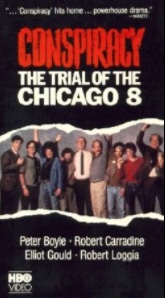
Conspiracy: The Trial of the Chicago 8 (1987, directed by Jeremy Kagan)


The year is 1969 and, in an Illinois courtroom, 8 political radicals stand accused of conspiring to disrupt the 1968 Democratic Convention.  The prosecution is putting the entire anti-war movement on trial while the defendants are determined to disrupt the system, even if it means being convicted.  The eight defendants come from all different sides of the anti-war movement.  Jerry Rubin (Barry Miller) and Abbie Hoffman (Michael Lembeck) represent the intentionally absurd Yippies.  Tom Hayden (Brian Benben) and Rennie Davis (Robert Carradine) are associated with the Students for a Democratic Society.  Bobby Seale (Carl Lumbly) is one of the founders of the Black Panthers while David Dellinger (Peter Boyle) is a longtime peace activist.  John Friones (David Kagan) and Lee Weiner (Robert Fieldsteel) represent the common activists, the people who traveled to Chicago to protest despite not being a leader of any of the various organizations.  Prosecuting  the Chicago 8 are Richard Schulz (David Clennon) and Tom Foran (Harris Yulin).  Defending the 8 are two radical lawyers, Leonard Wienglass (Elliott Gould) and William Kunstler (Robert Loggia).  Presiding over the trial is the fearsome and clearly biased Judge Julius Hoffman (David Opatoshu).

Conspiracy: The Trial of the Chicago 8 is a dramatization of the same story that inspired Aaron Sorkin’s The Trial of the Chicago 7 but, of the two films, it’s Jeremy Kagan’s The Trial of the Chicago 8 that provides a more valuable history lesson.  By setting all of the action in the courtroom and recreating only what was said during the trial, director Jeremy Kagan and his cast avoid the contrived drama that marred so much of Sorkin’s film.  Kagan trusts that the true story is interesting enough to stand on its own.  Kagan includes documentary footage from the convention protest itself and also interviews with the people who were actually there.  While Kagan may not have had the budget that Sorkin did, his film has the authenticity that Sorkin’s lacked.  Kagan also has the better cast, with Michael Lembeck and Barry Miller both making Abbie Hoffman and Jerry Rubin into something more than the mere caricatures that they are often portrayed as being.

The Trial of the Chicago 8 was a film that Jeremy Kagan spent a decade trying to make.  When he first tried to sell the idea behind the film to CBS in 1976, Kagan had Marlon Brando, Walter Matthau, George C. Scott, and Dustin Hoffman all willing to work for scale and take part in the production.  CBS still passed on the project, saying that no one was interested in reliving the 60s.  It wasn’t until 1987 that Jeremy Kagan was finally able to revive the film, this time with HBO.  It actually worked out for the best because, with HBO, there was no need to try to come up with a “clean” version for the language that was used in the courtroom or in the interviews with the actual participants.  The defendants could be themselves.

Though it has been overshadowed by Sorkin’s subsequent film, The Trial of the Chicago 8 is the definitive film about what happened in the aftermath of the the 1968 Democratic Convention.

Horror on TV: One Step Beyond 2.17 “Earthquake” (dir by John Newland)


Tonight’s episode of One Step Beyond deals with a bellboy named Gerald Perkins (David Opatoshu).  Gerald keeps telling everyone that there’s going to be an earthquake but no one’s willing to listen to him.  Everyone knows that Gerald is a recovering alcoholic so they assume that he’s just drinking again.  Needless to say, it’s far easier to fire someone than to listen to his insane ramblings, right?

Well, considering that this story takes place in San Francisco in 1906, perhaps they should have listened.

According to host John Newland, this is a true story.  It originally aired on January 12th, 1960!

Enjoy!

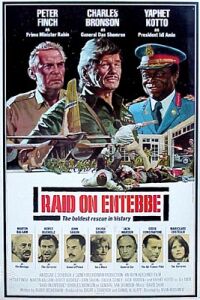
A Movie A Day #338: Raid on Entebbe (1977, directed by Irvin Kershner)


On June 27th, 1976, four terrorists hijacked an Air France flight and diverted it to Entebbe Airport in Uganda.  With the blessing of dictator Idi Amin and with the help of a deployment of Ugandan soldiers, the terrorists held all of the Israeli passengers hostage while allowing the non-Jewish passengers to leave.  The terrorists issued the usual set of demands.  The Israelis responded with Operation Thunderbolt, a daring July 4th raid on the airport that led to death of all the terrorists and the rescue of the hostages.  Three hostages were killed in the firefight and a fourth — Dora Bloch — was subsequently murdered in a Ugandan hospital by Idi Amin’s secret police.  Only one commando — Yonatan Netanyahu — was lost during the raid.  His younger brother, Benjamin, would later become Prime Minister of Israel.
Raid on Entebbe, a docudrama about the operation, was originally produced for NBC though it subsequently received an overseas theatrical release as well.  It’s an exciting tribute to the bravery of both the hostages and the commandos who rescued them.  Director Irvin Kershner directs in a documentary fashion and gets good performances from a cast full of familiar faces.  Charles Bronson, James Woods, Peter Finch, Martin Balsam, Stephen Macht, Horst Buchholz, Sylvia Sidney, Allan Arbus, Jack Warden, John Saxon, and Robert Loggia show up as politicians, commandos, terrorists, and hostages and all of them bring a sense of reality and humanity to their roles.

The film’s best performance comes from Yaphet Kotto, who plays Idi Amin as a strutting buffoon, quick to smile but always watching out for himself.  In the film, Amin often pays unannounced visits to the airport, where he lies and tells the hostages that he is doing his best to broker an agreement between the terrorists and Israel.  The hostages are forced to applaud Amin’s empty promises and Amin soaks it all up with a huge grin on his face.  Forest Whitaker may have won the Oscar for Last King of Scotland but, for me, Yaphet Kotto will always be the definitive Idi Amin.

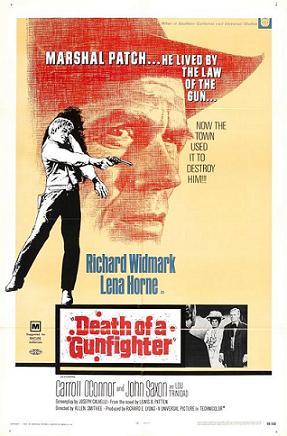
A Movie A Day #244: Death of a Gunfighter (1969, directed by Allen Smithee)


At the turn of the 20th century, the mayor and the business community of Cottonwood Springs, Texas are determined to bring their small town into the modern era.  The Mayor (Larry Gates) has even purchased one of those newfangled automobiles that have been taking the country by storm.  However, the marshal of Cottonwood Spings, Frank Patch (Richard Widmark), is considered to be an embarrassing relic of the past.  Patch has served as marshal for 20 years but now, his old west style of justice is seen as being detrimental to the town’s development.  When Patch shoots a drunk in self-defense, the town leaders use it as an excuse to demand Patch’s resignation.  When Patch refuses to quit and points out that he knows all of the secrets of what everyone did before they became respectable, the business community responds by bringing in their own gunfighters to kill the old marshal.

Death of a Gunfighter is historically significant because it was the very first film to ever be credited to Allen Smithee.  The movie was actually started by TV director Robert Totten and, after Widmark demanded that Totten be fired, completed by the legendary Don Siegel.  Since Totten worked for 25 days on the film while Siegel was only on set for 9, Siegel refused to take credit for the film.  When Widmark protested against Totten receiving credit, the Director’s Guild of America compromised by allowing the film to be credited to the fictitious Allen Smithee.

In the years after the release of Death of a Gunfighter, the Allen (or, more often, Alan) Smithee name would be used for films on which the director felt that he had not been allowed to exercise creative control over the final product.  The Smithee credit became associated with bad films like The O.J. Simpson Story and Let’s Get Harry which makes it ironic that Death of a Gunfighter is not bad at all.  It’s an elegiac and intelligent film about the death of the old west and the coming of the modern era.  It also features not only one of Richard Widmark’s best performances but an interracial love story between the marshal and a brothel madame played by Lena Horne.  The supporting cast is full of familiar western actors, with Royal Dano, Harry Carey, Jr., Larry Gates, Dub Taylor, and Kent Smith all making an impression.  Even the great John Saxon has a small role.  Though it may be best known for its “director,” Death of a Gunfighter is a film that will be enjoyed by any good western fan.