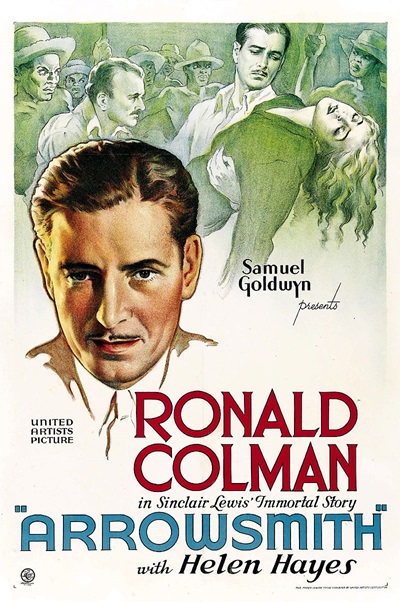
Lisa Reviews An Oscar Nominee: Arrowsmith (dir by John Ford)


In the 1931 Best Picture nominee Arrowsmith, Ronald Colman stars as Martin Arrowsmith, a doctor who is trying to save lives without compromising his ethics.

Arrowsmith is mentored by the famed bacteriologist, Max Gottlieb (A.E. Anson) and married to a nurse named Leora (Helen Hayes).  At first, Arrowsmith makes his living as the local doctor in Leora’s small hometown in South Dakota.  However, Arrowsmith is ambitious and wants to do more with his life and career than just take care of a small town.  He wants to cure the world of disease.  When he’s offered a position at the prestigious McGurk Institute in New York, he enthusiastically accepts.  Having just suffered a miscarriage, Leora supports Arrowsmith’s decision and travels to New York with him.  No matter what happens, Leora is always there to support her husband, even when he doesn’t seem to appreciate it.

When Arrowsmith thinks that he’s discovered an antibiotic serum that appears to be capable of curing all sorts of diseases, he attempts to stay true to the methods taught to him by Dr. Gottlieb.  He takes his time.  He tests carefully.  He doesn’t rush out and give the serum to everyone.  However, Arrowsmith finds his methods continually sabotaged by his colleagues, who hope to raise money by telling the press about a miracle serum that can “cure all diseases!”  When Arrowsmith later finds himself combatting an outbreak of the Bubonic Plague in the West Indies, he again tries to employ the scientific method but finds himself being pressured by government officials to give his untested serum to every single person on the island.  Eventually, Arrowsmith’s ethics are pushed to their limits when even Leora falls ill.

Arrowsmith was based on a best-selling novel by Sinclair Lewis, though the plot was changed to make the story more palpable for film audiences.  In the novel, Arrowsmith is a bit of cad who regularly cheats on his wife.  In the film, Arrowsmith is passionate and driven but the exact nature of his relationship with wealthy Joyce Lanyon (Myrna Loy) is left so ambiguous that it actually leaves one wondering why the character is in the film at all.  What both the film and the novel have in common is an emphasis on the importance of science and the scientific method.  Arrowsmith’s idealism runs into the harsh reality of life during an epidemic.  Government officials are more concerned with saying that they’ve done something as opposed to considering whether their actions have ultimately done more harm than good.  In its way, Arrowsmith predicted the COVID era.

Arrowsmith was the first John Ford film to be nominated for Best Picture and its financial success allowed Ford the freedom to go on to become one of Hollywood’s most important directors.  Seen today, Arrowsmith feels a bit creaky and self-important, with little of the visual flair that Ford brought to his later films.  Ronald Colman’s performance as Arrowsmith seems a bit stiff, especially when compared to the much more lively (and sympathetic) performance of Helen Hayes.  Arrowsmith is a big and serious film and, if we’re going to be honest, it’s a little bit boring.  Still, it’s interesting to see the issues of today being debated 90 years in the past.

As for the Oscars, Arrowsmith was nominated for Best Picture, Adaptation, Cinematography, and Art Direction.  It lost in all four of the categories in which it was nominated.  That year, Best Picture was won by Grand Hotel, which curiously didn’t receive any other nominations at all.
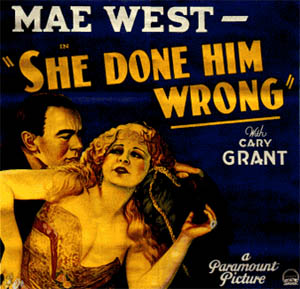
Lisa Reviews An Oscar Nominee: She Done Him Wrong (dir by Lowell Sherman)


She-done-him-wrong

When watching the 1933 film She Done Him Wrong, it helps to know a little something about American history.

It helps to know that the film was made at the tail end of the failed progressive experiment known as prohibition, an attempt to ban liquor in the U.S. which only served to make people idolize criminals and feel nostalgic for the time when you could just safely hang out in a saloon and get drunk with bunch of shady characters.

It helps to know that this film was made at a time when America was struggling through the Great Depression and, more than ever, movies were seen as an escape from reality.  The Depression also created a situation where, much like today, most Americans felt as if they were on the outside of the good life and, as a result, the most successful films of the time deal with outsiders getting something over on the smug and judgmental insiders.

It also helps to know that She Done Him Wrong was one of the last of the pre-Code films.  Though, by modern standards, the film may seem outwardly tame, the innuendo and subtext is anything but.  In fact, She Done Him Wrong was considered to be so racy that some people were actually scandalized when it became the biggest box office success of 1933.  (These were largely the same people who, 13 years before, celebrated the passage of prohibition.)  The infamous production code was largely instituted to make sure that a film like She Done Him Wrong could never be given another chance to corrupt filmgoers.

What exactly made She Done Him Wrong so controversial?

Well, it took place in a saloon in 1890s.  The saloon is owned by Gus (Noah Beery), who uses it as a front for prostitution and counterfeiting.  This is a film that features a lot of people drinking a lot of alcohol and it’s also a film that goes so far as to suggest that having a drink or two is not necessarily the worst thing in the world.  Captain Cummings (Cary Grant) runs a city mission that has opened up next to the bar and the film devotes a lot of time to poking fun at Cummings’s upright morality.  (Of course, Cummings has a secret of his own, one which suggests that his crusading attitude is just a convenient disguise.)  Though it would be repealed by the end of the year, Prohibition was still the law of the land when She Done Him Wrong was released and it’s fun to see how much the film has at the law’s expense.  That’s the type of fun that would basically be banned by the Production Code.

The Production Code would also require that all criminals be punished for their crimes by the end of a film.  In She Done Him Wrong, singer Lady Lou (Mae West) stabs to death the viscous Russian Rita (Rafaela Ottiano) and basically gets away with it.  It’s true that Lou was acting in self-defense but what makes She Done Him Wrong unique (for its time) is that Lou shows no remorse and that the killing is handled rather flippantly.  When the police, who have been searching the saloon for another criminal, burst into the room after Rita has been stabbed, Lou fools them by placing Rita’s corpse in a chair and combing her hair.  (“Haven’t you ever seen anyone comb someone’s hair before?”)  After the police leave, Lou has her bodyguard dispose of the body and Rita is never mentioned again.  Again, this is something that would never be allowed happen under the Production Code.

And then there’s the naked painting of Lou that hangs in the saloon.  Whenever it’s shown a screen, a man in a hat happens to be standing in just the right position to block the viewer from seeing the entire portrait.  Again, this would never have been allowed to happen under the Production Code.

And perhaps the biggest indication that this is a Pre-Code film is Mae West herself.  Reportedly, She Done Him Wrong was an extremely toned down version of West’s stage act but what was heard on-screen would certainly be enough to throw the guardians of decent society into a panic.  Nearly every line that she utters in this film is a double entendre but it’s not only what Mae West says.  It’s the way that she says it.  West may not have been a great actress but she had enough attitude that she didn’t need to be.  With every line, with every glance, with every movement, Mae West announces that she not only has sex but she enjoys it too.  In the Pre-Code days, that was unusual.  Once the Production Code went into effect, such a portrayal would be impossible.

As for the film itself — well, it’s pretty much just an excuse for Mae to be Mae.  There’s a plot, of course.  Lady Lou has many suitors and they all converge on the saloon at the same time.  However, Lou’s got her eye on the upstanding Captain Cummings.  (He’s a man in uniform, after all.)  It’s not a great film by any stretch of the imagination but, if you’re into film history or if you’re curious to see how American social mores have changed (and occasionally, not changed) over the years, She Done Him Wrong is a must see.

She Done Him Wrong is only 66 minutes long and it’s the shortest film to ever receive an Oscar nomination for best picture.  It received no other nominations and lost to Cavalcade.