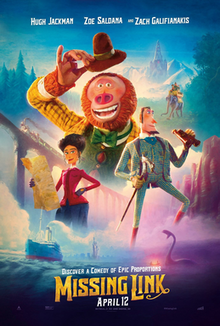
Film Review: Missing Link (dir by Chris Butler)


The year is 1886 and Sir Lionel Frost (Hugh Jackman) is the world’s greatest adventurer.

Or, at least, that’s what he says.  Actually, Sir Lionel may have made a name for himself and gained some popularity as a result of his many adventures but his fellow explorers and adventurers don’t take him seriously.  They view Sir Lionel as being little more than a self-promoter and they’re largely unimpressed with the all the time that he’s devoted to searching for mythical beasts like The Loch Ness Monster and lost lands like El Dorado.  Sir Lionel desperately wants to join the London-based Society of Great Men but the snobbish Lord Piggot-Dunceby (Stephen Fry) refuses to accept his application.

When Sir Lionel receives a letter from someone in America who claims to have tracked down the legendary Sasquatch, Sir Lionel and Lord Piggot-Duncey make a bet.  If Sir Lionel can prove that the Sasquatch exists, he will be allowed to join the Society.  Sir Lionel heads off to America while Lord Piggot-Dunceby promptly hires an evil bounty hunter named Willard Stenk (Timothy Olyphant) to prevent him from accomplishing his mission.  As Lord Piggot-Dunceby explains to his assistant, Mr. Collick (Matt Lucas), the world is changing too quickly.  If Sir Lionel isn’t stopped, people might start to believe in things like evolution or women’s rights.

When Sir Lionel arrives in America, he promptly starts searching for the Sasquatch and, amazingly enough, it doesn’t take him very long to find him.  It turns out that the Sasquatch — who Sir Lionel names Mr. Link — not only speaks remarkably good English but he’s also the one who wrote to Sir Lionel in the first place.  As played by Zach Galifianakis, Mr. Link is a rather laid back and good-natured Sasquatch.  In some ways, Mr. Link is surprisingly worldly and, in other ways, he’s rather naive.  He takes everything that he hears literally, which poses a problem since Sir Lionel has a tendency towards sarcasm.  It also turns out that Mr. Link is lonely but he thinks that he might be related to the Himalayan Yetis.  And Mr. Link thinks that Sir Lionel is just the man to help him get from America to Asia!

Sir Lionel reluctantly agrees.  Accompanying them on their journey is Sir Lionel’s former girlfriend, Adelina Fortnight (Zoe Saldana).  And pursuing them, every step of the way, is Lord Piggot-Dunceby and Willard Stenk.

Missing Link is an enjoyable and undeniably cute stop-motion animated film.  It was produced by Laika, the same animation outfit that previously gave us Kubo and The Two Strings.  While Missing Link is never as memorable or emotionally resonant as Kubo, it’s still a good-hearted film and entertaining enough that an adult can watch it without wanting to tear their hair out.  Blessed with impressively detailed animation and the comedic vocal talents of Hugh Jackman, Stephen Fry, Timothy Olyphant, and Zach Galifianikis, Missing Link has enough funny moments and clever lines that most audiences should be able to overlook the fact that the story itself sometimes feels a bit haphazard in its construction.  Much like the Sasquatch at the center of its story, Missing Link is a rather laid back film.  If Kubo was a carefully-constructed work of art, Missing Link feels like it was almost thrown together at random.  The film is at its best once it reaches the Himalayas, where the humor becomes very barbed and Emma Thompson steals the show in a sharp-witted cameo.

I enjoyed Missing Link.  It’s just too sweet-nartured not to like.
Film Review: The Last Days of Pompeii (dir by Ernest B. Schoedsack and Merian C. Cooper)


The summer after I graduated high school, I took a trip to Italy.

I absolutely loved it.  There’s nothing more wonderful than being 18 and irresponsible in one of the most beautiful and romantic countries in Europe.  I also loved it because everywhere I looked in Italy, I saw the remains of history.  When I was in Rome, I visited the Colosseum.  When I was in Southern Italy, I visited Comune di Melissa, the village where some of my ancestors once lived.  When I visited Florence, I became so overwhelmed by the beauty of it all that I nearly fainted.

And then there was Pompeii.  I spent a day visiting the ruins of Pompeii and it was an amazing experience.  The eruption of Mt. Vesuvius in 79 AD may have been horrific for the Romans but it’s also gave history nerds like me a chance to step right into the past.  Beyond just the thrill of seeing how the world once was, I have two main memories of Pompeii:

First, there was the visit to Pompeii’s brothel.  An Australian tourist lay down on one of the stone slabs so that his family could take pictures of him.

Secondly, there was the fact that I wore a really pretty red dress for my visit but I failed to take into account that 1) the area around Pompeii is very hilly and 2) it was a very windy day.  So, I can say that I’ve not only visited but I’ve flashed Pompeii as well.

The destruction of Pompeii has inspired several books and more than a few films, as well.  One of the earliest was the 1935 film, The Last Days of Pompeii.

The Last Days of Pompeii opens with Marcus (Preston Foster), an extremely bitter blacksmith who lives in the bustling city of Pompeii.  Marcus is bitter because he’s not rich and his family has been just been run down by some jackass in a chariot.  Marcus does find brief fame as a gladiator but he’s stricken with guilt after he kills a man and then discovers that he’s made an orphan out of the man’s son.  Marcus adopts young Flavius, just to then discover that the boy is seriously ill.  A fortune teller informs Marcus that Flavius will be healed by “the greatest man in Judea.”  Marcus naturally assumes that this is a reference to the Roman governor, Pontius Pilate (Basil Rathbone).  However, upon traveling to Judea, Marcus meets a different great man and then watches as his adopted son is healed.

Jump forward about two decades.  Marcus is now a rich man and is in charge of Pompeii’s gladiatorial games.  Flavius (now played by John Wood) has grown up to be an idealistic young man who barely remembers the day that he was healed. What Marcus doesn’t know is that Flavius has been helping slaves escape from Pompeii.  When Flavius is arrested, it appears that Marcus is doomed to watch his own son be killed in the arena.

But wait a minute — what’s that coming down the mountain?  It’s kinda smoky and red and it looks like it might be really hot and …. oh damn.

Now, there’s two problems here.  First off, from a historical point of view, the film’s timeline doesn’t work out.  Jesus was crucified in 33 AD.  Pompeii was destroyed 46 yeas later, in 79 AD.  Therefore, there’s no way that Flavius should only be in his early 20s.  Secondly, just the fact that the film takes place in Pompeii pretty much gives away the ending before the story even begins.  Since you know that the volcano is eventually going to kill everyone, it’s hard to get too caught up in any of the drama.  You just find yourself sitting there and going, “When isssssssssss the volcano going to eeeeeeeeeeeeerupt!?”

On the plus side, Preston Foster is one of the more underrated of the Golden Age stars and he does a pretty good job here.  Plus, you have to love any film that features Basil Rathbone as a semi-decadent Roman.  Rathbone plays Pilate as both a bored libertine and a guilt-stricken convert and, both times, he’s impressive.

Despite being directed by the team behind the original King Kong, The Last Days of Pompeii is a bit slow but, if you’re specifically a fan of old sword-and-sandal epics, it’s entertaining enough.  See it for Foster, Rathbone, and the ghosts of old Pompeii.

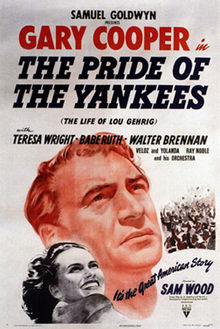
Lisa Reviews An Oscar Nominee: The Pride of the Yankees (dir by Sam Wood)


220px-The_Pride_Of_The_Yankees_1942

“People all say that I’ve had a bad break. But today … today, I consider myself the luckiest man on the face of the Earth.”

— Lou Gehrig (Gary Cooper) at the end of The Pride of the Yankees (1943)

After airing Foreign Correspondent earlier tonight, TCM followed up by showing the 1943 best picture nominee, The Pride of the Yankees.  Knowing that Pride of the Yankees was going to be a baseball film and that I know next to nothing about baseball, I recruited my sister, the Dazzling Erin, to watch the movie with me.  Erin loves baseball and I knew that she would be able to explain anything that went over my head.

Well, I absolutely loved watching this movie with my sister but it turns out that The Pride of the Yankees isn’t really much of a baseball movie.  True, it’s about a real life baseball player.  Several actual players appeared as themselves.  About 85% of the film’s dialogue deals with baseball and probably about 70% of the film features characters playing some form of the game.  But the film never goes into any great detail about baseball or how it’s played.  There’s no talk of strategy or rules or deeper meaning or anything else.  Going into the film, I knew that baseball was a game that involved throwing, swinging bats, and running.  And it turns out that was all that I needed to know.

The Pride of the Yankees is less about baseball and more about celebrity.  It’s a biopic of Lou Gehrig, who today is best known for his battle with ALS, a disease that is also known as Lou Gehrig’s disease.  Lou Gehrig died on June 2, 1941 and The Pride of the Yankees was released just a year later.  Watching the film, it’s obvious that Gehrig was a beloved figure, the type of celebrity who, if he were alive today, would probably be the center of stories like, “Lou Gehrig Did Something This Weekend And It Was Perfect.”  Watching the film, it easy to imagine how traumatic it must have been for the nation when a beloved athlete like Lou Gehrig died at the age of 37.

As a result, The Pride of the Yankees is less a biopic and more a case for canonization.  From the minute that the film’s Lou Gehrig appears on-screen, he is presented as being the type of saintly athlete who, by promising to hit two home runs in one game, inspires a crippled child to walk.  Lou is modest, kind, unpretentious, and never gets angry.  Over the course of the film, he takes care of his mother, displays a worthy work ethic, and marries Eleanor.  He and Eleanor have a perfect marriage without a single argument or a hint of trouble, except for the fact that Lou sometimes gets so busy playing baseball with the local children that he’s late coming home.  There’s not a hint of sadness in their life, until Lou suddenly gets sick.

And really, it should not work.  If ever there’s ever been a film that should be painfully out-of-place in our more cynical times, it would be The Pride of the Yankees.  However, the film still works because Lou is played by Gary Cooper and Eleanor is played by Teresa Wright.  These two excellent performers bring their considerable talents to making overly sentimental scenes feel credible.  Gary Cooper was 40 years old when he made The Pride of the Yankees and there’s a few scenes — especially the ones where Lou is supposed to be a student at Columbia University — where Cooper is clearly too old for the role.  But, for the most part, Gary Cooper did a great job as Lou Gehrig.  Cooper is especially memorable when Lou first starts to show signs of being ill.  Watching Lou struggle to swing a bat, I was reminded of a horse struggling to stand on an injured leg.  It was almost painfully poignant.

The Pride of the Yankees was nominated for 11 Academy Awards, including best picture.  However, it lost to another sentimental film that featured Teresa Wright, Mrs. Miniver.