James Bond Film Review: Licence to Kill (dir. by John Glen)


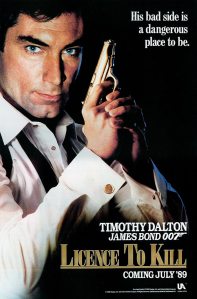
Licence to Kill, which was initially released in 1989, was the 16th “official” James Bond film.  It was also the second and the last one to feature Timothy Dalton in the role of James Bond.  This is the one where Felix Leiter gets eaten by a shark, Bond resigns from MI6, and ends up going to Central America in search of revenge.  Sad to say, it’s also one of my least favorite of the Bond films.

Licence to Kill starts out with Bond in Florida, attending the wedding of his best friend, Felix Leiter (played by David Hedison, who previously played the role in Live and Let Die).  However, before going to ceremony, Felix and Bond take a few minutes to arrest notorious drug lord Franz Sanchez (Robert Davi).  With the help of a crooked DEA agent (played by a wonderfully smarmy actor named Everett McGill), Sanchez escapes from custody.  Accompanied by his psychotic henchman Dario (Benecio Del Toro), Sanchez gets his revenge by killing the new Mrs. Leiter and feeding Felix to a shark.  When Bond discover the barely alive Felix, he also discovers a note that (in a scene borrowed from the novel Live and Let Die) reads, “He disagreed with something that ate him.”

Investigating on his own, Bond discovers that Sanchez’s partner in Florida is the wonderfully named Milton Krest (played by a brilliantly sleazy Anthony Zerbe).  Soon, James Bond is on a mission of vengeance that involves tracking down and killing every member of Sanchez’s organization.  However, M (Robert Brown) doesn’t like the idea of his best secret agent killing the entire population of Florida.  Bond responds by resigning from the service and heading to Central America on his own.
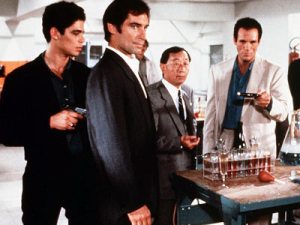
In typical Bond film fashion, James Bond manages to infiltrate Sanchez’s organization and Sanchez soon takes a liking to the man who has vowed to kill him.  Along the way, Bond romances both Sanchez’s abused mistress Lupe (Talisa Soto) and an ex-CIA agent named Pam Bouvier (Carey Lowell) and the viewers learn that Sanchez’s criminal enterprise not only involves drugs but also a crooked TV preacher (played by Las Vegas mainstay Wayne Newton) as well.

Let’s start with the positive.  Robert Davi, playing the role of Franz Sanchez, makes for a memorable villain.  Along with the silky charm and hints of madness that we’ve come to expect from Bond villains, Davi brings an almost perverse edge to the character.  Every line of dialogue that he delivers is practically dripping with decadence.  Whether he’s doting on his pet iguana, his main henchman Dario, or poor Lupe, Sanchez makes for a dangerously charismatic and compelling villain, one that feels like he would have been at home in one of Ian Fleming’s original novels.  Wisely, Davi plays his role almost as if he was playing James Bond and, as a result, the scenes that he shares with Dalton all have a crackling energy to them that is missing from the film as a whole.
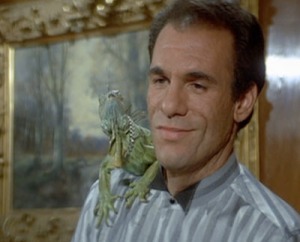
In fact, almost all of the villains are compelling in this film, from Franz Sanchez all the way down to the lowliest henchman.  As played by a very young Benicio Del Toro, Dario is all smoldering intensity and arrogant swagger.  Smuggler Milton Krest is played by veteran character actor Anthony Zerbe and he gets one of the bloodiest death scenes in the history of the series.  However, I have to admit that my favorite bad guy was Sanchez’s business manager, Truman-Lodge (played by Anthony Starke).  Truman-Lodge is just so enthusiastic about the business opportunities that came along with allying oneself with evil that it’s rather infectious.

With such a memorable collection of bad guys, it’s a shame that the film didn’t provide them with any goals worthy of their evil talents.  In previous (and future) Bond films, far less interesting villains have still come up with plans to allow them to take over the world.  Even Moonraker‘s Hugo Drax was able to overcome his lack of personality and come up with a diabolical intergalactic scheme.  Meanwhile, Franz Sanchez — one of the most complex and impressive Bond villains of all time — is simply content to sell drugs and feed people to sharks.  It feels almost disrespectful to Davi’s performance that Sanchez’s goals are, ultimately, so boring.

And, in the end, I think that’s the main problem that I have with Licence to Kill.  The film feels so predictable.  There’s nothing about it that makes it comes across as a story that could only have been about James Bond.  Instead, it feels like the type of standard action/revenge film that always seems to come out every summer.  The film’s hero might be an Englishman named James Bond but he could just as easily be an American named Jake Sully.

According to Sinclair McKay’s invaluable history of the Bond franchise, The Man With The Golden Touch, Licence to Kill was specifically written to compliment Timothy Dalton’s more “realistic” interpretation of the Bond character.  As Dalton played Bond as grim and serious, Licence to Kill is a grim and serious film.  Innocents and villains alike die in bloody agony and, the few times that Dalton does smile, the expression looks so unnatural that you worry that his face is about to split in half.  Unfortunately, along with being grim and serious, Dalton’s Bond is also remote and uncharismatic and, with the exception of Robert Davi, he doesn’t have any chemistry with anyone else in the cast.  (Carey Lowell brings a lot of energy to the role of Pam but Dalton’s Bond never seems to be that into her.)  Dalton simply doesn’t make for a very compelling hero and, as a result, Licence to Kill ends up feeling like an empty collection of occasionally impressive stunts.

Licence to Kill holds a few dubious distinctions.  It was the least financially succesful of all the Bond films and it was also the last Bond film to be produced by Albert Broccoli and directed by John Glen.  It was also the last to feature Robert Brown in the role of M and, of course, it was also the last to feature Timothy Dalton in the role of James Bond.  (That’s not all that shocking when you consider just how miserable and bored Dalton seems to be in this film.)  Over the next six years, the Bond franchise would be mired in a lawsuit between Eon productions and producer Kevin McClory and when James Bond finally did return, he would do so in the form of Pierce Brosnan.

We’ll be taking a look at Goldeneye tomorrow.
James Bond Review: Live and Let Die (dir. by Guy Hamilton)


One year and one day ago the very first James Bond film to star Sir Roger Moore, Live and Let Die, in the title role was reviewed by Lisa Marie, and now it’s time to revisit the eight official film in the series.

With the previous Bond entry, Diamonds Are Forever, we finally see Sean Connery run out of gas when it came to playing the title role of James Bond. Yet, despite the obvious boredom Connery was having in the film the producers of the series were still wanting him to come back for another Bond film. Maybe it was his experience during the production of Diamonds Are Forever or Connery finally decided it was truly time to go the series’ producers didn’t get their wish and were in a rush to find someone new to wear the mantle o Agent 007.

They finally found their new James Bond in the form of English-actor Roger Moore and production on Live and Let Die began soon after.

Roger Moore, for me, has always been the start of the less serious, but much more fun era of the James Bond franchise. His films still had the intrigue and action of the Connery-era, but the writers and producers of the series put in more one-liners and humor in the story. We begin to see the start of this in the previous Bond film (not handled as well and came off as awkward at times), but it was in Live and Let Die and in Roger Moore that this change in the series’ tone finally hit it’s stride.

The film dials back the global domination attempts by the series of villians both SPECTRE and not. This time around Bond must investigate the deaths of three MI6 agents who had been investigating one Dr. Kananga, the despot of the fictitious Caribbean island of San Monique. Kananga (played by Yaphet Kotto) also has an alter-ego in the form of Mr. Big who runs a series of soul food restaurants as a front for his drug business. Every Bond film always tries to out-elaborate the previous one with it’s villains plans. There’s no attempts by Kananga/Big to dominate the world. His plans are pretty capitalistic in a ruthless sort of way. He wants to corner the drug market in the US by flooding the illegal drug market with his own heroin which he plans to give away for free thus bankrupting the other crime lords and drug dealers.

This plan by Kananga actually looks to be very sound and it helps that he has the beautiful seer Solitaire (played by a young and beautiful Jane Seymour) to help him outwit ad stay ahead of his competitors and the law. His plan would’ve succeeded if not for the meddling of one British super-spy named James Bond.

Live and Let Die might not have been as serious about it’s story as the early Connery films, but it definitely had a much more faster pace with more action to distinguish Moore from Connery. One particular famous action sequence involves Bond escaping from Kananga’s drug farm in the Louisiana Bayou country being chased not just by Kananga’s henchmen but by the local police in the form of Sheriff J.W. Pepper who plays the role of fool and comedy relief in the film. Even the smaller action scenes in the film had more life and fun to them like Bond escaping a gator pit by timing a run across the backs of a line of gators to safety.

Where the previous bond film’s attempt at injecting humor and more action into the story were more failures than successes in this film Roger Moore Bond film they worked in due part to Moore’s playful delivery of the one-liners and bon mots the role has become known for of late. Any trepidation that audiences and producers might have had about  Moore taking on the role that had been made famous by Connery  soon went away as this film played out.

Live and Let Die still remains my favorite of all the Roger Moore Bond films and saw it as the highlight of his time playing the character. While the follow-up films were good in their own right it was this initial Moore entry in the series where the writers, Moore and veteran Bond filmmaker Guy Hamilton were able to find the perfect balance of thrilling action and humor that the rest of the Moore-era films couldn’t replicate.

Next up for James Bond…The Man with the Golden Gun.

Horror Film Review: Live and Let Die (dir. by Guy Hamilton)


I know what you’re going to say before you say it.

“Okay, Lisa,” you sigh, “I hate to tell you this but Live and Let Die is not a horror film.  Live and Let Die is a James Bond film.  In fact, it’s the first one to feature Roger Moore in the role of Bond.  It’s the one where Yaphet Kotto is the guy who’s both a Harlem drug dealer and a world leader and he’s planning on importing all this heroin from Haiti or somewhere and Bond runs off with his Tarot card reader who is played by Jane Seymour, who has mismatched eyes, just like you!”

“Thank you,” I say in my shy little way as my cheeks flush red and my mismatched eyes glance downward.

“However,” you continue, “it’s hardly a horror film.  Live and Let Die is just the James Bond film where they go to Louisiana and end up chasing each other in boats and then Clifton James shows up as this redneck sheriff and its just kinda embarrassing.”

“May I speak now?” I ask as I narrow my multi-colored eyes at you, “Now, to be honest, I’ve only recently started to really watch all of the old school James Bond films from the 60s and the 70s but Live and Let Die is actually one of my favorites, even with Clifton James as Sheriff J.W. Pepper.  I mean, the film’s actually a lot of fun, Yaphet Kotto made a great villain, and even if Roger Moore wasn’t quite as sexy and dangerous as Sean Connery was, at least he wasn’t all stiff and humorless like Daniel Craig.  In fact, I think it could be argued that Live and Let Die was the first — and maybe only — truly Grindhouse James Bond film.  I just find it interesting how the whole film is basically a hybrid of all of the big exploitation genres of 1973.   The scenes in Harlem and really the film’s entire plot is pretty much ripped off from blaxploitation while the voodoo scenes all have this kind of campy, Hammer feel to them.  Even the scenes in Louisiana are an homage to the southern car chase movies that were apparently big at the drive-ins back then.”

“That’s all good and well, Lisa, but how does that make Live and Let Die a horror film?  And don’t say it’s because Felix Leiter is played by David Hedison, the star of the original Fly because–”

“Hold on,” I say, “this is the point where we show the trailer.”

“Okay, Lisa Marie,” you say, “now that you’ve indulged in your bizarre trailer fetish, explain just how exactly this is a horror film and don’t try doing that thing you always do where you link it to some weird-ass thing that happened to you like ten years ago.”

My nostrils flare as I begin, “Ten years ago, me and my family were taking a vacation in voodoo country…”

“Lisa Marie, did you not read the previous paragraph?”

“Oh, sorry.”  I pause in order to get my thoughts straight in my head.  “Well, first off, let’s start with the opening credits.  Now, I’ll be honest here and admit that I’ve always kinda wanted to be one of those girls that are always dancing around naked during the opening credits of all the old school James Bond films–” 

“That’s a shock.”

“–so I always end up paying attention to those opening credits.  I mean, that’s my time to fantasize about being in a James Bond film.  And I have to say, the opening credits of Live and Let Die — Agck!  Seriously, everyone always spends so much time talking about how great the theme song is that they kinda miss just how freaky and nightmarish those opening credits are.  I mean, seriously, when you’re at home alone and you’re watching this in a dark room, these opening credits are genuinely unsettling.  Here, check them out.”

“Okay,” you say, “I can see how the credits might freak you out but that’s just like 2 minutes of a two hour film–”

“Oh my God, I’m so not even done yet!” I snap, “This film isn’t about James Bond fighting drug dealers.  All of that stuff with Yaphet Kotto and the heroin and all that — it’s all just an excuse to get to what the film is truly about: James Bond vs. Baron Samedi, the man who can not die!  As played by Geoffrey Holder, Baron Samedi’s only in a few scenes but he dominates the entire film.  I mean, it’s actually kinda funny because every time Baron Samedi shows up, someone dies but the film comes to life.”

“In fact,” I continue, now pretty much talking to myself, “when Baron Samedi first appears in the film, he’s killing this poor, terrified man by holding a poisonous snake up to the man’s face and oh my God, that scene freaked me out when I first saw it!  In fact, it’s the only scene from a James Bond film that’s ever given me a nightmare.  Even Eva Green drowning in Casino Royale didn’t freak me out as much as that snake scene did and you know I’m a lot more scared of drowning than I am of snakes.  Which is odd since I live in Texas and there’s a lot more snakes around here than large bodies of water…”

“Slow down and breathe, Lisa Marie,” you say, “you’re getting off topic.”

“Right, sorry.  Anyway, it’s a scary scene precisely because Baron Samedi seems to be enjoying killing the man so much.  Then again, it could also be the fact that Baron Samedi had the most evil laugh ever.  Seriously, listen to it in the scene below.”

As you watch the scene, I continue to speak, my words tumbling one after another out of my mouth, “But the scariest Baron Samedi scene isn’t even on YouTube.  Seriously, YouTube sucks.  I hate YouTube.  I mean, you can find a thousand videos of silly people doing that Wii workout game in their underwear but you can’t find the freakiest Baron Samedi scene ever.  Seriously, forget about Occupying Wall Street.  Let’s occupy freaking YouTube and demand–”

“Focus, Lisa.”

“Sorry.  Anyway, the freakiest scene in Live and Let Die and I would dare say the freakiest scene of the entire James Bond series, comes towards the end of the film.  Baron Samedi pops up out of this grave and James Bond like shoots him and blows off half his forehead, right?  And Baron Samedi just stand there perfectly still and emotionless.  Then, his eyes slowly roll upward and stare up at where his forehead used to be.  So, Bond shoots him like three more times and Baron Samedi just collapses like a rag doll.  And then, suddenly, Baron Samedi — forehead intact — pops out of another grave and does that evil laugh of his!  Oh.  My.  God!  It is so freaky!  I was watching it and I was just like…AGCK!

“And that,” I conclude, “is why Live and Let Die is a horror film.”

However, now that I’m finished, you don’t reply.  I look up and I see that you’re gone.

And in your place…