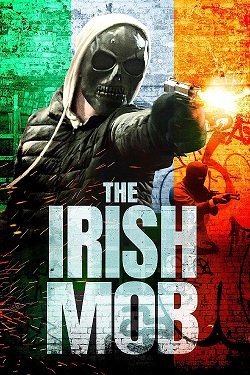
Film Review: The Irish Mob (dir by Patrick McKnight)


Valentino “Val” Fagan (played by Rob McCarthy) was named after Rudolph Valentino but he didn’t grow up to be a chivalrous lover, the type whose romantic eyes make hearts swoon.  Instead, Val grew up to be a mobster, the head of the Irish mob.  His eyes view the world with mistrust and anger.  As he tells us in the cocky voice-over that runs through The Irish Mob, Dublin is his city.  Whether its drugs, theft, or dealing weapons with the IRA, Val is involved.

However, it’s not easy being the boss.

For one thing, Val has the Garda after him.  Detective Liz Delahunt (Pauline O’Driscoll) is obsessed with taking Val down.  She’s got the wall of her office set up with one of those crazy charts that links Val and his associates to a series of unsolved murders throughout Ireland.  Liz is clever and she’s determined.  In one of the film’s funnier moments, she puts Val under a protection order so that he ends up with Detective Kevin Hogan (David Greene) following him around 24 hours a day and staking out his home.  Whenever Val looks out of a window, Hogan gives him a friendly wave.

As well, the Corrigan Brothers, who are Val’s Amsterdam-based drug connections, have just lost a fairly large shipment of drugs and the money that they would have made from selling them.  The Corrigans expect their associates to kick in to help make up for the loss and it’s pretty clear that failure to do so will lead to something not good happening.  Val may be rich but he’s not that rich and he soon finds himself taking risks in order to raise the money.  Right when it appears that Liz’s funding has been cut, one of Val’s brazen robberies leads to Liz being told that she’ll have all the money that she needs to pursue her case against Val.

Finally, there’s Dessie Corrigan (George Bracebridge), a monstrous sociopath who has just been released from prison and who is looking to get back into the Dublin rackets.  A misunderstanding leads to Corrigan deciding that Val sold him out to the Garda.  Corrigan soon starts to attack Val’s men and makes plans to come after Val himself.  As with so many of the criminals in The Irish Mob, Corrigan is an idiot but he’s a very determined idiot.  He’s also someone who can easily be manipulated by those looking to take over Dublin.

Val has his ways of dealing with the stress.  He genuinely loves his son and comes about as close to being human as he probably can whenever he’s just being a father.  Though he spends a lot of time fighting with his wife, he does have a mistress who he enjoys spending an hour or two with.  And, of course, there’s always cocaine.  The more stressed Val gets, the more he does.  The more paranoid Val becomes, the more people he kills.  It’s not easy being in charge but, as Val tells us, Dublin is his city,

Plotwise, The Irish Mob is a standard Mafia movie, complete with a philosophical voice over and scenes of random violence.  Val reached his position of power by being smarter than everyone else but, now that he’s in charge, he’s forced to depend on people who are stupid, sadistic, and impulsive.  Val thinks that he can control the cycle of violence but what he doesn’t understand is that the cycle controls him and not the other way around.  Rob McCarthy gives a steely performance as Val and the Dublin locations give the film a gritty feel.  Unfortunately, the plot itself doesn’t really feature many surprises and the film’s concluding twist, while being appropriately tragic, is still one that most audiences will see coming from a mile away.  Then again, that may be the point.  Val’s fate is as predestined as those who came before him and those who will come after him.  In the end, the cycle just keeps repeating.
Retro Television Review: After The Promise (dir by David Greene)


Welcome to Retro Television Reviews, a feature where we review some of our favorite and least favorite shows of the past!  On Sundays, I will be reviewing the made-for-television movies that used to be a primetime mainstay.  Today’s film is 1987’s After the Promise!  It  can be viewed on YouTube!

Mark Harmon is, in many ways, the ideal television actor.  He’s handsome in a distinguished but not overwhelming sort of way.  He projects a pleasant personality.  He’s likably low-key.  He’s a talented actor but he’s also a bit of a safe and predictable actor.  It’s been said that the difference between a TV star and a movie star is that a movie star combines charisma with danger whereas a TV star combines a likable screen presence with reliability.  Mark Harmon’s been a reliable TV presence for longer than I’ve been alive.

In 1987’s After the Promise, Harmon plays Elmer Jackson, a carpenter who is just trying to survive day-to-day in Depression-era California.  Though his wife (who is implied to be a Christian Scientist) begs him not to take her to the hospital when she gets ill, Elmer goes against her wishes.  When he gets her to the hospital, he is treated rudely by the staff.  A cop approaches him in the waiting room and brusquely orders him to move his car.  When a doctor finally does approach Elmer, he calmly explains that Elmer’s wife has did of TB and that she should have been brought to the hospital weeks ago.

Now a widower, Elmer is determined to keep the last promise that he made to his wife and give his four sons the best life that he possibly can.  Unfortunately, the government is determined to keep Elmer from doing that.  When Elmer goes to the government to try to get temporary financial assistance, the government reacts by taking his children away from him and forcing them into foster care.  When Elmer, during one of his weekly visits, tries to take the children for a ride, the government bans him from having any contact with his children.  When Elmer’s sons try to escape from the foster home, they’re separated and sent to separate facilities.

Informed that he can only get his children back if he proves that he’s financially stable, Elmer becomes an itinerant worker.  It’s only after he meets and marries Anna (Diana Scarwid) that Elmer finally gets a chance to be reunited with his sons but, after years of abuse, his sons have their own traumas to deal with before they can accept Elmer as being their father.

This is a movie that really pulls at your heartstrings!  There’s nothing subtle about it but, at the same time, its portrait of bureaucrats without empathy is one that feels very real and contemporary.  Over the course of the film, Elmer learns that the rules are not being written to help out a blue collar worker who doesn’t have a lot of money and, watching the film, it’s hard not to consider that the rules haven’t really changed that much over the years.  Elmer isn’t just fighting to reunited his family.  His fighting to save them from a system that is designed to dehumanize.  It’s an ideal role for a television star like Mark Harmon, as Elmer isn’t a terribly complex man but he is a very determined one.  It’s a role that demands a lot of sincerity and Harmon certainly delivers.  For that matter, so does this simple but emotionally resonant film.

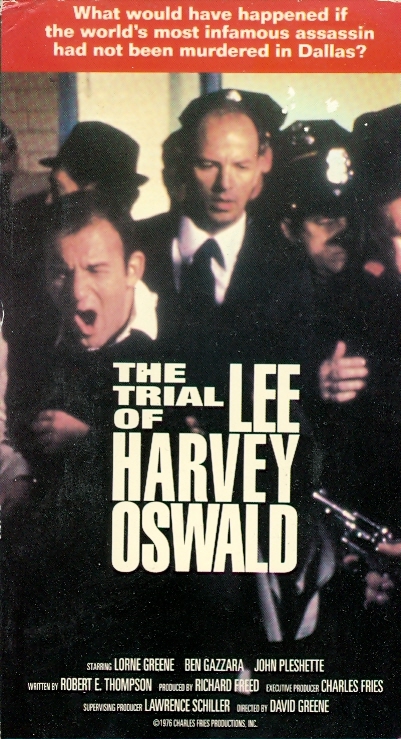
The Trial of Lee Harvey Oswald (1977, directed by David Greene and Gordon Davidson)


What if, instead of being shot by Jack Ruby, Lee Harvey Oswald had survived and been put on trial for the murder of President John F. Kennedy?

That’s the question asked by this television film.  John Pleshette plays Lee Harvey Oswald while Lorne Greene plays his attorney, Matt Weldon and Ben Gazzara plays the prosecutor, Kip Roberts.  The film imagines that the trial would have been moved to a small Texas town because Oswald presumably wouldn’t have been able to get a fair trial in Dallas.  While Roberts is forced to deal with his own doubts as to whether or not Oswald actually killed the President, Weldon is frustrated by Oswald’s paranoid and self-destructive behavior.  Oswald insists that he’s a patsy and that he was framed by “them” but he refuses to tell Weldon who they are.

With a running time of four hours, The Trial of Lee Harvey Oswald is a courtroom drama that tries to be fair to both sides and which ends with a frustrating cop-out.  While Weldon presents all of the evidence that real-life conspiracy theorists frequently cite in their attempts to prove Oswald’s innocence, Roberts makes the case that was presented in the Warren Commission.  Unfortunately, the film ends up trying too hard to avoid coming down on one side or the other and just proves that it’s impossible to be even-handed when it comes to conspiracy theories around the Kennedy assassination.  It’s either buy into the idea that it was all a huge conspiracy involving mobsters and intelligence agents or accept that it was just Oswald doing the shooting as a lone assassin.  Trying to come down in the middle, as this film does, just doesn’t work.

John Pleshette does a good job as Oswald and bears a passing resemblance to him.  Because the movie refuses to take a firm stand on whether or not Oswald’s guilty, the character is written as being a cipher who claims to be innocent but who, at the same time, also refuses to take part in his defense.  Pleshette plays up Oswald’s creepy arrogance, suggesting that Oswald was capable of trying to kill someone even if he didn’t actually assassinate JFK.  Both Greene and Gazzara are convincing as the two opposing attorneys, even if neither one of them really does much more than offer up a surface characterization.

The majority of the movie takes place in the courtroom, with a few flashbacks to Oswald’s past included to keep things from getting too stagnant.  When the film was made, people were still learning about the conspiracy theories surrounding the Kennedy assassination and The Trial of Lee Harvey Oswald might have had something new to tell them.  Seen today, the majority of the film’s evidence seems like old news.  The Trial of Lee Harvey Oswald never escapes the shadow of later films, like Oliver Stone’s JFK.

It’s hard not to regret that The Trial of Lee Harvey Oswald wasn’t willing to come definitively down on one side or the other.  Instead, it ends by telling us that we’re the jury and that the only verdict that matters is that one that we come up with.  They could have just told us that at the start of the movie and saved us all four hours.