International Film Review: Shanghai 13 (dir by Chang Cheh)


A Hong Kong-Taiwanese co-production that was first released in 1984, Shanghai 13 takes place during the early days of World War II in Asia, when the conflict was primarily viewed as being between Japan and China.  With the help of a thief named Black Hat (Jimmy Wang Yu), a low-level but patriotic Shanghai bureaucrat named Mr. Gao (Chiang Ming) steals a report that details the collaboration between Japan and a puppet regime that has been installed in Northern China.  Mr. Gao hopes to take the documents to Hong Kong, where he will be able to safely publish them and reveal just how corrupt the Chinese collaborators are.  Needless to say, the collaborators would rather this not happen and they are determined to assassinate Mr. Gao before he boards the last boat to Hong Kong.

Fortunately, Mr. Gao is not alone.  The 13 Rascals have been called in to protect Mr. Gao.  Who are the 13 Rascals?  They are a collection of talented marital artists and they are all patriots, determined to reveal the truth about what is happening in Northern China.  The 13 Rascals are played by an ensemble of Hong Kong and Taiwanese film veterans.  One appears after another, each getting their chance to show off what they can do while defending Mr. Gao.  Many of the rascals lose their lives to protect Mr. Gao but that seems to be the point of the film.  No sacrifice is too much when its done to protect the honor of one’s country.

To really understand what’s going on with Shanghai 13, it probably helps to know a bit about not only the Second Sino-Japanese War and the subsequent chain of events that led to the Republic of China relocating its central government to Taiwan.  My knowledge of these events is pretty much Wikipedia-level and I’m not going to present myself as being an expert.  That said, it’s pretty obvious that Mr. Gao, who is forced to leave his home city by a corrupt and ruthless government, is meant to serve as a stand-in for both Taiwan and Hong Kong (or, at least, Hong Kong before it was transferred to Chinese control).  Just as the Rascals will sacrifice their lives to protect Mr. Gao, they would do the same for Taiwan and Hong Kong.  The implication, of course, is that the audience should do the same.

Fortunately, if international politics are not your thing, Shanghai 13 can also be enjoyed as just a non-stop action film.  Admittedly, the film does get off to a bit of a slow start.  (If you’ve ever wanted to see every little detail of how to crack a safe, this is the film for you.)  Once the fighting begins, it’s pretty much nonstop and more than a little bloody.  Faces are kicked.  Bones are shattered.  Clawed gloves are worn.  One man carries a killer fan and laughs whenever anyone tries to remove it from his hands.  The film is full of Hong Kong and Taiwanese stars, all of whom get their chance to show off their moves and the majority of whom also get a dramatic death scene.  One man gets impaled a pole and still announces that he would rather die with honor than surrender.  (And, needless to say, he drops dead shortly afterwards.)  There’s enough slow motion to keep any slo mo of doom enthusiast happy.  The final battle takes place in a ship yard and features combatants jumping on top of shipping crates.  It’s exciting and weird.

Throughout it all, Mr. Gao stands in the background and watches.  Mr. Gao is not a fighter and he can only watch while everyone else in the movie sacrifices their lives so that Mr. Gao can reveal the truth about China’s puppet regime.  If this was an American film, I’m sure that the last-standing hero would probably get angry with Mr. Gao, much as Snake Plissken did with the President in Escape From New York.  But in Shanghai 13, all that matters is that Mr. Gao is a patriot.  He’s a man trying to protect his nation from a corrupt government and, for that reason, 13 people are willing to risk their lives to protect him.  We could use more people like the 13 Rascals.
Horror Film Review: The Legend of the 7 Golden Vampires (dir by Roy Ward Baker)


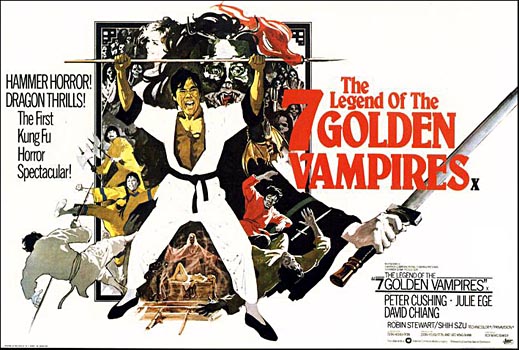
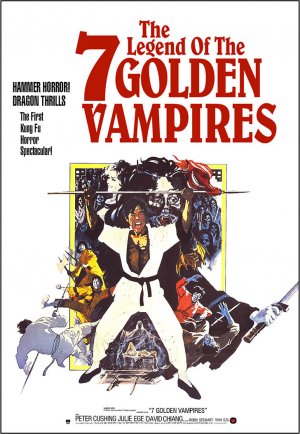
The-Legend-of-the-Seven-Golden-Vampires-poster

As some of our more frequent readers may remember, I shared the 1974 Dracula-martial arts hybrid The Legend of the 7 Golden Vampires as one of our horrors on the lens last October.  Judging from the comments that I got last year, this was apparently one of the more popular films that we featured.

And why not?  The film is one of those rather ludicrous movies that really could have only been made in the early 1970s.  It combines two genres that really should not go together — martial arts and the Hammer Dracula series — and somehow, it all works.  Don’t get me wrong.  The film doesn’t make a bit of sense.  I’ve seen it a few times and I still have a hard time following just what exactly is going on.  But you don’t watch a film called The Legend of the 7 Golden Vampires for the plot.  This is one of those movies that you watch for the style.  Fortunately, The Legend of the 7 Golden Vampires is all about style.

The Legend of the 7 Golden Vampires is the final entry in Hammer’s Dracula series.  Or, at least, it might be.  It all depends on whether or not you consider 7 Golden Vampires to actually be a part of the series.  I do but quite a few people don’t.

Why the controversy?

Well, first off, Christopher Lee does not appear in this film.  Much as he did with Brides of Dracula, Lee read the script and announced that he would not be returning to play Dracula.  Of course, when Lee refused to appear in Brides of Dracula, Hammer responded by creating an entirely new vampire for Prof. Van Helsing to battle.  This time, however, they simply recast the role.  An actor by the name of John Forbes-Robertson took on the role of Dracula and, unfortunately, he gave a rather bland and unmemorable performance.  If Lee’s Dracula seemed to be motivated by rage, Forbes-Robertson is merely petulant.

The other issue that purists have with the film is that it violates the continuity of the previous Dracula films.  The film opens in 1805 and features Dracula leaving his castle for China, where he will spend the next 100 years as the leader of the infamous 7 Golden Vampires.  The problem with this, of course, is that there had already been 7 other films that established that Dracula spent the 19th Century going between England and Eastern Europe.

It would be easy to declare that 7 Golden Vampires has nothing to do with the other Hammer Films except for the fact that Peter Cushing returns of Prof. Van Helsing.  When the film opens, Van Helsing is in China, lecturing to skeptical students about the legend of the 7 Golden Vampires.  After one lecture, Van Helsing is approached by a man (David Chiang), who explains that the 7 Golden Vampires have been attacking his village.  Van Helsing agrees to help the man vanquish the 7 Golden Vampires and, along the way to the village, he even tells some stories about his previous battles with Dracula.

So, here’s my theory.  The Legend of the 7 Golden Vampires does take place in the same continuity as the Christopher Lee Dracula films but I do not believe that the vampire played by Forbes-Robertson is actually Dracula.  I think he’s just an upstart who has claimed the infamous name while the actual Dracula is inconvenienced.

As for the film itself, it works far better than you might expect.  At the time 7 Golden Vampires went into production, Hammer was struggling to survive with their once racy products now seen as being rather tame when compared to what other studios were releasing.  7 Golden Vampires was a co-production between Hammer and the Shaw Brothers, which means that the film was full all of the gothic trappings that I love about Hammer while also featuring all of the martial arts action that fans of the Shaw Brothers would have expected.  It’s an odd combination that works exactly because it is so unexpected.

Finally, one word about the 7 Golden Vampires.  Not only are they far more desiccated than the average Hammer vampire but whenever they ride up on their horses, they’re filmed in slow motion, just like the zombies from Amando De Ossorio’s Blind Dead films.  As a result, those 7 Golden Vampires are pure nightmare fuel.

The Legend of the 7 Golden Vampires may have been the final entry in Hammer’s Dracula franchise but at least the series went out on a memorable note.

http://www.youtube.com/watch?v=_YEBUyRQjgs

Horror On The Lens: The Legend of the 7 Golden Vampires (dir by Roy Ward Baker)


Legend_of_the_7_golden_vampires

Today’s horror movie is from Hammer films and, needless to say, it’s lot of fun.  In The Legend of the 7 Golden Vampires, an ennui-stricken Count Dracula (James Forbes-Robertson) leaves his castle and travels all the way to China.  Once in China, he resurrects the legendary 7 golden vampires and uses them to raid a nearby village.  One villager (played by David Chiang) goes to the legendary Prof. Van Helsing (Peter Cushing, of course) for help.  Van Helsing, along with his son (Robin Stewart) and a wealthy widow (Julie Ege, who decorated several Hammer films), goes to the village to battle the vampires.  Providing protecting for Van Helsing’s group is Chiang’s sister (Szu Shih) and six other brothers.

First released in 1974, The Legend of the 7 Vampires was Hammer’s attempt to revive the failing fortunes of their most iconic monster by collaborating with Hong Kong film producer Sir Run Run Shaw.  The result is an entertaining hybrid of a traditional Hammer vampire film and a Hong Kong kung fu movie.  While James Forbes-Robertson makes for a poor replacement for Christopher Lee, Cushing is perfect as always.