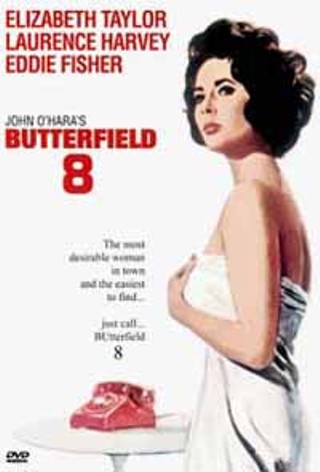
“Mama, face it,” Gloria Wandrous (Elizabeth Taylor) announces in the 1960 film, BUtterfield 8, “I was the slut of all time!”
Personally, I think Gloria is being a little bit too hard on herself. Certainly the film suggests, in its 1960 way, that she’s promiscuous and that she only sleeps with men for money but that doesn’t necessarily make her the slut of all time. For one thing, I would think that the slut of all time would have more options than just a wimpy pianist played by Eddie Fisher or a depressing, self-absorbed businessman played by Laurence Harvey.
“I still say it stinks,” Elizabeth Taylor said, almost immediately after winning her first Oscar for her performance in BUtterfield 8 and she’s kind of right. BUtterfield 8 is not a particularly good film, though not quite as bad as Taylor seemed to believe it to be.
Taylor won the Oscar after suffering a near fatal bout of pneumonia and having to undergo a tracheotomy. Along with saying that the film stunk, Taylor also often said that she only won her first Oscar because she nearly died. That may or may not be true but the thing is, Taylor’s the best thing in this overwritten and overheated mess of a movie. She certainly gives a better and more sympathetic performance than Laurence Harvey, who is cast as her married lover, Wilson Liggett. We’re meant to sympathize with Ligget but Harvey plays him as if he’s in a permanently sour mood and, after just a few minutes of listening to him bitch about every little thing, the viewer will get sick of him. It’s hard to really see what Gloria Wandrous sees in this whiny alcoholic.
Then again, the only other option that the film gives Gloria is Steve Carpenter, the pianist played by Eddie Fisher. Steve can’t decide if he’s in love with his boring girlfriend, Norma (Susan Oliver) or if he’s in love with Gloria. However, Steve has no problem letting Gloria borrow one of Norma’s dresses so that she can wear it when she goes home to visit her mother and I have to say that if I was Norma, Steve would be finding a new bed to sleep in after that. Gloria tells Steve that he needs to decide who he’s in love with but Steve jut can’t do it. Of course, in real life, Eddie Fisher left Debbie Reynolds so that he could marry Elizabeth Taylor. (A year or so later, Taylor left Fisher so that she could marry Richard Burton.)
BUtterfield 8 is one of those films that was undoubtedly considered to be daring when it was first released, seeing as how it acknowledged that people had sex without getting married first. (GASP!) Of course, though the film acknowledges that people have sex, it still makes sure to let us know that no one’s happy afterwards and that promiscuity eventually leads to death. (I mean, BUtterfield 8 may have taken risks but it still knew better than to defy the production code.) Seen today, the entire film is rather tame, talky, and slow but the star power of Elizabeth Taylor still comes through. The film opens with a lengthy sequence of Gloria getting ready for her day and, as you watch it and, more importantly, as you watch Elizabeth Taylor, you find yourself thinking that this is what a movie star is supposed to be. She dominates the film and she manages to credibly deliver even the most overheated pieces of dialogue. (Just try to imagine Jennifer Lawrence delivering the “slut of all time” line and you’ll immediately understand the difference between the movie stars of the past and the movie stars of the present. Of course, you could also say the same thing about trying to imagine a young Elizabeth Taylor in Silver Linings Playbook or The Hunger Games.) In fact, one could argue that Taylor’s performance is almost too good for the material. The film, in its 1960 way, suggests that Gloria would be better off if she just settled down but it’s impossible to imagine Taylor’s Gloria Wandrous settling for the stiffs played by Laurence Harvey and Eddie Fisher.
Though Elizabeth Taylor was correct about BUtterfield 8‘s overall quality, it’s still a good example of what star power can do for an otherwise mediocre film.
 Through the Shattered Lens